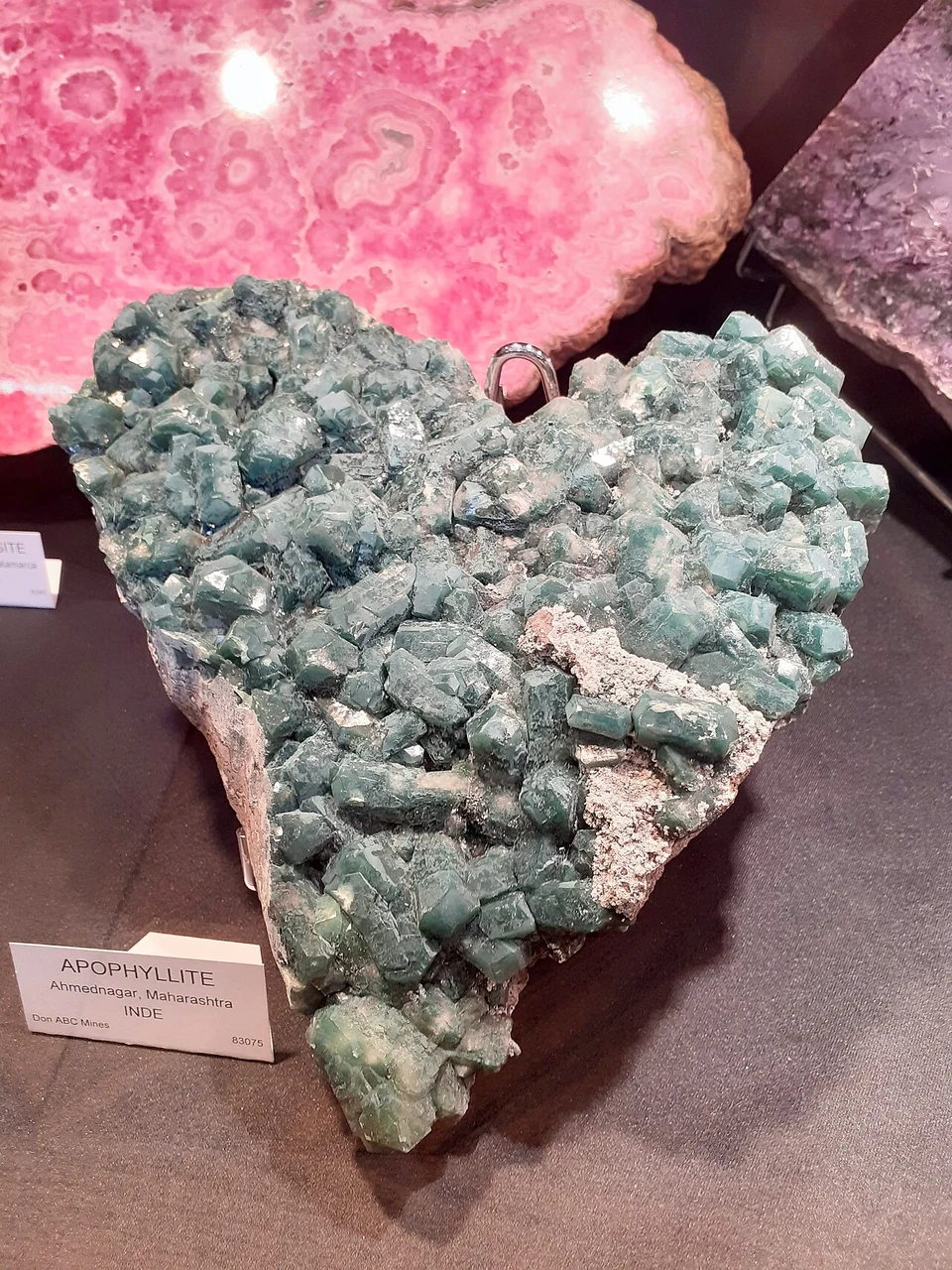
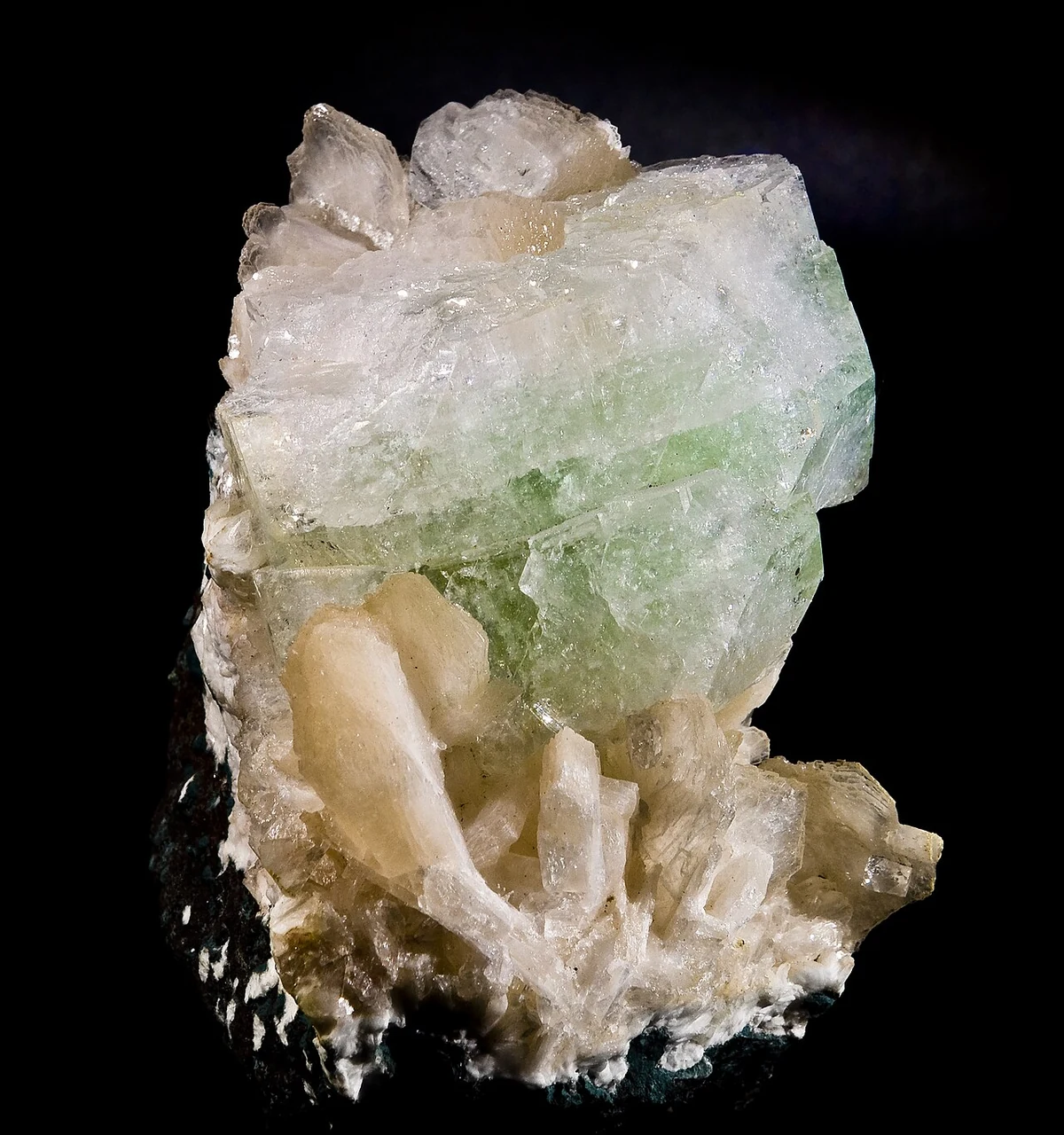
Apophyllite is a group name. The data here refer to potassium fluorapophyllite rather than every specimen sold under the shortened name. Distinguishing group members precisely requires compositional identification.
Apophyllite: spiritual meanings, practices and correspondences in two contemporary sources. Their traditional language is presented alongside a separate original practice.
The Crystal Council presents apophyllite as a companion for meditation, lucid dreams and contact with angels and guides. The author proposes keeping a specimen by the bed and associates green material with contemplation of nature at dawn or dusk. A separate passage discusses pairing it with grounding stones, including black tourmaline, onyx and haematite. Within this contemporary system, these balance openness to spiritual imagery. Dreaming, outdoor meditation and arrangements of stones thus offer distinct settings for exploring that symbolism. [423]
Happy Glastonbury tells of apophyllite metaphorically “choosing” an observer through sparkle and interest. It develops intuition, spirit guides, Akashic records and changed perspective, describing meditation and wearing jewellery. Like TCC, it builds imagery of contact with higher realms, but emphasises a personal relationship with a particular specimen. Past-life accounts remain beliefs, without being used to establish other people’s intentions. HG also emphasises recognising recurring habits. A change of perspective is presented as a route towards understanding personal choices more clearly. [445]
Correspondences in the cited source
The Crystal Council: third eye and crown; earth and wind. [423]
An Avonoria editorial suggestion
Editorial suggestion — not a documented rite
Original practice, “a point of view”: place apophyllite on a stable base and choose an issue you find difficult to describe. First record facts another person could access, then your own assumptions. Move an ordinary light source or change where you sit and observe how the view of the crystal faces changes. This can be a metaphor for changing perspective without attributing consciousness to the stone. Add one question that would test an assumption. If you use a spiritual guardian symbol, treat it as an image of a chosen value such as honesty or care. Finish with a concrete action: checking a document, talking or postponing judgement until information is available. Do not try to obtain an answer by staring at a reflection for a long time. The exercise can last a few minutes; its outcome should be a clearer account of the problem.
Associations with lucid dreaming are not a recommendation to disrupt rest. A large cluster in particular should remain securely positioned, even when decorating a meditation space. Contact with the body is unnecessary for it to represent an intention.
Scope of the sources: The listed pages were consulted, without claiming to have read the books they cite. Correspondences document a selected contemporary current rather than a shared system for all cultures. Symbolic cleansing can consist of an intention alone, without water, salt, smoke or exposure to sunlight.
Cavities in basaltic rocks and formation from hydrothermal fluids are typical. Colourlessness or green colour does not signify a different type of mineralogically measured “energy”.
Personal / spiritual practice
Request the precise label and photographs of the base, terminations and adhesive repairs. “Apophyllite” may suffice for decoration but not for a precisely identified collection. Do not assess quality solely by the number of sharp terminations. Check whether the specimen can be stood safely and removed from its packaging. Green and colourless pieces may have different prices, but price is not a scale of spiritual effectiveness. Do not chip off a fragment to inspect lustre or structure.
Material-specific guidance is given under safe handling; settings and treatments need separate assessment.
Storage and specimen form
Use a separate supported compartment away from a sunny windowsill. Keep the provenance label with the object.
Do not lift clusters by their crystals; move them by the matrix over a padded support. Do not place them on the body or in bed. For an intact, unexamined specimen we recommend dust protection and cautious dry cleaning of sound parts, without baths, salt or heat. Water in the formula means water within the mineral structure, not permission to soak it. Do not restore lustre by abrading the surface.
Do not grind, drill or inhale dust. This card concerns intact objects; a chemical formula alone does not quantify exposure. [37]
FAQ
Does this card authenticate my specimen?
No. Request the precise name, treatment disclosure and documentation appropriate to the object’s value. Do not perform destructive home tests.
What research says — in brief
The cited clinical trial concerned rose quartz, not this atlas entry. It does not establish a therapeutic effect for this material; the symbolism is presented for understanding traditions and personal practice. [159]
fluorapophylliteMineral Data Publishing · accessed 2026-10-29
Mineralogical, gemological, institutional or scientific source. Its scope is recorded in the source index.
apophyllite Meanings and Crystal PropertiesThe Crystal Council · accessed 2026-10-29
Commercial practitioner source: documents beliefs, not medical evidence. The site sells crystals, so we give a bibliographic description without an active link; the full address is kept in Avonoria’s source documentation.
Placebo effects in alternative medical treatments for anxiety: false hope or healing potential?Cambridge University Press / CNS Spectrums · 2025 · accessed 2026-10-29DOI: 10.1017/S1092852925100515
Mineralogical, gemological, institutional or scientific source. Its scope is recorded in the source index.
apophyllite — contemporary meanings and practicesHappy Glastonbury · accessed 2026-10-29
Commercial practitioner source: documents beliefs, not medical evidence. The site sells crystals, so we give a bibliographic description without an active link; the full address is kept in Avonoria’s source documentation.
quartzMineral Data Publishing · accessed 2026-10-29
Mineralogical, gemological, institutional or scientific source. Its scope is recorded in the source index.