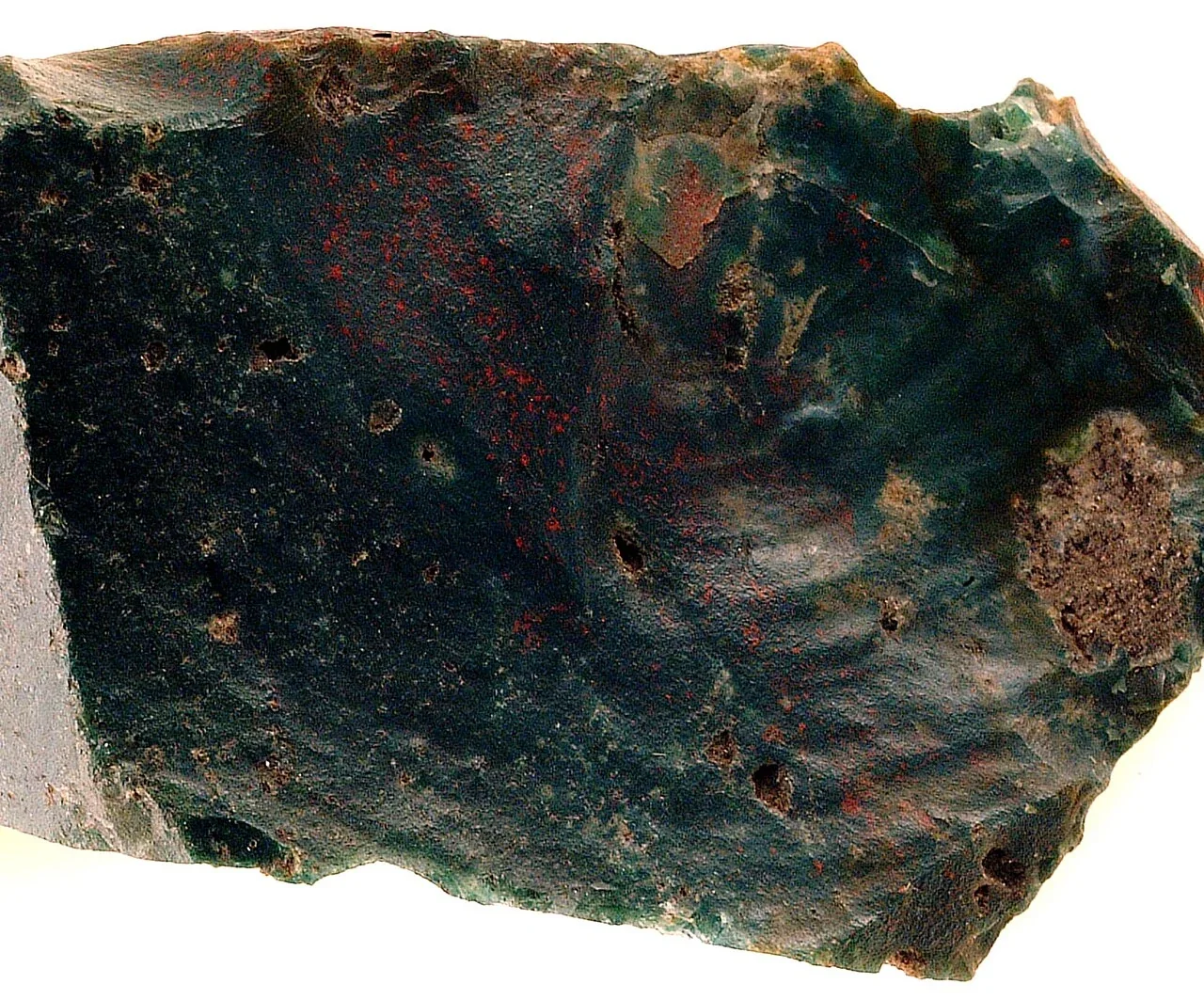
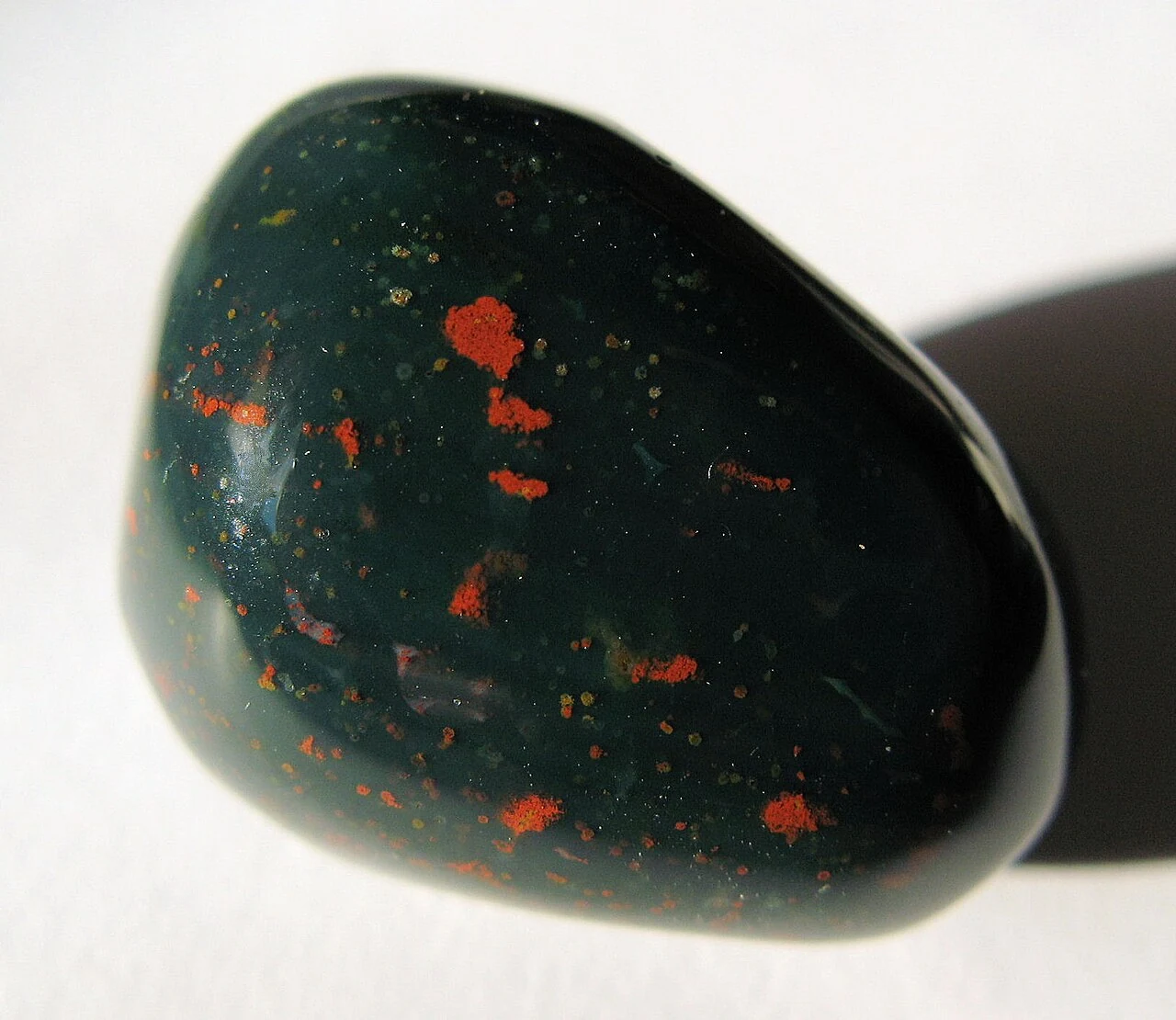
Bloodstone, also called heliotrope, is dark-green chalcedony with red spots. It is not hematite, despite similar blood associations in the names. It has a narrow, distinct atlas scope; blood jasper does not create another entry.
The Crystal Council presents bloodstone as a symbol of courage, persistence and inner strength. Its root-chakra association organises the account around stability and readiness to meet a challenge. In the affirmation section, the stone is an amulet accompanying expression of ideas previously kept hidden. Emphasis falls on trusting intuition, choosing one's direction and moving beyond repetitive patterns. This contemporary account highlights personal motivation during difficulty; the material's name and red spots are not used here as a basis for claims about blood functions. [175]
A second account and differences of emphasis
Crystal Vaults combines courage with intuition and mental clarity. It describes carrying bloodstone as an amulet during change, emphasising the strength needed to maintain direction. Creativity appears alongside this: moving from an idea to a project and finding motivation to develop it. Compared with The Crystal Council's affirmations, the account gives more prominence to an enduring object accompanying everyday life. Its root and heart associations bring stability together with feeling, whereas the other account concentrates its chakra map on the root. [218]
The name can sound dramatic, but safe practice does not need a dramatic ritual. In our editorial interpretation, a red detail against a dark background may represent a small cue to act. It need not signify battle or self-sacrifice; courage also includes asking for support and stepping back from overload.
Choose one red spot and associate it with a small, specific step you have postponed. Write down when you will take it and whom you can ask for help. Afterwards, put the stone away to mark completion rather than immediately seeking another challenge. If the concern is health-related, the step may be arranging a consultation; the object itself is not a diagnostic or therapeutic tool.
Courage can be practised by choosing an appropriate task size. If the written step feels overwhelming, divide it into preparation, contact and action. The stone may mark only the first stage. After completing it, name what has already worked without demanding further effort. This rhythm leaves room for both determination and rest.
Scope of the sources: The correspondences above document contemporary practitioner approaches. The practice is original, not a reconstructed historical rite. Choose only a meaning that suits you. Returning the stone to a clean stand can mark a symbolic ending; physical cleaning is covered separately in the card.
Look at the whole stone, not only the reddest part of a photograph. The pattern may be fine, irregular or concentrated on one side; a descriptive match does not authenticate a specimen. [163]
Reference properties
A photograph and trade name cannot establish a particular specimen's composition, treatment or origin. Observe in ordinary light; do not use flame, acid or scratching tests.
Bloodstone has a narrow scope in this series: characteristic green chalcedony with red spots. Jasper and bloodstone are not interchangeable labels for every multicoloured stone.
What a photograph cannot establish
A photograph and trade name cannot establish a particular specimen's composition, treatment or origin. Observe in ordinary light; do not use flame, acid or scratching tests.
Chalcedony forms siliceous aggregates; local conditions require deposit documentation. [167]
Material facts
Gemdat links the green background to inclusions and the red spots to iron oxides. It describes a compact aggregate and notes that ‘blood jasper’ is a trade term that does not settle structure. The proportion of red varies and is not a measure of energetic quality. [163]
Editorial suggestion — not a documented rite
Request the name bloodstone or heliotrope and ask whether the piece was dyed, impregnated or assembled. These are questions, not an assumption that every listing involves such treatment. Avoid judging value through promises of ‘blood purification’; a historical name is not a medical use.
Choose a smooth, intact specimen and dry cleaning when treatment is unknown. Do not try to colour water red or pulverise the material. The name does not justify contact with a wound or drinking preparations made with the stone.
Storage and specimen form
Store separately in soft wrapping, away from heaters and windowsills. Do not use salt or prolonged soaking as a universal care method.
Store securely, protect sharp edges and check settings. Do not place stones in the mouth.
Do not grind or drill at home; this card concerns the intact specimen, not its dust. [37]
FAQ
Does bloodstone help with bleeding?
The name and legends do not establish such an effect. Do not put the stone on a wound; bleeding requires appropriate first aid and, depending on the circumstances, medical attention.
What research says — in brief
The cited clinical trial concerned rose quartz, not this atlas entry. It does not establish a therapeutic effect for this material; the symbolism is presented for understanding traditions and personal practice. [159]
Mineralogical, gemological, institutional or scientific source. Its scope is recorded in the source index.
QuartzHandbook of Mineralogy · accessed 2026-10-29
Mineralogical, gemological, institutional or scientific source. Its scope is recorded in the source index.
bloodstone Meaning and Crystal PropertiesThe Crystal Council · accessed 2026-10-29
Commercial practitioner source: documents beliefs, not medical evidence. The site sells crystals, so we give a bibliographic description without an active link; the full address is kept in Avonoria’s source documentation.
JasperGemdat · accessed 2026-10-29
Mineralogical, gemological, institutional or scientific source. Its scope is recorded in the source index.
Placebo effects in alternative medical treatments for anxiety: false hope or healing potential?Cambridge University Press / CNS Spectrums · 2025 · accessed 2026-10-29DOI: 10.1017/S1092852925100515
Mineralogical, gemological, institutional or scientific source. Its scope is recorded in the source index.
bloodstone Meanings and UsesCrystal Vaults · accessed 2026-10-29
Commercial practitioner source: documents beliefs, not medical evidence. The site sells crystals, so we give a bibliographic description without an active link; the full address is kept in Avonoria’s source documentation.