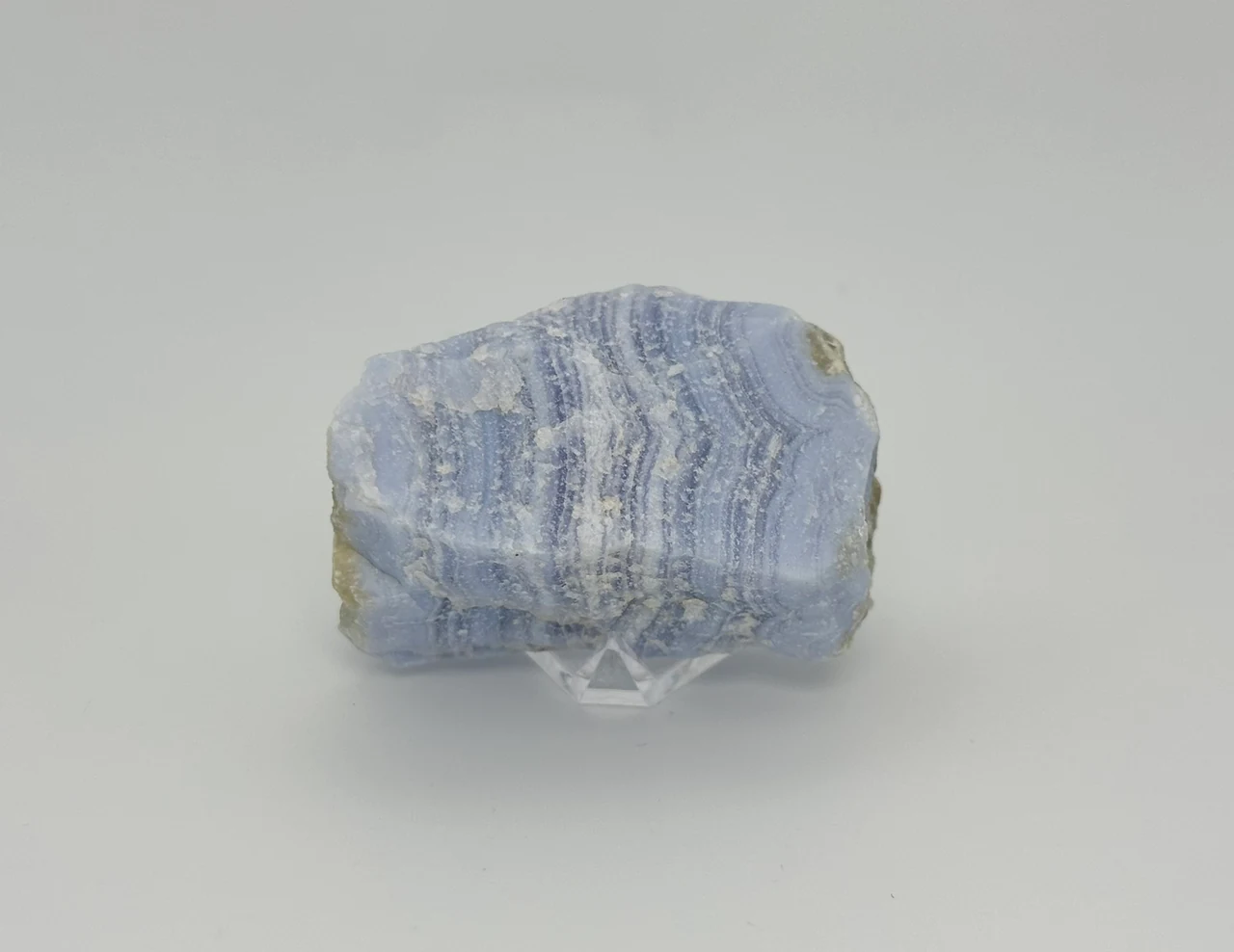
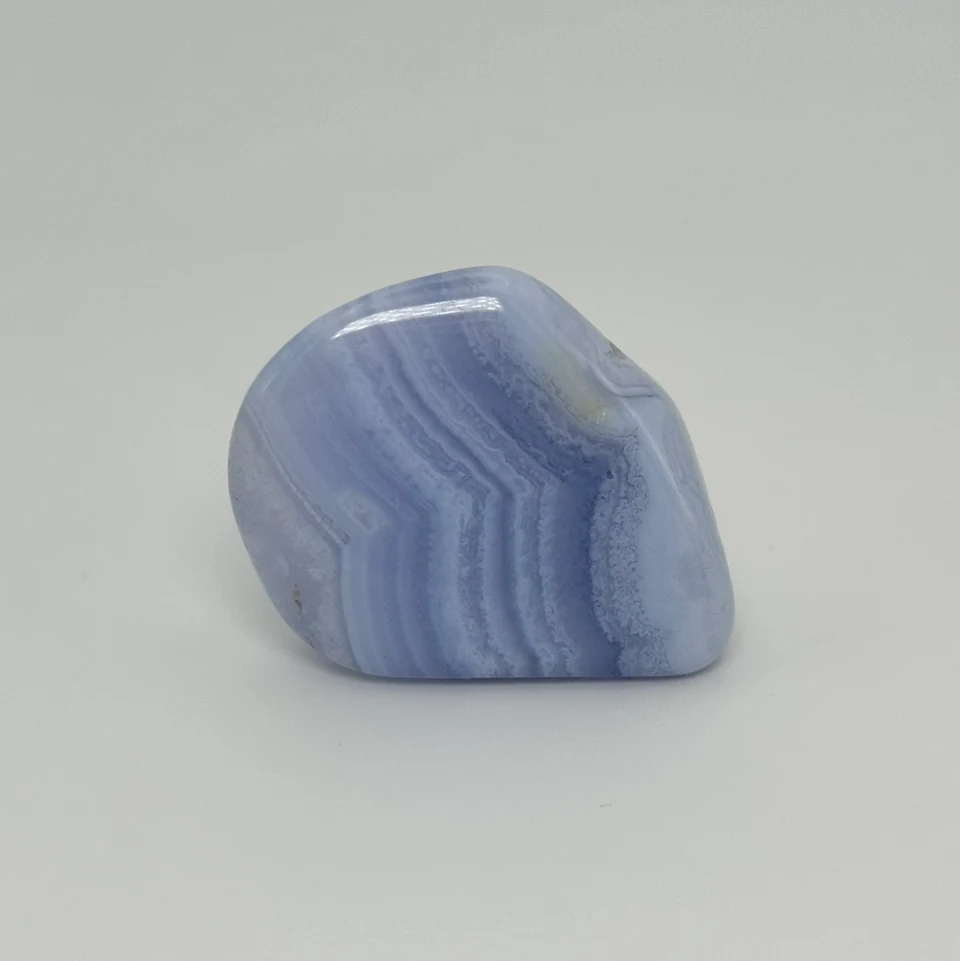
Blue lace agate is a recognised name for banded chalcedony with a pale blue and white pattern. Its communication motif has a separate place in this atlas, while it remains within the agate family. Any blue-dyed agate should not automatically receive this name.
The Crystal Council associates blue lace agate with voice, confidence in speaking and gentle expression of truth. The authors propose spoken affirmations and using the stone as a symbolic companion for presentations or conversations in which speaking up feels difficult. The throat organises these associations, while its delicate appearance develops the theme of calm communication. Suggested combinations include aquamarine, chrysocolla and lapis lazuli; rose quartz adds kindness. This model centres on how thoughts are expressed rather than producing a particular reaction in another person. [213]
A second account and differences of emphasis
Crystal Vaults emphasises diplomacy, encouragement and calmly expressing truth. It distinguishes this agate from a protective stone: instead, it symbolises support for speaking clearly and being heard. Throat and third eye connect expression with reflection, while the account's gentle tone concerns conversations where anger can arise. The Crystal Council gives greater prominence to daring to speak. Communication is the shared theme, but one account centres on how a conversation is conducted, while the other emphasises readiness to begin it. [226]
Our interpretation of the lace pattern concerns space for pauses in conversation. Speaking louder or longer is unnecessary for a clear message. The stone can remind us of an unhurried pace, while another person's right to disagree remains part of the conversation.
Before a conversation, place agate beside three short sentences: what I observed, what I need and what I am requesting. Read them aloud once, leaving a pause between sentences. Shorten wording that assigns hidden intentions to someone else. You may carry the stone as a reminder to pause, but do not use it to impose the exercise on another person.
You can practise listening too. After another person speaks, repeat what you understood in your own words and invite correction. The stone can remind you of that sequence but is not an argument in a dispute. Do not judge someone as having a ‘blocked chakra’ because they disagree; leave their experience in their own words.
Scope of the sources: The correspondences above document contemporary practitioner approaches. The practice is original, not a reconstructed historical rite. Choose only a meaning that suits you. Returning the stone to a clean stand can mark a symbolic ending; physical cleaning is covered separately in the card.
Observe the subtle course of paler and darker layers in diffuse light. Lace describes an appearance, not a laboratory result. Establishing natural colour or provenance requires more than comparing photographs. [242]
Reference properties
A photograph and trade name cannot establish a particular specimen's composition, treatment or origin. Observe in ordinary light; do not use flame, acid or scratching tests.
Layered vein fillings, sometimes with cavities and associated minerals. [242]
Common lookalikes and imitations
Dyed agate
Why it looks similar
Blue-dyed agate can also have bands.
What can help distinguish it
Gemdat documents agate dyeing. Identifying the variety and natural colour requires material information; a pale blue photograph is insufficient.
What a photograph cannot establish
A photograph and trade name cannot establish a particular specimen's composition, treatment or origin. Observe in ordinary light; do not use flame, acid or scratching tests.
A study of material from Ysterputs, Namibia, describes hydrothermal veins in fractures of a Jurassic dolerite sill. Wavy bands of fibrous chalcedony alternate with granular quartz. Associated minerals require separate identification. [242]
Editorial suggestion — not a documented rite
Ask whether blue lace identifies the recognised variety or merely describes the product's colour. Request disclosure of dyeing, impregnation and any repairs. Retain a photograph of the entire piece, especially if it contains cavities or attached minerals; those also require care.
Because of possible associated minerals and unknown treatment, we use a soft dry cloth. Do not brush small crystals aggressively or treat an entire rough specimen as uniform quartz. Salt, steam and prolonged soaking are unnecessary for symbolic practice.
Storage and specimen form
Store separately in soft wrapping, away from heaters and windowsills. Do not use salt or prolonged soaking as a universal care method.
Store securely, protect sharp edges and check settings. Do not place stones in the mouth.
Do not grind or drill at home; this card concerns the intact specimen, not its dust. [37]
FAQ
Does this entry duplicate agate?
It is a named variety in the same family, distinguished by pattern and its separate practitioner account. It is not an additional mineral species; the core agate entry excludes this detailed scope.
What research says — in brief
The cited clinical trial concerned rose quartz, not this atlas entry. It does not establish a therapeutic effect for this material; the symbolism is presented for understanding traditions and personal practice. [159]
Mineralogical, gemological, institutional or scientific source. Its scope is recorded in the source index.
Blue Lace Agate from Ysterputs, Southern NamibiaJoanna Wicht and Duncan Miller / FMF · accessed 2026-10-29
Mineralogical, gemological, institutional or scientific source. Its scope is recorded in the source index.
Blue lace agate and chalcedony pseudomorphs from Ysterputs in southern NamibiaWelman-Purchase, Wicht, Miller and Roelofse / Journal of African Earth Sciences · 2024 · accessed 2026-10-29DOI: 10.1016/j.jafrearsci.2024.105211
Mineralogical, gemological, institutional or scientific source. Its scope is recorded in the source index.
blue-lace-agate Meaning and Crystal PropertiesThe Crystal Council · accessed 2026-10-29
Commercial practitioner source: documents beliefs, not medical evidence. The site sells crystals, so we give a bibliographic description without an active link; the full address is kept in Avonoria’s source documentation.
Placebo effects in alternative medical treatments for anxiety: false hope or healing potential?Cambridge University Press / CNS Spectrums · 2025 · accessed 2026-10-29DOI: 10.1017/S1092852925100515
Mineralogical, gemological, institutional or scientific source. Its scope is recorded in the source index.
blue-lace-agate Meanings and UsesCrystal Vaults · accessed 2026-10-29
Commercial practitioner source: documents beliefs, not medical evidence. The site sells crystals, so we give a bibliographic description without an active link; the full address is kept in Avonoria’s source documentation.