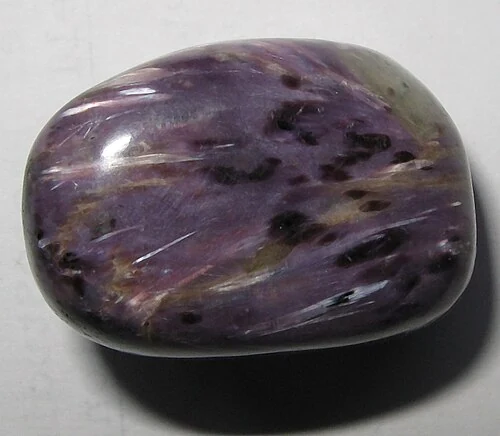
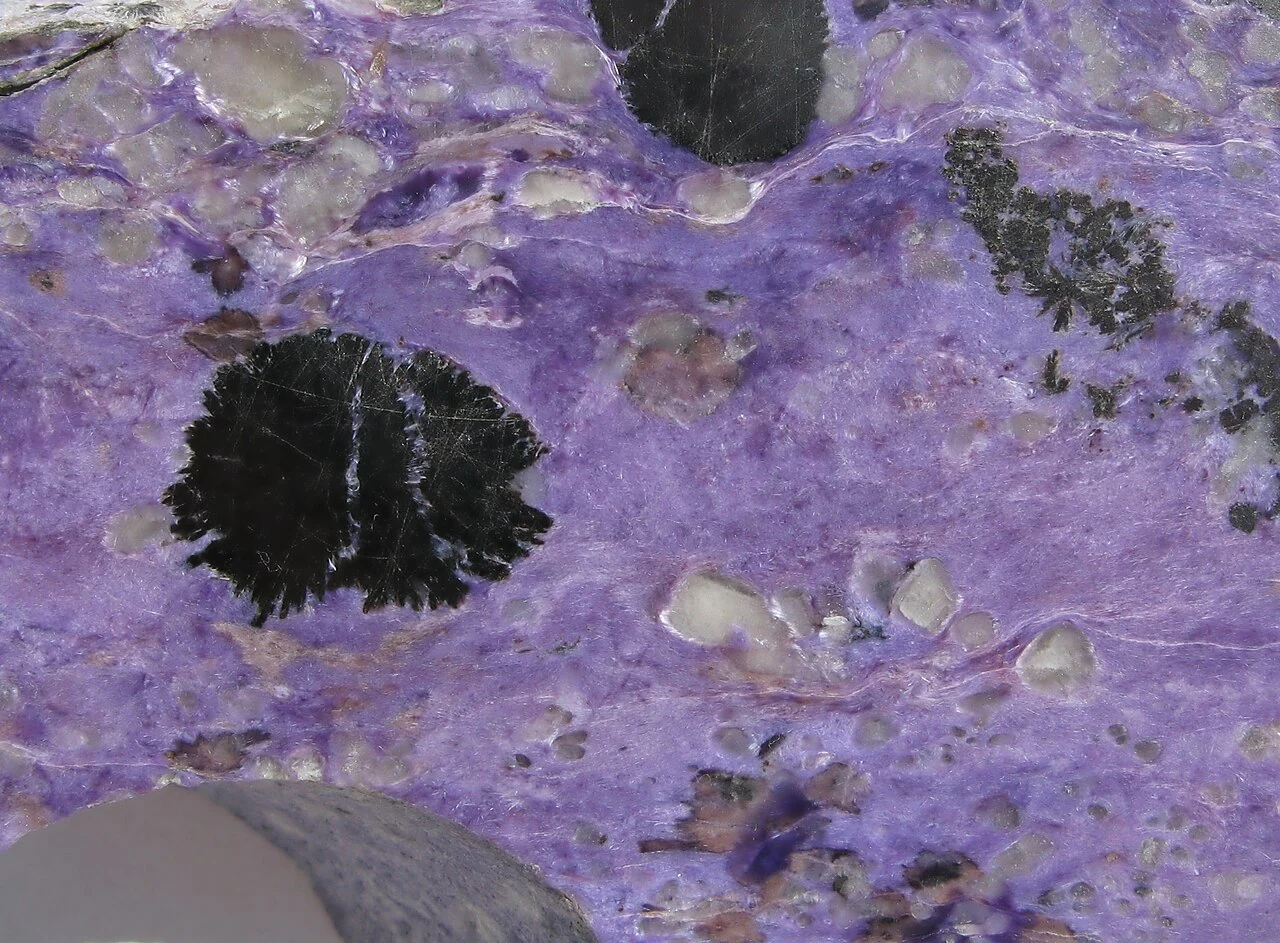
Charoite is a complex silicate known for lilac and purple aggregates. An ornamental object may also contain other minerals. Its formula expresses compositional variation rather than a simple stone “recipe”.
Charoite: spiritual meanings, practices and correspondences in two contemporary sources. Their traditional language is presented alongside a separate original practice.
The Crystal Council attributes self-understanding, self-acceptance and transformation to charoite. Intuition and aura protection complete this current’s symbolism of readiness for change. TCC attributes openness to intuition and a changed self-image to charoite. Its meditative meaning centres on recognising personal worth and readiness for another stage, alongside a symbolic aura shield. Acceptance and transformation are not opposing themes: the account encourages recognising personal worth while remaining open to other possibilities in life. [426]
Happy Glastonbury describes an imagined conversation with a held stone and a question about life direction. The Violet Ray and Violet Flame name spiritual transformation and release of established patterns. The author mentions aura clearing and a protective jewellery pairing with turquoise. Compared with TCC, this is a more pictorial dialogue ritual; an answer can be treated as personal reflection rather than an external message. The imagined dialogue gives an intention a personal tone. Mentioned jewellery with turquoise combines transformation with an image of protective presence. [452]
Correspondences in the cited source
The Crystal Council account includes the third eye and crown, among other correspondences, and the wind element. [426]
An Avonoria editorial suggestion
Editorial suggestion — not a documented rite
Original practice, “changing a self-story”: write one sentence beginning with “always” or “never” that you use about yourself. Place charoite beside it and observe its colours without searching for a hidden sign. Then find a concrete exception to your generalisation. Write a second version that includes the exception without promising immediate transformation. Add a small experiment for tomorrow, such as asking a question instead of assuming the answer. After doing it, record the outcome. The object is a reminder that a self-description can be updated through experience. If the topic touches difficult events, do not force a detailed account or a return to memories; choose an ordinary daily habit instead. The purple pattern can remain decoration, while the exercise’s meaning lies in more considered language and a testable action.
We do not reconstruct an ancient use of charoite from a contemporary website. This pack documents present-day symbolism. The absence of older evidence does not remove personal meaning, but it sets the boundary for historical claims.
Scope of the sources: The listed pages were consulted, without claiming to have read the books they cite. Correspondences document a selected contemporary current rather than a shared system for all cultures. Symbolic cleansing can consist of an intention alone, without water, salt, smoke or exposure to sunlight.
Observe in diffused light without scratching, heating or breaking.
Mohs hardness
Crystal system
Monoclinic
Material property
The Handbook gives a monoclinic system and fibrous massive aggregates. Hardness is undetermined in the consulted sheet, so the numerical field remains empty. [409]
The documented occurrence in Russia’s Murun area is linked to rock metasomatism near a syenite–limestone contact.
Personal / spiritual practice
Do not accept an assurance that charoite cannot be imitated. Ask for the material name, disclosure of dye, resins and repairs, and photographs of the actual object. Pattern variation is not evidence of synthetic origin, just as vivid purple does not establish natural origin. For a substantial purchase obtain gemmological documentation. Also establish whether you are buying a mineral specimen with a locality label or a decorative piece of rock; both can be valued, but answer different questions.
Material-specific guidance is given under safe handling; settings and treatments need separate assessment.
Storage and specimen form
Use a separate supported compartment away from a sunny windowsill. Keep the provenance label with the object.
A fibrous appearance is not an invitation to comb or abrade the surface. Do not grind or drill at home. For an unexamined object, use a soft dry cloth and a separate padded space. Avoid salt baths, ultrasonic cleaning, steam and heating; the water and light stability of the particular specimen has not been tested here. Choose a setting that protects edges. Assess chips and cracks before wearing rather than concealing them with oil.
Do not grind, drill or inhale dust. This card concerns intact objects; a chemical formula alone does not quantify exposure. [37]
FAQ
Does this card authenticate my specimen?
No. Request the precise name, treatment disclosure and documentation appropriate to the object’s value. Do not perform destructive home tests.
What research says — in brief
The cited clinical trial concerned rose quartz, not this atlas entry. It does not establish a therapeutic effect for this material; the symbolism is presented for understanding traditions and personal practice. [159]
CharoiteMineral Data Publishing · accessed 2026-10-29
Mineralogical, gemological, institutional or scientific source. Its scope is recorded in the source index.
charoite Meanings and Crystal PropertiesThe Crystal Council · accessed 2026-10-29
Commercial practitioner source: documents beliefs, not medical evidence. The site sells crystals, so we give a bibliographic description without an active link; the full address is kept in Avonoria’s source documentation.
Placebo effects in alternative medical treatments for anxiety: false hope or healing potential?Cambridge University Press / CNS Spectrums · 2025 · accessed 2026-10-29DOI: 10.1017/S1092852925100515
Mineralogical, gemological, institutional or scientific source. Its scope is recorded in the source index.
charoite — contemporary meanings and practicesHappy Glastonbury · accessed 2026-10-29
Commercial practitioner source: documents beliefs, not medical evidence. The site sells crystals, so we give a bibliographic description without an active link; the full address is kept in Avonoria’s source documentation.
LepidoliteMineral Data Publishing · accessed 2026-10-29
Mineralogical, gemological, institutional or scientific source. Its scope is recorded in the source index.