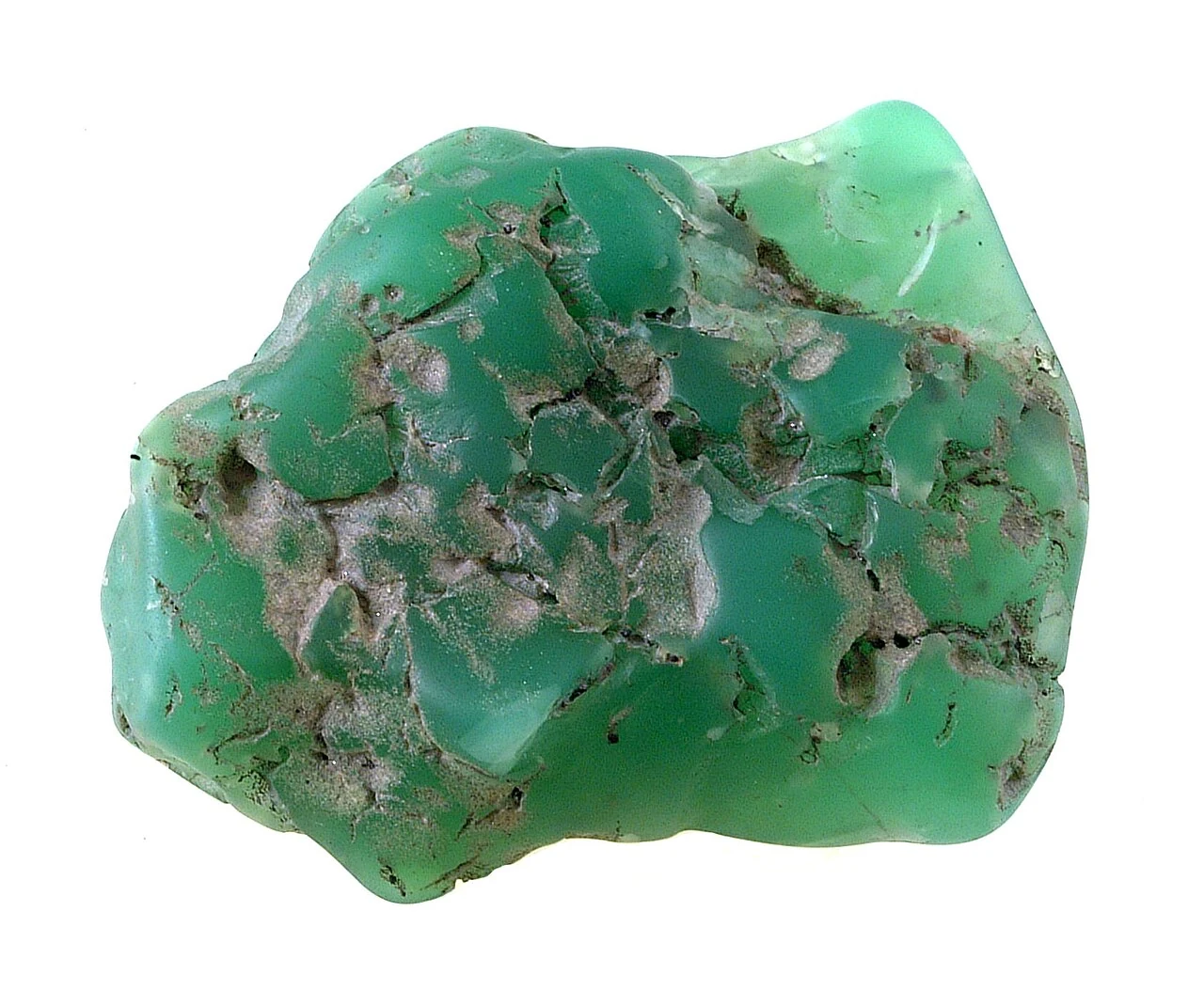
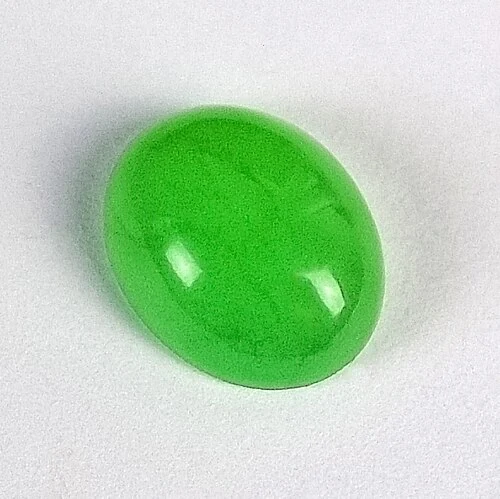
Chrysoprase is a green chalcedony variety, not jadeite. The trade name ‘Australian jade’ may suggest a relationship that does not exist. This entry concerns identified chrysoprase; green colour alone does not determine the material.
The Crystal Council links chrysoprase with kindness, compassion and personal will. It brings together the heart and solar plexus: the former represents emotional openness, the latter readiness for deliberate action. Its practice description includes outdoor meditation at dawn or dusk, when the surroundings may support attention. Green colouring reinforces the association with renewal and nature. The account encourages recognising one's feelings and expressing them consistently with a chosen intention; it provides a symbolic framework rather than a procedure for diagnosing emotional states. [174]
A second account and differences of emphasis
Happy Glastonbury presents chrysoprase through hope, optimism, joy and willingness to let go. It connects the stone with forgiveness and comfort, which jewellery can symbolise in personal practice. It assigns the stone to the sacral chakra, while The Crystal Council names the heart and solar plexus. This is an actual difference between systems, not something to erase by inventing one correct table. Both accounts concern emotional openness, but organise it differently within the subtle-body map and describe everyday use differently. [230]
Our suggested focus is the meeting of kindness and boundaries. Compassion need not mean accepting every request. A green object can invite a check on whether the help offered is actually possible. Online stories about Alexander the Great are not presented here as verified chrysoprase history.
Sit by a window or in a quiet outdoor place, with the stone beside a notebook. Record one situation in which you want to show kindness and one boundary you need to keep. Compose a short sentence joining the two, such as an offer of limited, specific help. Do not expect special sensations; the exercise ends with a clear decision, not an obligation to rescue others.
The practice can distinguish acceptance from giving up. Write what you can influence today and what requires time or other people's involvement. Choose a small gesture of kindness towards yourself without demanding immediate improvement in mood. Chrysoprase serves as a reminder; it need not become a tool for suppressing anger or sadness.
Scope of the sources: The correspondences above document contemporary practitioner approaches. The practice is original, not a reconstructed historical rite. Choose only a meaning that suits you. Returning the stone to a clean stand can mark a symbolic ending; physical cleaning is covered separately in the card.
Uniform or lightly clouded green can appear soft and waxy. Neutral lighting helps describe the hue, but cannot establish nickel content or dyeing. [162]
Reference properties
A photograph and trade name cannot establish a particular specimen's composition, treatment or origin. Observe in ordinary light; do not use flame, acid or scratching tests.
The origin of colour requires professional assessment. Resemblance alone is insufficient to label a specimen either natural chrysoprase or an imitation.
What a photograph cannot establish
A photograph and trade name cannot establish a particular specimen's composition, treatment or origin. Observe in ordinary light; do not use flame, acid or scratching tests.
Gemdat describes veins in nickel-bearing rocks and laterites above serpentinites. [162]
Material facts
The green is associated with fine nickel-bearing components. Gemdat also records dyed chalcedony that imitates chrysoprase's appearance. The stone ranges from translucent to opaque; saturation and clarity should not be assumed identical in every specimen. [162]
Editorial suggestion — not a documented rite
Ask for mineral identity and treatment disclosure, not only a country in the listing title. Do not transfer jadeite pricing to chrysoprase or vice versa. For a daily companion, inspect edges and mounting; a symbol of compassion does not require a rare or perfectly uniform piece.
This review has not established care instructions for every treatment used on chrysoprase. Keep to gentle dry wiping and a location without strong heating. Do not use salt or soaking to symbolically renew an intention.
Storage and specimen form
Store separately in soft wrapping, away from heaters and windowsills. Do not use salt or prolonged soaking as a universal care method.
Store securely, protect sharp edges and check settings. Do not place stones in the mouth.
Do not grind or drill at home; this card concerns the intact specimen, not its dust. [37]
FAQ
Does ‘Australian jade’ mean jadeite?
No. Applied to chrysoprase, it is a trade description. A purchase needs material identification, because similar colour does not make these stones the same mineral.
What research says — in brief
The cited clinical trial concerned rose quartz, not this atlas entry. It does not establish a therapeutic effect for this material; the symbolism is presented for understanding traditions and personal practice. [159]
Mineralogical, gemological, institutional or scientific source. Its scope is recorded in the source index.
chrysoprase Meaning and Crystal PropertiesThe Crystal Council · accessed 2026-10-29
Commercial practitioner source: documents beliefs, not medical evidence. The site sells crystals, so we give a bibliographic description without an active link; the full address is kept in Avonoria’s source documentation.
Placebo effects in alternative medical treatments for anxiety: false hope or healing potential?Cambridge University Press / CNS Spectrums · 2025 · accessed 2026-10-29DOI: 10.1017/S1092852925100515
Mineralogical, gemological, institutional or scientific source. Its scope is recorded in the source index.
Commercial practitioner source: documents beliefs, not medical evidence. The site sells crystals, so we give a bibliographic description without an active link; the full address is kept in Avonoria’s source documentation.