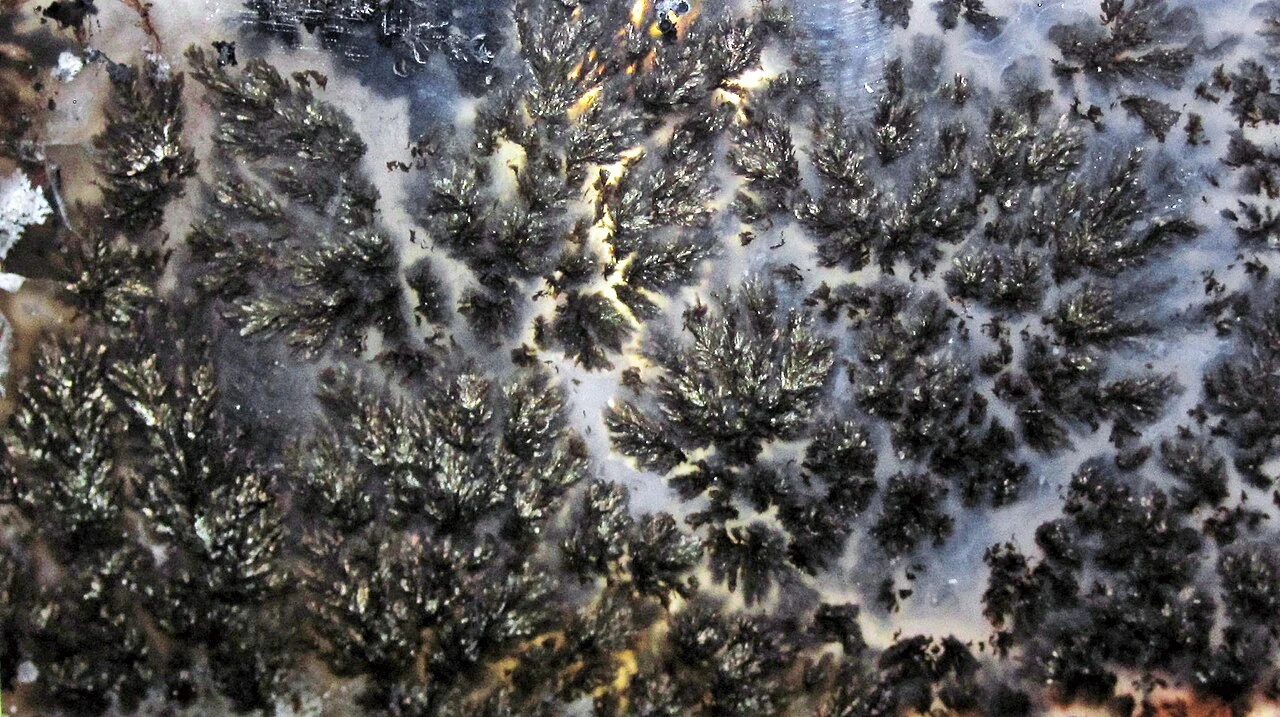
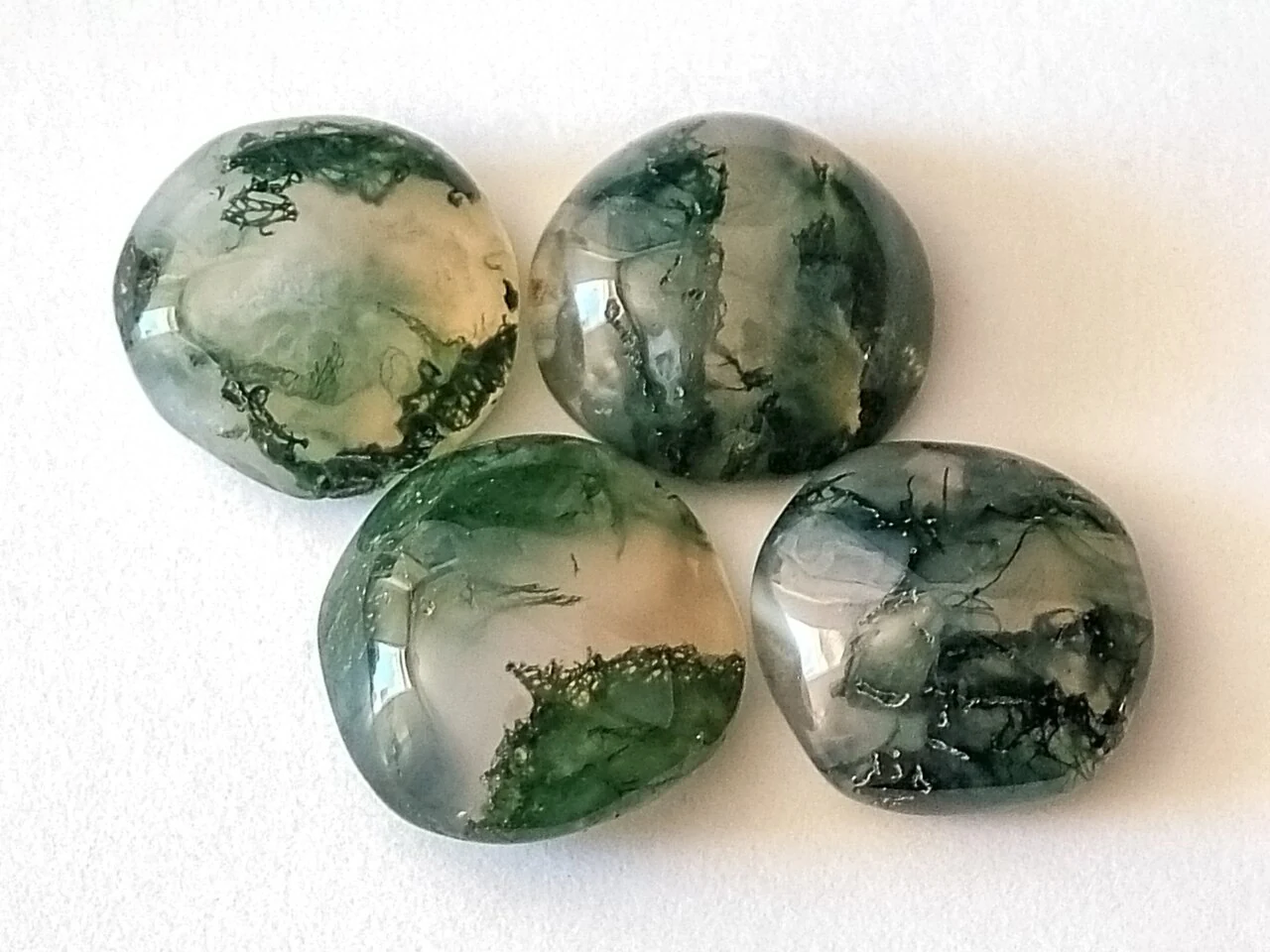
Moss agate is chalcedony with mineral inclusions resembling moss. The name is established even though typical material lacks the banding required by a strict definition of agate. This does not mean that it contains plants or fossilised moss.
The Crystal Council presents moss agate through contact with nature, grounding and free expression. A Mother Earth image accompanies its narrative of returning to simple pleasures and interests. The inner-child theme develops through art, food, animals and other experiences that draw attention towards everyday life. Root and heart bring stability together with openness, while the earth element organises the account. Plant-like mineral patterns provide a starting point for nature symbolism; they are not evidence that the stone contains moss or possesses a special biological power. [214]
A second account and differences of emphasis
Crystal Vaults develops an image of a gardeners' stone and gradual abundance. Growth symbolism extends to cultivation, saving and slowly expanding an undertaking; this is the language of patient increase rather than a sudden breakthrough. The broader agate motif of gentle energy and yin–yang balance completes the account. The Crystal Council gives more prominence to enjoying simple contact with nature. Both use plant-like patterns as a starting point, but one develops persistent tending while the other emphasises presence and free expression. [227]
The moss-like image can lead towards observing actual surroundings rather than collecting ever more objects. Our motif is noticing small changes: a leaf, the weather or day length. A stone does not replace contact with nature or grant permission to take specimens from protected places.
View the agate for a minute, then take a short walk or look at a plant by a window. Find one actual detail you had not noticed before. Describe it without interpretation: shape, shade or arrangement. Afterwards, place the stone beside your note as a reminder of observation. Do not put it into soil or water; the exercise requires no physical contact with a plant.
An original gardening ritual can involve checking a plant's actual needs: light, soil moisture and space. Leave the stone beside its label, outside the pot. Record an observation rather than assuming growth accelerated because of the object. This connects an aesthetic motif with attention to a particular living organism.
Scope of the sources: The correspondences above document contemporary practitioner approaches. The practice is original, not a reconstructed historical rite. Choose only a meaning that suits you. Returning the stone to a clean stand can mark a symbolic ending; physical cleaning is covered separately in the card.
A translucent or milky host allows branching patterns to be seen at different depths. Denser portions can appear almost uniformly green. Examine the pattern from several sides; resemblance to a landscape is the viewer's association. [203]
Reference properties
A photograph and trade name cannot establish a particular specimen's composition, treatment or origin. Observe in ordinary light; do not use flame, acid or scratching tests.
Moss agate is distinguished by visible inclusion patterns; chrysoprase's green relates to microscopic nickel minerals. An ambiguous specimen requires assessment.
What a photograph cannot establish
A photograph and trade name cannot establish a particular specimen's composition, treatment or origin. Observe in ordinary light; do not use flame, acid or scratching tests.
Gemdat lists green amphibole or chlorite-group inclusions and occurrence as fracture fillings and pebbles. Brown and red tones can relate to iron oxidation. The descriptive name specifies neither one chemical reaction nor one formation locality. [203]
Ask for material identification and treatment disclosure, not just the label ‘nature stone’. Do not treat a plant-like pattern as evidence of biological origin. If a seller assigns a specific locality, request batch documentation or a previous label; pattern resemblance alone is insufficient.
Choose a soft cloth for an unfamiliar specimen. Do not try to extract green inclusions or perform dust tests. Do not make burying it a required ‘cleansing’: moisture, dirt and any coatings then become difficult to control. Returning it to a clean stand is enough as a gesture closing the practice.
Storage and specimen form
Store separately in soft wrapping, away from heaters and windowsills. Do not use salt or prolonged soaking as a universal care method.
Store securely, protect sharp edges and check settings. Do not place stones in the mouth.
Do not grind or drill at home; this card concerns the intact specimen, not its dust. [37]
FAQ
Was the moss in moss agate once alive?
The typical pattern is formed by mineral inclusions rather than preserved plants. The resemblance is visual; a particular specimen still requires assessment.
What research says — in brief
The cited clinical trial concerned rose quartz, not this atlas entry. It does not establish a therapeutic effect for this material; the symbolism is presented for understanding traditions and personal practice. [159]
Mineralogical, gemological, institutional or scientific source. Its scope is recorded in the source index.
moss-agate Meaning and Crystal PropertiesThe Crystal Council · accessed 2026-10-29
Commercial practitioner source: documents beliefs, not medical evidence. The site sells crystals, so we give a bibliographic description without an active link; the full address is kept in Avonoria’s source documentation.
ChrysopraseGemdat · accessed 2026-10-29
Mineralogical, gemological, institutional or scientific source. Its scope is recorded in the source index.
Placebo effects in alternative medical treatments for anxiety: false hope or healing potential?Cambridge University Press / CNS Spectrums · 2025 · accessed 2026-10-29DOI: 10.1017/S1092852925100515
Mineralogical, gemological, institutional or scientific source. Its scope is recorded in the source index.
moss-agate Meanings and UsesCrystal Vaults · accessed 2026-10-29
Commercial practitioner source: documents beliefs, not medical evidence. The site sells crystals, so we give a bibliographic description without an active link; the full address is kept in Avonoria’s source documentation.