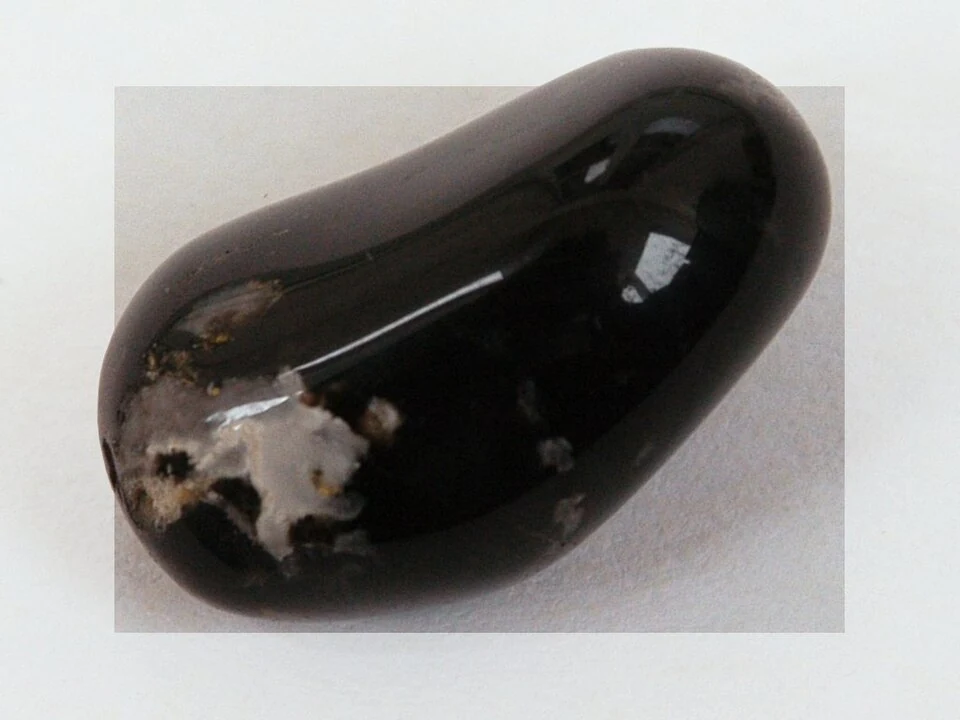
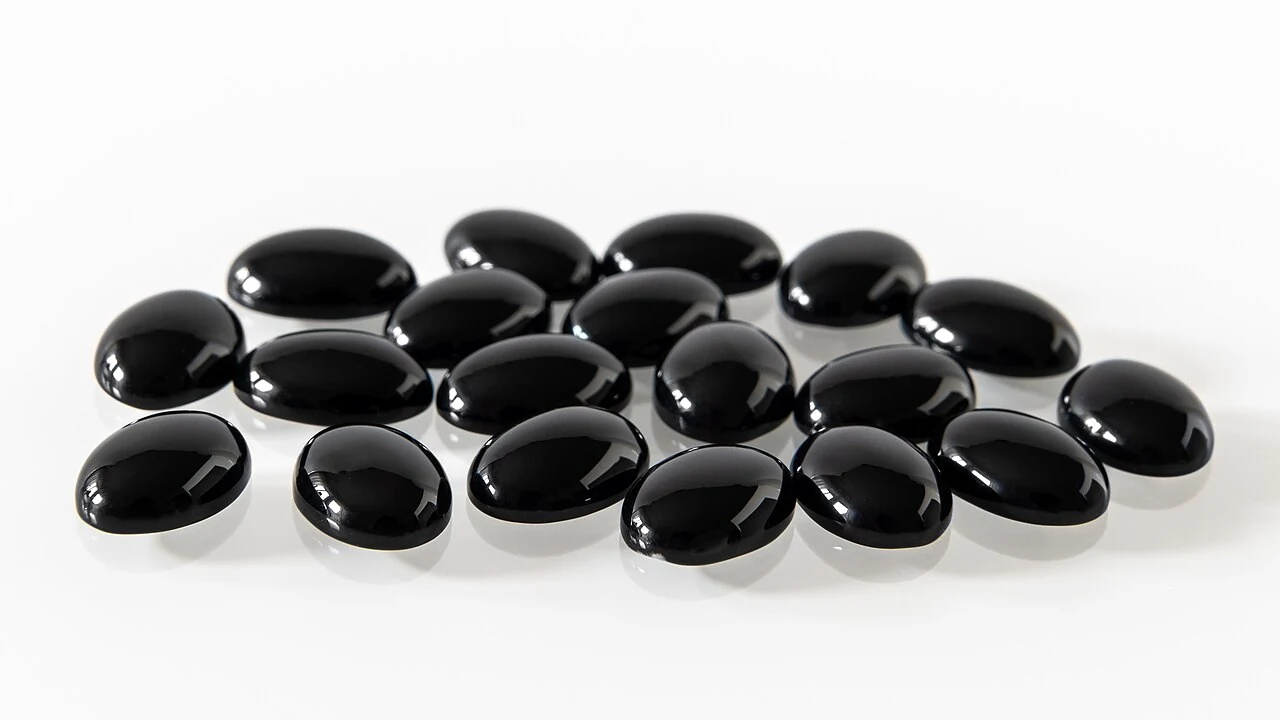
In a strict sense, onyx is chalcedony with parallel layers, commonly black and white. Trade usage also applies the name to uniformly black chalcedony. This entry covers both meanings while separating structure from colour; it does not automatically include decorative rocks called onyx marble.
The Crystal Council describes black onyx through concentration, willpower and persistence. Within its symbolism, the stone supports maintaining an intention when a task requires consistency, while protective language concerns keeping one's own direction. The authors propose meditation with a specimen placed in front of the practitioner and attention connected to a specific intention. They associate it with the root, solar plexus and third eye, bringing together stability, personal will and insight. This account concerns black material in contemporary practice rather than every historical meaning of onyx. [183]
A second account and differences of emphasis
Crystal Vaults develops a contemporary image of self-mastery, belonging and persistence. Earth and family roots support stability, while consistency and intuition accompany decisions. The authors juxtapose different, sometimes contradictory accounts of onyx rather than limiting it to one lucky-talisman role. Against The Crystal Council's emphasis on focus and will, connection with one's place and surroundings becomes more prominent. The comparison shows practitioner literature developing a black stone's meaning in several directions instead of deriving it solely from colour. [219]
Correspondences in the cited sources
The Crystal Council: root, solar plexus and third eye. [183]
An Avonoria editorial suggestion
Editorial suggestion — not a documented rite
Black-and-white contrast can become a motif of boundaries without forcing black-and-white judgements of people. Our interpretation centres on clearly defining one's commitments. The stone may mark a pause before replying; it cannot identify another person's intentions or replace conversation.
Place onyx beside a phone or notebook. Before accepting a new commitment, write what you are actually promising, how much time you have and when you will reply. Draft one calm refusal and one conditional acceptance. Afterwards, put the stone away. The exercise supports clear decisions rather than a belief that the surroundings are full of hostile energies.
A useful sentence for practising boundaries is: ‘I will reply after checking my diary.’ You need neither refuse immediately nor agree to every invitation. The object beside your phone reminds you to pause. If a uniformly black specimen reveals no bands, the exercise still works; it does not depend on seeing a particular number of layers.
Scope of the sources: The correspondences above document contemporary practitioner approaches. The practice is original, not a reconstructed historical rite. Choose only a meaning that suits you. Returning the stone to a clean stand can mark a symbolic ending; physical cleaning is covered separately in the card.
Straight contrasting layers are a useful identification motif. A uniformly black tumbled stone does not reveal that structure, so colour alone cannot establish onyx. [165]
Reference properties
A photograph and trade name cannot establish a particular specimen's composition, treatment or origin. Observe in ordinary light; do not use flame, acid or scratching tests.
Parallel-layered chalcedony; also uniformly black material in trade usage. [165]
Common lookalikes and imitations
Banded agate
Why it looks similar
Both are layered chalcedony.
What can help distinguish it
Onyx is distinguished by parallel layers, and core agate by concentric or curved layers. Black colour alone does not settle identification.
What a photograph cannot establish
A photograph and trade name cannot establish a particular specimen's composition, treatment or origin. Observe in ordinary light; do not use flame, acid or scratching tests.
Chalcedony forms layered siliceous aggregates in cavities. [167]
Material facts
Gemdat classifies onyx within agate and chalcedony and records dyeing of black material. A separate card is justified by an established gem variety and naming ambiguity, not by a claim of a distinct mineral species. [165]
Editorial suggestion — not a documented rite
Ask whether the listing concerns layered onyx, dyed black chalcedony or another material. Treatment disclosure matters more than a promise of protection. Request a written description when buying jewellery; dark settings or studio lighting may obscure the stone itself.
When dyeing is uncertain, begin with a soft dry cloth. Do not treat black colour as evidence of resistance to sunlight, detergents or soaking. Symbolic cleansing can consist of tidying the space and rewriting an intention.
Storage and specimen form
Store separately in soft wrapping, away from heaters and windowsills. Do not use salt or prolonged soaking as a universal care method.
Store securely, protect sharp edges and check settings. Do not place stones in the mouth.
Do not grind or drill at home; this card concerns the intact specimen, not its dust. [37]
FAQ
Does black colour establish natural onyx?
No. The name also covers dyed chalcedony, and other black materials may resemble it. The origin of colour and material identity are separate questions.
What research says — in brief
The cited clinical trial concerned rose quartz, not this atlas entry. It does not establish a therapeutic effect for this material; the symbolism is presented for understanding traditions and personal practice. [159]
Mineralogical, gemological, institutional or scientific source. Its scope is recorded in the source index.
QuartzHandbook of Mineralogy · accessed 2026-10-29
Mineralogical, gemological, institutional or scientific source. Its scope is recorded in the source index.
Black Onyx Meaning and Crystal PropertiesThe Crystal Council · accessed 2026-10-29
Commercial practitioner source: documents beliefs, not medical evidence. The site sells crystals, so we give a bibliographic description without an active link; the full address is kept in Avonoria’s source documentation.
AgateGemdat · accessed 2026-10-29
Mineralogical, gemological, institutional or scientific source. Its scope is recorded in the source index.
Placebo effects in alternative medical treatments for anxiety: false hope or healing potential?Cambridge University Press / CNS Spectrums · 2025 · accessed 2026-10-29DOI: 10.1017/S1092852925100515
Mineralogical, gemological, institutional or scientific source. Its scope is recorded in the source index.
onyx Meanings and UsesCrystal Vaults · accessed 2026-10-29
Commercial practitioner source: documents beliefs, not medical evidence. The site sells crystals, so we give a bibliographic description without an active link; the full address is kept in Avonoria’s source documentation.