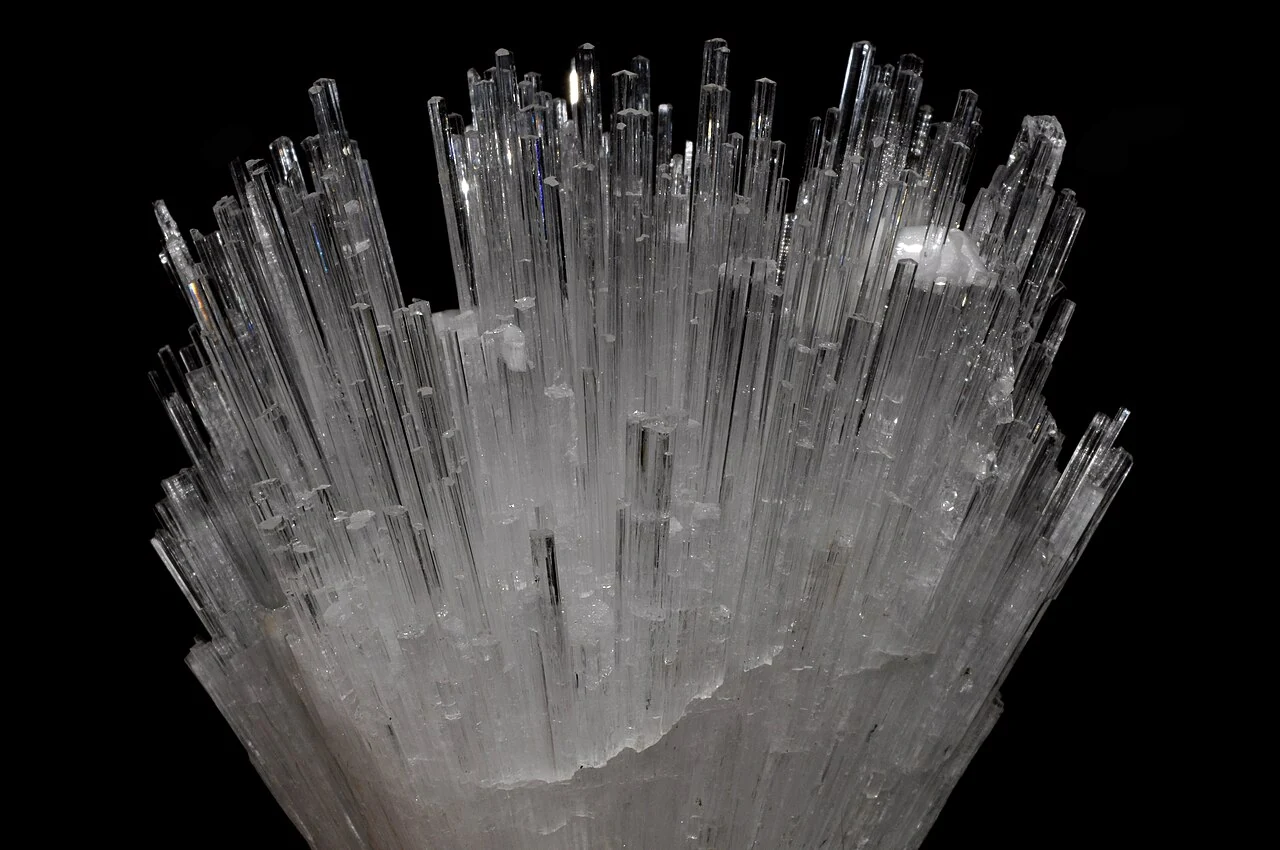
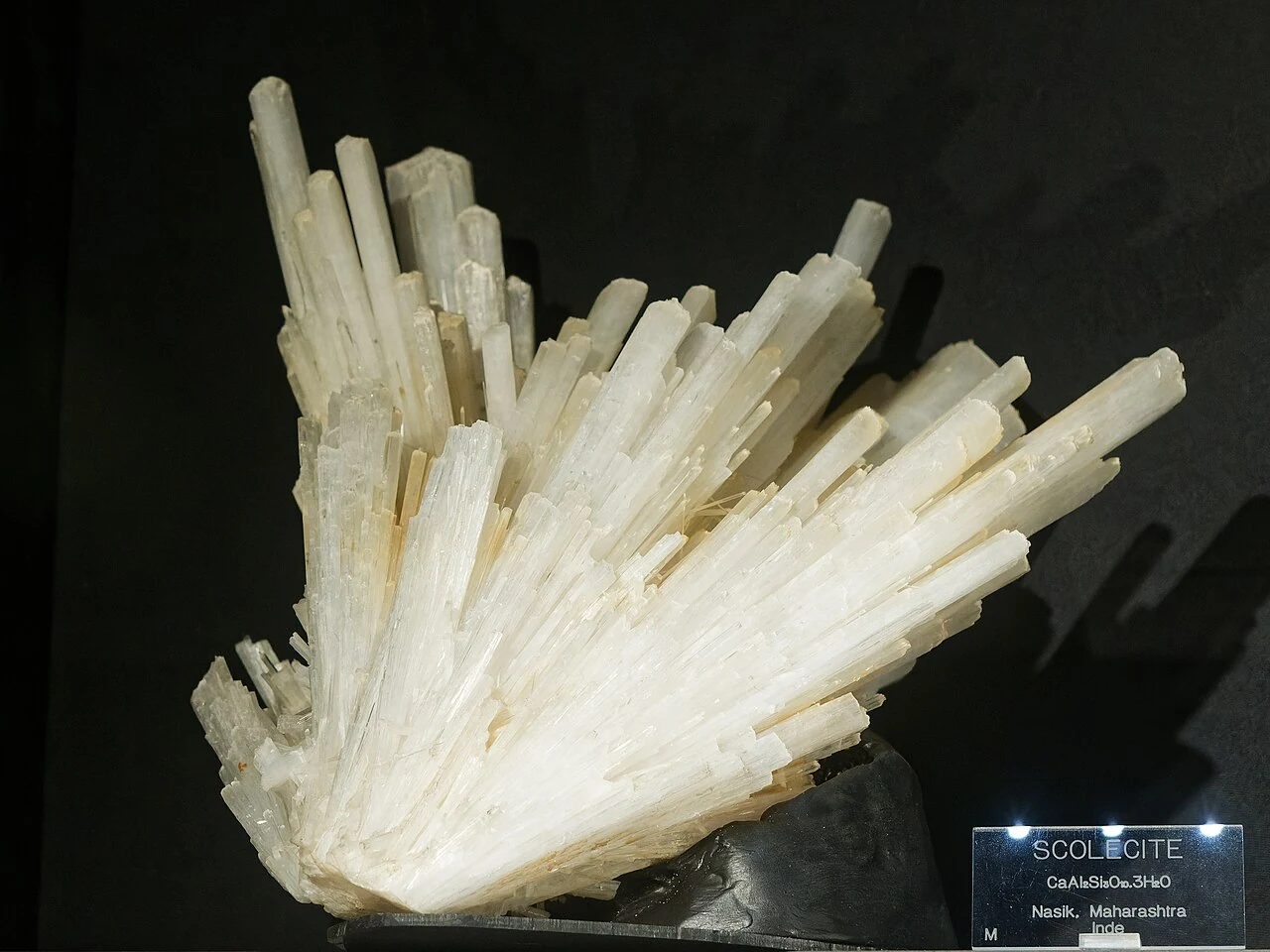
Scolecite is a hydrated calcium aluminosilicate in the zeolite group. Pale radiating sprays of slender crystals are particularly recognisable; their delicacy matters more in use than the Mohs number alone.
Scolecite: spiritual meanings, practices and correspondences in two contemporary sources. Their traditional language is presented alongside a separate original practice.
The Crystal Council links scolecite with inner quiet, dreams and spiritual development. Pale colour and radiating form become symbols in that account, rather than evidence of energy transmission. TCC recommends quiet meditation and attention to dream imagery. Its account directs attention inward, values simplicity and gently separates reflective time from daily bustle. The dream motif involves more than retaining images: in TCC’s narrative it forms part of quietly exploring one’s inner world and spiritual sensitivity. [405]
Healing Crystals develops connection, awareness and symbolic release of blockages. It lists unity, inner peace and angel communication, with the crown as its principal correspondence. Its affirmation concerns connection with different realms of the universe. Alongside TCC, a shared contemplative direction emerges, but HC stresses unity while TCC focuses on dream imagery. Fragile material can be observed on its base instead of carried. HC identifies Capricorn and the symbolic number one. Its emotional themes include teamwork, extending the meaning beyond individual meditation towards community. [442]
Correspondences in the cited source
The Crystal Council identifies the crown and third eye and the wind element. [405]
An Avonoria editorial suggestion
Editorial suggestion — not a documented rite
Original practice, “an evening margin”: leave scolecite in its display case and open a notebook. Write three short sentences: what held my attention today, what can wait, and what I will address tomorrow. For a minute, observe the arrangement of crystals from a comfortable distance. Do not place them on your face or in bed. When a new thought arrives, add it to the later list instead of acting immediately. If you keep a dream journal, record only what you remember in the morning, with a date and no obligation to interpret it. Not recalling a dream does not mean the practice failed. You may end by closing the notebook and switching off additional lighting. Scolecite becomes a signal for finishing work rather than a device controlling sleep. After several days, assess the usefulness of the routine itself.
Contemporary practices use dreams and visions as a language of experience. This card does not recommend interrupting sleep or inducing unusual states. An intention can be expressed without touching a fragile specimen, preserving both symbolism and collection safety.
Scope of the sources: The listed pages were consulted, without claiming to have read the books they cite. Correspondences document a selected contemporary current rather than a shared system for all cultures. Symbolic cleansing can consist of an intention alone, without water, salt, smoke or exposure to sunlight.
The Handbook lists cavities in basaltic rocks and other settings. Recorded occurrences include India, Iceland and Scotland.
Personal / spiritual practice
Check whether the offer shows a rough radiating specimen or a compact polished object. These involve different handling considerations. Request photographs of crystal tips, the base and any repairs. White colour alone does not distinguish zeolites. If the name comes only from automatic photograph identification, treat it as a hypothesis. For everyday display choose a sound specimen that can be viewed without constant moving. Material shedding tiny needles is unsuitable as a stone to rub in the hand.
Material-specific guidance is given under safe handling; settings and treatments need separate assessment.
Storage and specimen form
Use a separate supported compartment away from a sunny windowsill. Keep the provenance label with the object.
Lift by a sound base rather than a radiating spray. Place rough material in a closed box or display case. Do not brush fibrous aggregates or blow dust towards your face. Avoid soaking, salt and heating in rituals; this is cautious protection of a fragile object. The word “fibrous” does not automatically mean asbestos. Do not process it at home, and avoid contact with breaking needles.
Do not grind, drill or inhale dust. This card concerns intact objects; a chemical formula alone does not quantify exposure. [37]
FAQ
Does this card authenticate my specimen?
No. Request the precise name, treatment disclosure and documentation appropriate to the object’s value. Do not perform destructive home tests.
What research says — in brief
The cited clinical trial concerned rose quartz, not this atlas entry. It does not establish a therapeutic effect for this material; the symbolism is presented for understanding traditions and personal practice. [159]
ScoleciteMineral Data Publishing · accessed 2026-10-29
Mineralogical, gemological, institutional or scientific source. Its scope is recorded in the source index.
scolecite Meanings and Crystal PropertiesThe Crystal Council · accessed 2026-10-29
Commercial practitioner source: documents beliefs, not medical evidence. The site sells crystals, so we give a bibliographic description without an active link; the full address is kept in Avonoria’s source documentation.
Placebo effects in alternative medical treatments for anxiety: false hope or healing potential?Cambridge University Press / CNS Spectrums · 2025 · accessed 2026-10-29DOI: 10.1017/S1092852925100515
Mineralogical, gemological, institutional or scientific source. Its scope is recorded in the source index.
scolecite — contemporary meanings and practicesHealing Crystals · accessed 2026-10-29
Commercial practitioner source: documents beliefs, not medical evidence. The site sells crystals, so we give a bibliographic description without an active link; the full address is kept in Avonoria’s source documentation.
fluorapophylliteMineral Data Publishing · accessed 2026-10-29
Mineralogical, gemological, institutional or scientific source. Its scope is recorded in the source index.