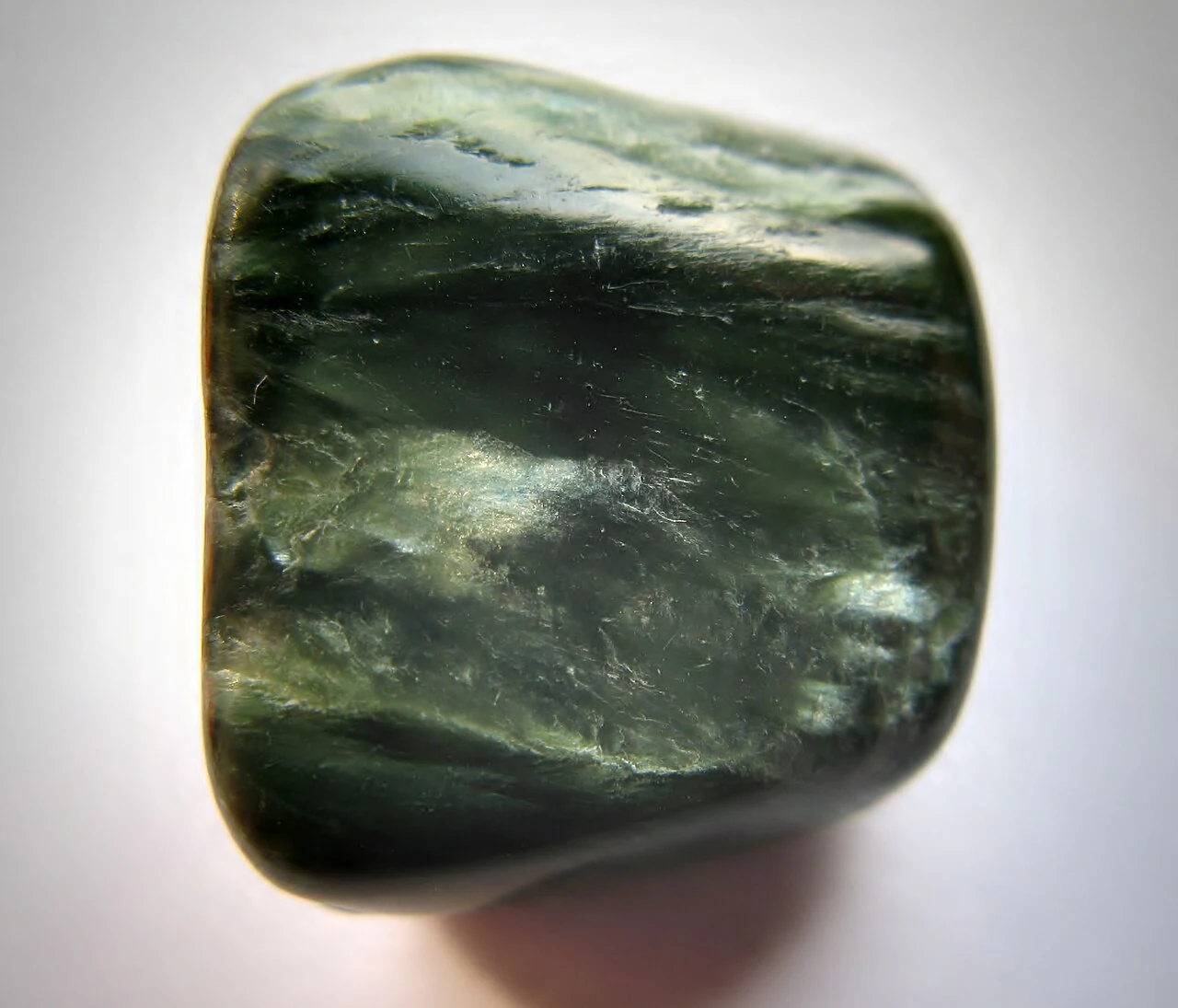
Seraphinite is a trade name for ornamental clinochlore in the chlorite group. Green colour and pale feathery reflections are compared to wings; this is a visual resemblance rather than a separate mineral composition.
Seraphinite: spiritual meanings, practices and correspondences in two contemporary sources. Their traditional language is presented alongside a separate original practice.
The Crystal Council describes seraphinite through self-reflection, self-trust and new beginnings. The author links spiritual growth with examining everyday activities, surroundings and interests. A separate practice uses closed eyes and imagined emerald light, symbolically organising the whole chakra system. Regular ritual cleansing is also recommended, even when the stone is merely worn. These are distinct parts of one contemporary approach: recognising a life direction, visualising inner balance and renewing a relationship with a talisman. Light here describes imagery rather than measurable mineral radiation. [425]
Healing Crystals develops a relationship with seraphim and imagery of angelic protection. Meditation concerns one’s place and purpose, including time in nature; the author uses the concept of a devic realm. The heart is principal, with crown and third eye secondary. TCC lists all main chakras, so the maps differ. Both use imagery of gentle spiritual presence and personal work. Nature provides HC with a concrete setting for contemplation. The devic realm belongs to the author’s spiritual imagination rather than mineral identification. [451]
Correspondences in the cited source
The Crystal Council’s list includes the seven main chakras and the earth and storm elements. [425]
An Avonoria editorial suggestion
Editorial suggestion — not a documented rite
Original practice, “a kind witness”: place seraphinite in its box and write a short account of a situation in which you judge yourself harshly. Then write the response you would give someone close to you in similar circumstances. Use concrete facts rather than empty reassurance. The stone’s pale pattern can be a personal sign of a gentler view; it need not imply that a supernatural being is present. If angelic symbolism belongs to your spirituality, retain it as a language of care. Choose one correction or apology that is genuinely needed and one thing for which you need not punish yourself. End by keeping the note in your own journal. Do not make the stone responsible for removing difficult memories. Accountability and kindness towards yourself can coexist.
The seven chakras here belong to the cited publisher’s system, not an analysis of radiation from the specimen. A ritual can remain quiet and symbolic, without smoke, scattered salt or washing after every use. For a soft material in particular, restrained care has practical value.
Scope of the sources: The listed pages were consulted, without claiming to have read the books they cite. Correspondences document a selected contemporary current rather than a shared system for all cultures. Symbolic cleansing can consist of an intention alone, without water, salt, smoke or exposure to sunlight.
Clinochlore is soft, with hardness 2–2.5 and perfect cleavage. GIA confirmed clinochlore in examined stones sold as “seraphinite”; one was wax treated. [408][416]
Clinochlore can form through hydrothermal alteration of other silicates. Not every occurrence has the decorative feathery appearance.
Material facts
GIA examined particular specimens, so its article does not authenticate every modern object. [416]
Personal / spiritual practice
Ask about impregnation or wax treatment and examine the surface under several lighting directions. Reflections may change as it turns; one attractive photograph does not represent the stone’s whole appearance. For jewellery, consider a protective setting and how it will be used. Seraphinite is not green jade merely because a polished object has a similar shape.
Material-specific guidance is given under safe handling; settings and treatments need separate assessment.
Storage and specimen form
Use a separate supported compartment away from a sunny windowsill. Keep the provenance label with the object.
Soft clinochlore needs protection from abrasion and impacts. Do not carry it loose in a pouch with hard pebbles. Use a very soft dry cloth without abrasive polish; do not remove wax yourself with solvent. We do not recommend soaking, salt, steam, ultrasonic cleaning or heating. Any coating needs assessment separately from the mineral’s own properties. If the surface starts separating into layers, limit handling and seek advice on protection.
Do not grind, drill or inhale dust. This card concerns intact objects; a chemical formula alone does not quantify exposure. [37]
FAQ
Does this card authenticate my specimen?
No. Request the precise name, treatment disclosure and documentation appropriate to the object’s value. Do not perform destructive home tests.
What research says — in brief
The cited clinical trial concerned rose quartz, not this atlas entry. It does not establish a therapeutic effect for this material; the symbolism is presented for understanding traditions and personal practice. [159]
clinochloreMineral Data Publishing · accessed 2026-10-29
Mineralogical, gemological, institutional or scientific source. Its scope is recorded in the source index.
seraphinite Meanings and Crystal PropertiesThe Crystal Council · accessed 2026-10-29
Commercial practitioner source: documents beliefs, not medical evidence. The site sells crystals, so we give a bibliographic description without an active link; the full address is kept in Avonoria’s source documentation.
Chatoyant clinochlore from Russia; Gem News, Summer 1996Gemological Institute of America · 1996 · accessed 2026-10-29
Mineralogical, gemological, institutional or scientific source. Its scope is recorded in the source index.
Placebo effects in alternative medical treatments for anxiety: false hope or healing potential?Cambridge University Press / CNS Spectrums · 2025 · accessed 2026-10-29DOI: 10.1017/S1092852925100515
Mineralogical, gemological, institutional or scientific source. Its scope is recorded in the source index.
seraphinite — contemporary meanings and practicesHealing Crystals · accessed 2026-10-29
Commercial practitioner source: documents beliefs, not medical evidence. The site sells crystals, so we give a bibliographic description without an active link; the full address is kept in Avonoria’s source documentation.
muscoviteMineral Data Publishing · accessed 2026-10-29
Mineralogical, gemological, institutional or scientific source. Its scope is recorded in the source index.
Unusual Faceted Massive FuchsiteGemological Institute of America · 2013 · accessed 2026-10-29
Mineralogical, gemological, institutional or scientific source. Its scope is recorded in the source index.