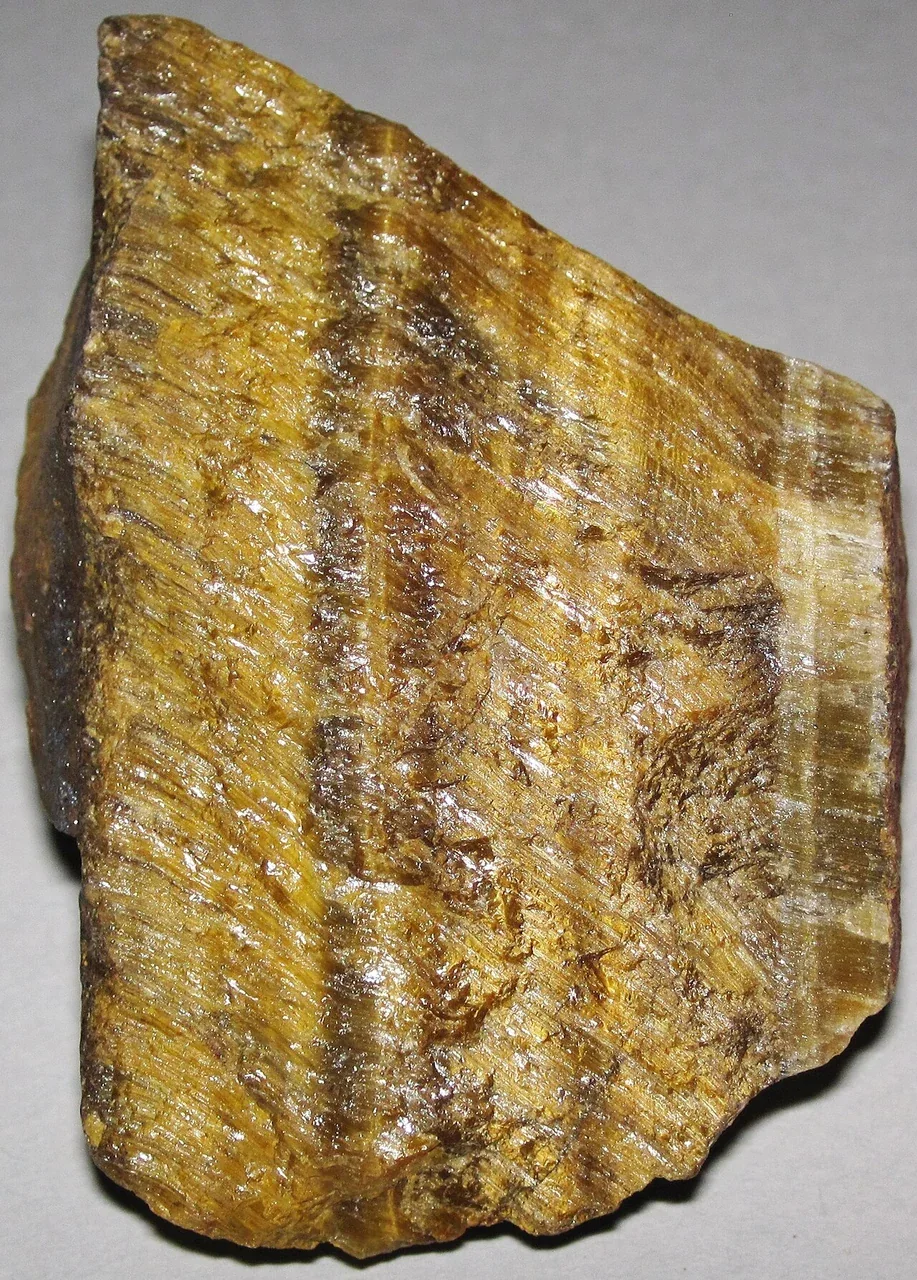
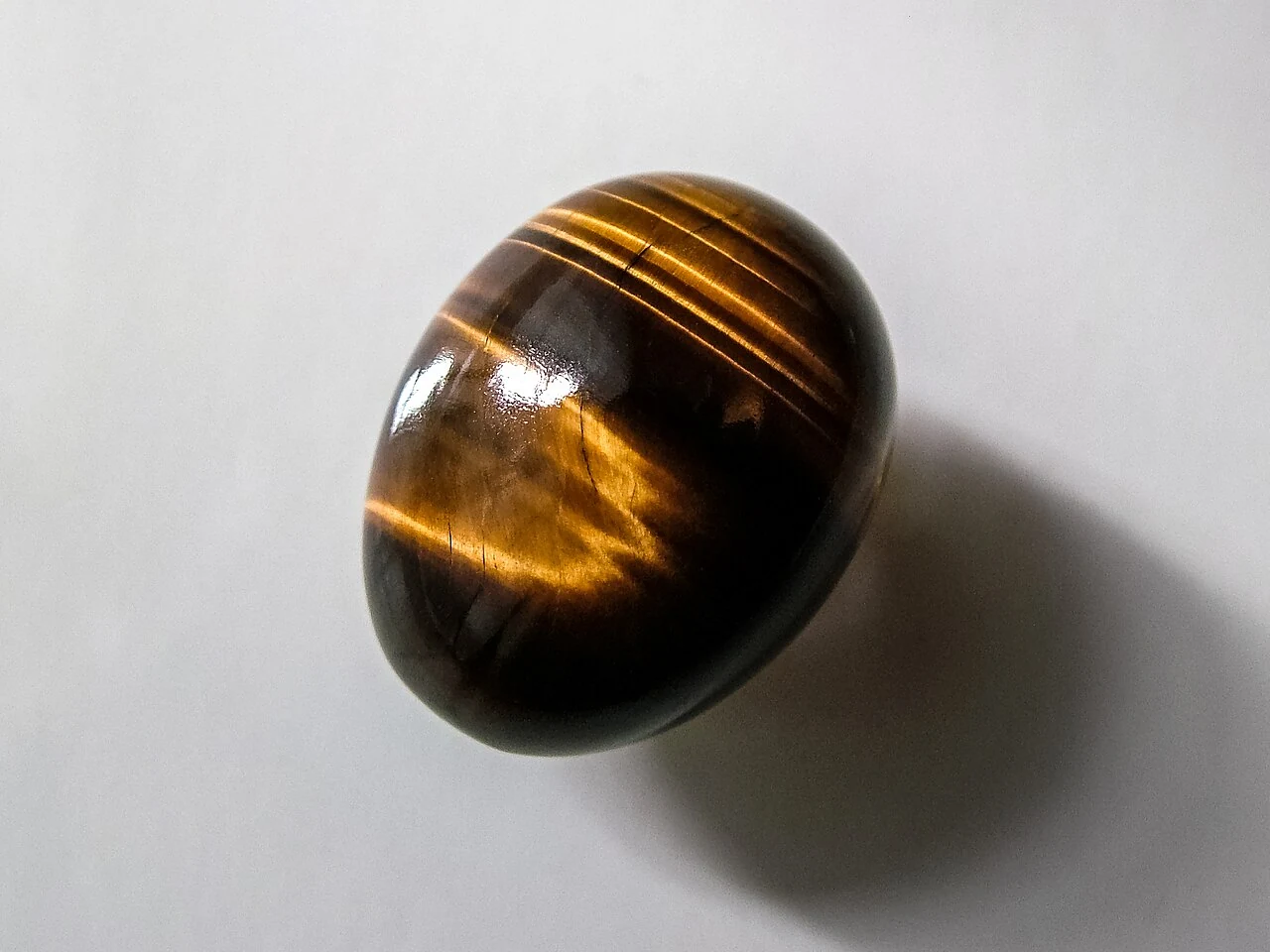
Tiger’s eye is recognised by a moving band of light against a golden-brown background. It is a quartz aggregate with an oriented structure, not a single eye-shaped crystal. The optical effect is a physical feature; its attributed protection belongs to a different layer of description.
The Crystal Council presents tiger's eye through personal will, focus and creative courage. The solar plexus anchors these associations, while recognising one's capabilities and taking on new tasks form the central theme. The website describes morning or evening meditation with the stone held in the hand and speaking ideas or desires aloud. It also mentions combinations with citrine, pyrite and orange calcite for creative practice. Its account therefore emphasises turning intention into action and maintaining attention on a chosen goal. [181]
A second account and differences of emphasis
Crystal Vaults emphasises balancing extremes, practical judgement and responsible use of power. It brings solar and earthy motifs together with thoughtful, compassionate decision-making. Its inner-vision image concerns recognising causes and consequences, rather than simply wanting an outcome intensely. The Crystal Council gives more prominence to speaking an intention and creative initiative. The comparison shows two complementary interpretations: concentrating on a goal and considering the consequences of action. In both cases, the eye motif belongs to symbolic language. [217]
The moving reflection can serve as a metaphor for changing perspective. In our interpretation, courageous action goes together with checking facts and considering consequences. Examine several possibilities before selecting one. The stone can provide a focus during that reflection.
Set the stone on a table without bringing it close to your eyes. Observe its reflection from two angles and write two possible interpretations of a difficult situation. Beside each, note a supporting fact and a missing piece of information. Finish by choosing one conversation or check that could inform your decision. If the reflection distracts you, turn the stone over: the exercise concerns consideration, not reaching a special state.
Do not rush a decision simply because the stone's motif suggests courage. If information is still missing, leave the matter open and return to your note after checking it.
Scope of the sources: The correspondences above document contemporary practitioner approaches. The practice is original, not a reconstructed historical rite. Choose only a meaning that suits you. Returning the stone to a clean stand can mark a symbolic ending; physical cleaning is covered separately in the card.
Slowly changing the angle of ordinary light reveals a silky reflection. Its movement alone does not identify the material: fibre-optic glass can also imitate a cat's eye. [170]
Reference properties
A photograph and trade name cannot establish a particular specimen's composition, treatment or origin. Observe in ordinary light; do not use flame, acid or scratching tests.
Compact quartz material with a directional texture. [170]
Common lookalikes and imitations
Fibre-optic glass
Why it looks similar
It can produce a moving band of light.
What can help distinguish it
GIA describes glass imitations of chatoyant gems. Colour uniformity is insufficient for diagnosis; gemmological testing separates the optical effect from material identity.
What a photograph cannot establish
A photograph and trade name cannot establish a particular specimen's composition, treatment or origin. Observe in ordinary light; do not use flame, acid or scratching tests.
GIA's 2025 review links the effect to fibrous amphibole inclusions and their alteration products within quartz. It discusses simultaneous growth, differing from simple fibre replacement. We therefore do not repeat the popular explanation that all asbestos has invariably been replaced. [170]
Editorial suggestion — not a documented rite
Choose a finished, intact specimen with stated identity and provenance. Do not buy fibrous offcuts for home polishing. Ask the seller to distinguish tiger’s eye from dyed products and glass. Directional-light photography helps assess the effect, but cannot certify composition.
Because fibrous inclusions may be present, do not cut, drill or abrade this material. Use only an intact, smooth specimen; put damaged or dusty material in a closed container. A dry cloth is a cautious choice. Do not prepare elixirs or perform acid tests.
Storage and specimen form
Store separately in soft wrapping, away from heaters and windowsills. Do not use salt or prolonged soaking as a universal care method.
Store securely, protect sharp edges and check settings. Do not place stones in the mouth.
The material can contain fibrous amphiboles; do not grind, drill or crush it. For practice, select intact, stable specimens without shedding fibres. [37]
FAQ
Does a smooth specimen involve the same exposure as dust?
No. Exposure route matters. This card does not assess a particular specimen or quantify fibres; it limits the practice to an intact object and excludes home processing.
What research says — in brief
The cited clinical trial concerned rose quartz, not this atlas entry. It does not establish a therapeutic effect for this material; the symbolism is presented for understanding traditions and personal practice. [159]
Structures Behind the Spectacle: A Review of Optical Effects in Phenomenal Gemstones and Their Underlying NanotexturesGIA · 2025 · accessed 2026-10-29
Mineralogical, gemological, institutional or scientific source. Its scope is recorded in the source index.
QuartzHandbook of Mineralogy · accessed 2026-10-29
Mineralogical, gemological, institutional or scientific source. Its scope is recorded in the source index.
Tiger Eye Meaning and Crystal PropertiesThe Crystal Council · accessed 2026-10-29
Commercial practitioner source: documents beliefs, not medical evidence. The site sells crystals, so we give a bibliographic description without an active link; the full address is kept in Avonoria’s source documentation.
Placebo effects in alternative medical treatments for anxiety: false hope or healing potential?Cambridge University Press / CNS Spectrums · 2025 · accessed 2026-10-29DOI: 10.1017/S1092852925100515
Mineralogical, gemological, institutional or scientific source. Its scope is recorded in the source index.
tigers-eye Meanings and UsesCrystal Vaults · accessed 2026-10-29
Commercial practitioner source: documents beliefs, not medical evidence. The site sells crystals, so we give a bibliographic description without an active link; the full address is kept in Avonoria’s source documentation.