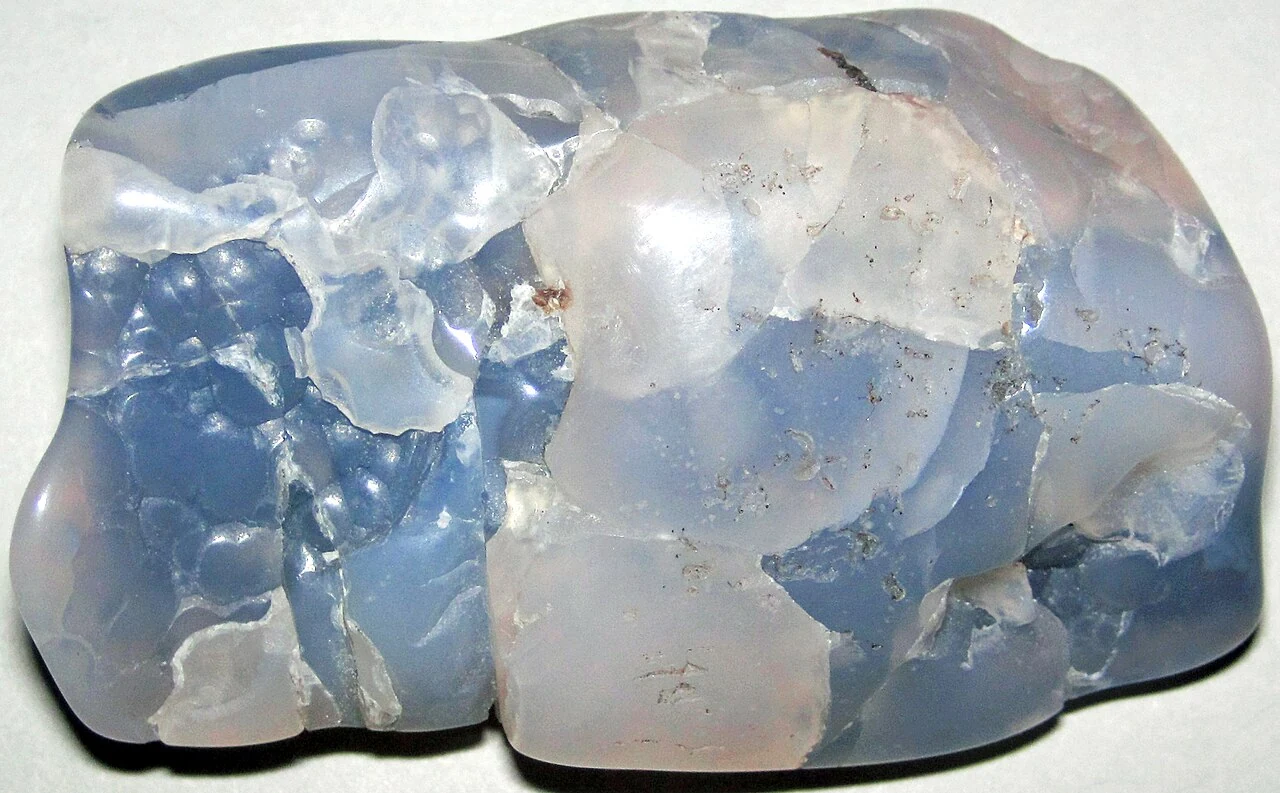
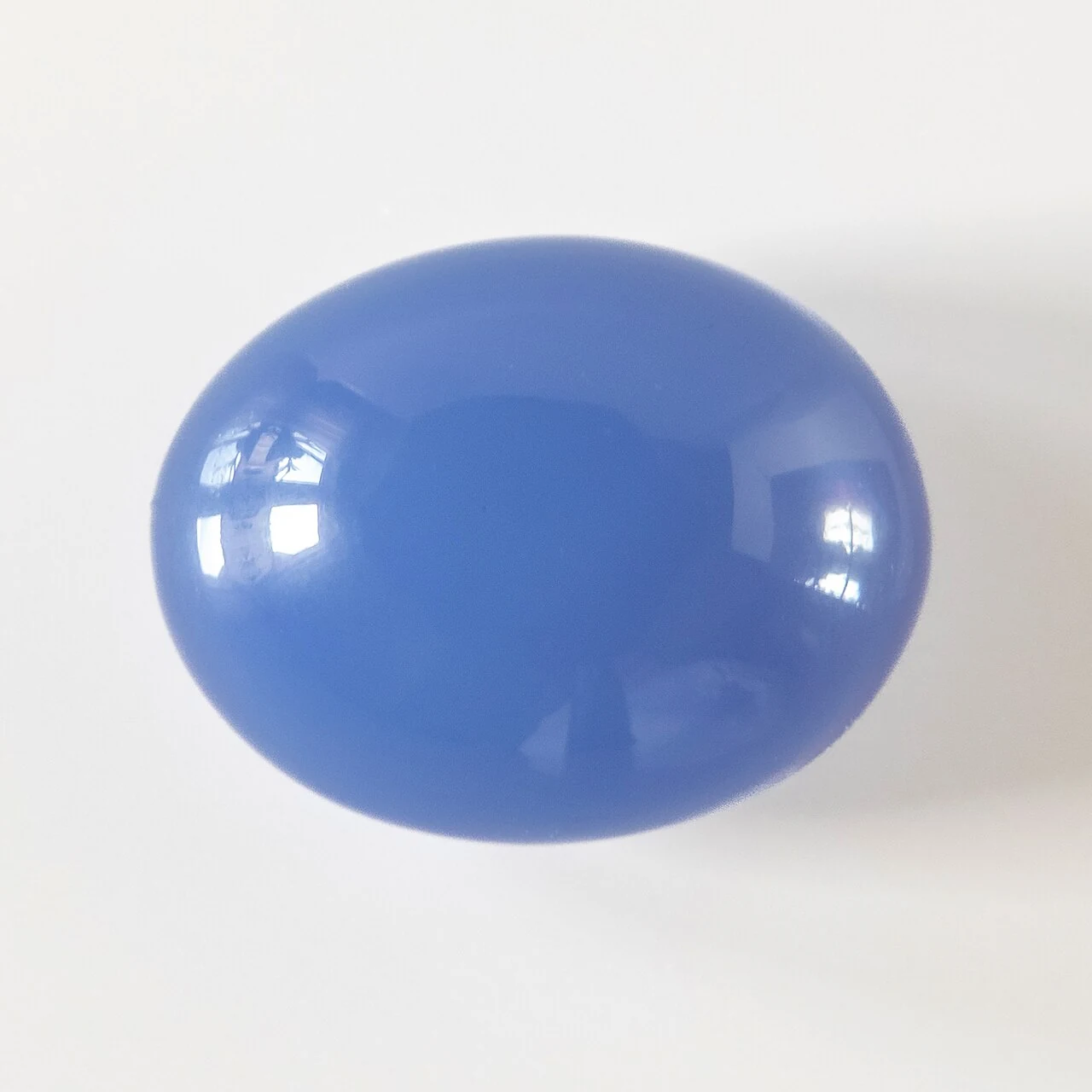
Blue chalcedony is a recognised gem variety, not an additional mineral species. In this series its relatively even colour is distinguished from the lace-like bands of blue lace agate. The name describes a material choice rather than another type of chemical energy.
The Crystal Council connects blue chalcedony with calm communication, honest self-expression and greater ease in speaking. The heart, throat and third eye organise its map: feeling finds words, while reflection helps choose them. The author presents the stone as a companion to conversation and public speaking, especially when a gentle but distinct voice is wanted. Contemporary blue symbolism emphasises composure and room for reflection. Practice centres on bringing speech into agreement with personal intention and becoming willing to share it. [350]
A second author and the context of correspondences
Crystal Vaults presents blue chalcedony as a speaker’s stone for weighing words before speaking. It links the material with reflection, patience and readiness to act after consideration. Pale blue becomes an image of trust and calmly examining one’s life. Meditation is described through gazing at the stone and listening to inner wisdom. TCC gives greater emphasis to emotional expression, while CV emphasises measured speech. Together these themes portray communication as speaking, pausing and choosing attentively. [351]
An Avonoria editorial suggestion
Editorial suggestion — not a documented rite
Original Avonoria interpretation. Blue chalcedony can remind us of the pace of speech. Before replying, we suggest a short pause and choosing the most important sentence. This interpretation of voice symbolism leaves room for clear speech and attentive listening.
Exercise. Place a polished stone beside a notebook and prepare one short statement you would like to make in a meeting. Read it once at your usual pace and again with a natural pause before the request. Notice clarity rather than unusual sensations. Write down the version that best conveys your intention. Afterwards the stone can serve as a discreet reminder to pause; it need not be worn at the throat.
Returning to everyday life. Before a conversation, recall the chosen pause. Afterwards, note whether the statement was clear and what the reply contributed. Communication then becomes a concrete practice that can gradually develop.
Scope of the sources: We do not adopt the practitioner website’s claim that all current supply comes from one region of Turkey. This entry excludes the separately catalogued blue lace agate.
Fine-grained material without visible individual crystals; in trade, chalcedony often denotes comparatively uniform colour. [349]
Reference properties
View under neutral lighting and compare existing surfaces only. Hardness and streak below are reference data: do not scratch, break, heat or grind the specimen. Ask a specialist to examine valuable or unidentified materials.
Mohs hardness
Crystal system
Not applicable / not a single crystal
Material property
Fine-grained material without visible individual crystals; in trade, chalcedony often denotes comparatively uniform colour. [349]
Typical material forms
Fine-grained aggregates rather than large single crystals. [387]
Common lookalikes and imitations
Dyed howlite
Why it looks similar
Both materials can appear as blue beads.
What can help distinguish it
A blue item may be dyed howlite. Chalcedony is silica-based and howlite is a borate; a bead's colour and pattern do not replace identification.
What a photograph cannot establish
A photograph does not establish composition, treatment or the provenance of an individual specimen.
Chalcedony is microcrystalline silica; the reference establishes no single origin for the whole blue category.
Very fine-grained quartz material; this card covers blue material without prominent lace-like banding. [349]
Material facts
Chalcedony forms fine-grained silica aggregates. We do not assign every blue specimen to one deposit or country. [387]
Personal / spiritual practice
Ask about dyeing and whether the exact photographed specimen is being sold. Blue colour alone does not identify chalcedony. Examine bead holes and surfaces, or a pendant’s mounting. A poetic name does not replace a material description. If an unbanded appearance matters, state that preference rather than expecting every commercial use of chalcedony to be identical.
For unknown treatments, choose a soft dry cloth. Avoid salt, thermal shocks, steam and ultrasonics; care must also suit the setting. Do not put the stone in drinking water or reduce it to powder. Symbolic cleansing can be replaced by calmly returning it to a separate pouch.
Storage and specimen form
A separate, stable labelled container; protect against falls and access by children or pets.
Care is a precautionary editorial policy for an intact specimen with unconfirmed treatment. Wash hands after handling rough material; do not perform scratch, heat or acid tests.
Do not grind or drill at home. Dust is a different exposure route from handling an intact specimen. [37]
FAQ
How does blue chalcedony differ from blue lace agate?
This entry concerns material without the distinct banded structure of agate. Blue lace agate has its own entry. Ask about dyeing too, because a colour name does not disclose treatment.
What research says — in brief
The cited clinical trial concerned rose quartz, not this atlas entry. It does not establish a therapeutic effect for this material; the symbolism is presented for understanding traditions and personal practice. [159]
Buying Guide: Get to Know the Different Types of ChalcedonyGem-A · accessed 2026-10-29
Mineralogical, gemological, institutional or scientific source. Its scope is recorded in the source index.
Blue chalcedony Meanings and Crystal PropertiesThe Crystal Council · accessed 2026-10-29
Commercial practitioner source: documents beliefs, not medical evidence. The site sells crystals, so we give a bibliographic description without an active link; the full address is kept in Avonoria’s source documentation.
Turquoise buying guideGemological Institute of America · accessed 2026-10-29
Mineralogical, gemological, institutional or scientific source. Its scope is recorded in the source index.
Placebo effects in alternative medical treatments for anxiety: false hope or healing potential?Cambridge University Press / CNS Spectrums · 2025 · accessed 2026-10-29DOI: 10.1017/S1092852925100515
Mineralogical, gemological, institutional or scientific source. Its scope is recorded in the source index.
Handbook of Mineralogy: quartzMineral Data Publishing · 2001 · accessed 2026-10-29
Mineralogical, gemological, institutional or scientific source. Its scope is recorded in the source index.
Blue chalcedony — second practitioner accountCrystal Vaults · accessed 2026-10-29
Commercial practitioner source: documents beliefs, not medical evidence. The site sells crystals, so we give a bibliographic description without an active link; the full address is kept in Avonoria’s source documentation.