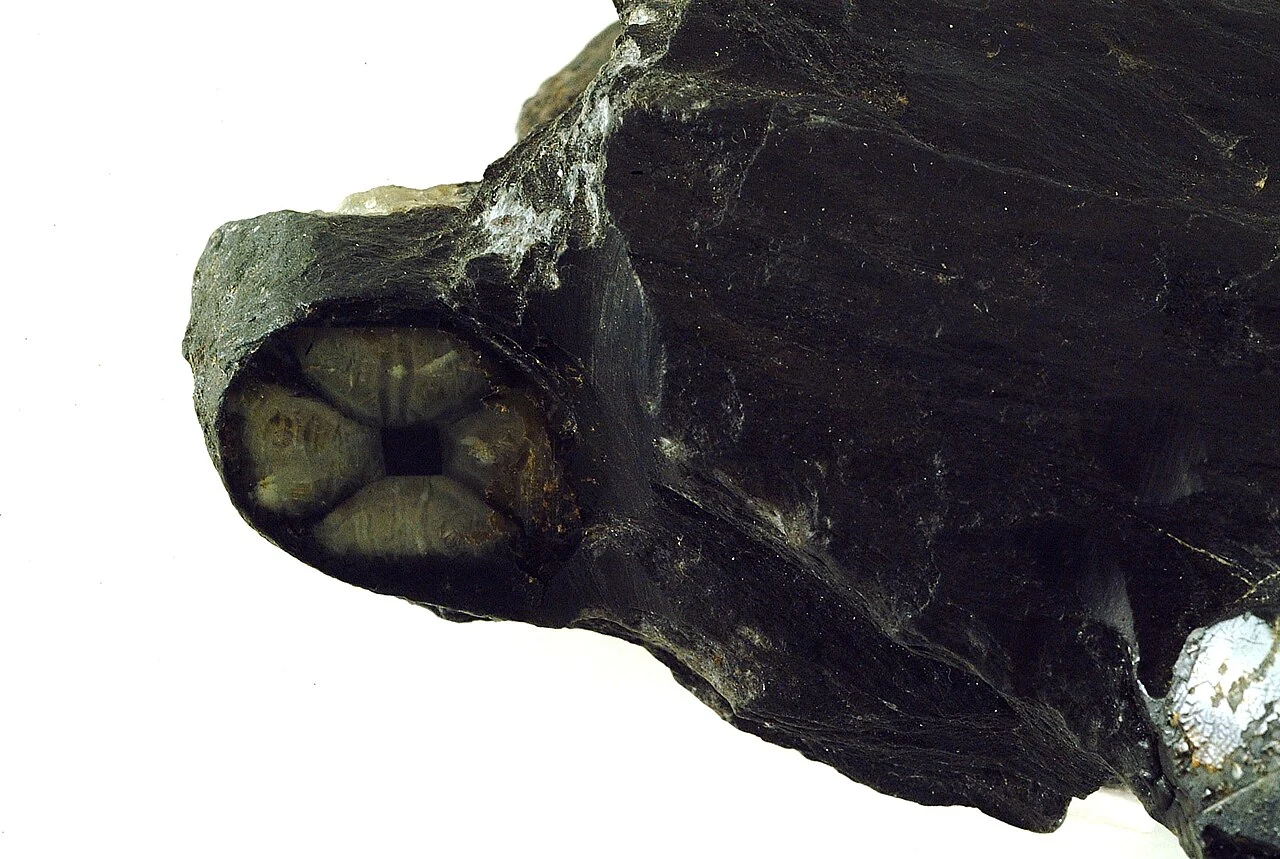
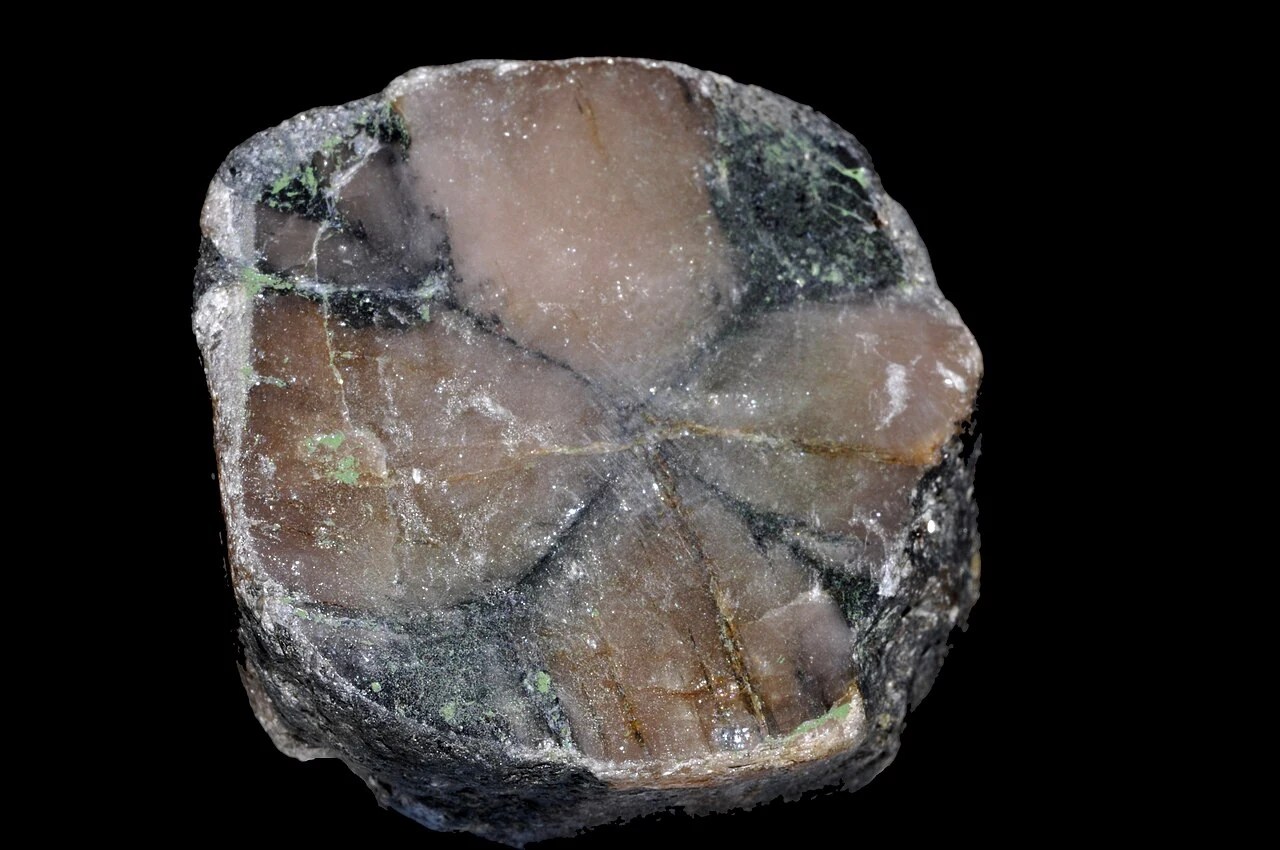
Chiastolite is an andalusite variety with dark inclusions forming a cross in section. GIA also describes polished spheres displaying this pattern. The cross consists of inclusions within the material, not two intersecting crystals.
Chiastolite’s visible cross can become a personal symbol of support. Two contemporary accounts lead from connection with the earth towards harmony in one’s surroundings.
Lithotherapy tradition
The authors’ meanings and correspondences are presented in the full lithotherapy extension. [298][299]
Meaning in lithotherapy
The Crystal Council presents chiastolite as a talisman of protection, rootedness in Mother Earth and self-discovery. It associates it with inward peace and symbolic shielding of the aura. In this contemporary account, the cross becomes a way to discuss support and personal growth; readers can explore these meanings as practitioner language. The author describes carrying the talisman as a way to maintain that intention in daily life. Protection and self-knowledge are connected themes rather than merely decorative interpretations of shape. [298]
Correspondences and differences
TCC names root; the individual HC page labels sacral. Catalogue associations can vary. [298][299]
A second contemporary approach
Healing Crystals emphasises harmony in the home. Its contemporary sequence moves from choosing a reflective moment through holding or carrying the stone and affirmation to returning it to a chosen space. Compared with TCC, attention shifts from personal rootedness towards home and everyday relationships. The source affirmation concerns both household members and visitors, taking symbolism beyond solitary meditation. Here it invites reflection on the quality of shared space. [299]
An Avonoria editorial suggestion
Editorial suggestion — not a documented rite
Original practice: four places of support. Lay chiastolite flat and observe its pattern without needing to touch it. Draw a cross on another sheet and write four things around it that help you feel at home: a person, place, activity and small object. They need not be exceptional. A kitchen table, familiar walking route or regular conversation are enough. Add one concrete memory from recent days beside each word. Notice whether one space fills more easily than the others. Do not treat this as a diagnosis; leave a space blank and return later if you wish. Choose one way to care for a source of support: tidying a small area, making time for a favourite activity or arranging a meeting. Then put the stone away and make that gesture at a convenient time. The cross simply organises the page without imposing a religious interpretation. At the end of the week, revisit the note and change the words if appropriate. The drawing alone also works; neither a perfect natural cross nor an expensive setting is needed.
Scope of the sources: You can describe your own sensations as personal experience. The exercise does not require accepting every belief in both catalogues; choose meanings you understand and leave room to revise your interpretation.
Chiastolite is an andalusite variety with dark inclusions forming a cross in section. GIA also describes polished spheres displaying this pattern. The cross consists of inclusions within the material, not two intersecting crystals. [296][297]
Reference properties
Observe existing surfaces in neutral light. Mohs values are not instructions to scratch, break or heat.
The andalusite host has hardness 6.5–7.5 and a good cleavage direction. Cross patterns vary in thickness and regularity; their symmetry is not a scale of spiritual quality. [296][297]
Typical material forms
Andalusite crystals with cross-shaped dark inclusions visible in section; the spheres discussed by GIA are fashioned objects. [296][297]
Common lookalikes and imitations
Staurolite
Why it looks similar
Both names may be associated with a cross pattern.
What can help distinguish it
Chiastolite displays an inclusion cross; staurolite may form cross-shaped crystal twins.
What a photograph cannot establish
A photograph does not establish composition, hardness or treatment.
Andalusite occurs notably in metamorphosed clay-rich sediments. Chiastolite remains a variety, not a separate species with extra elements in its ideal formula. Inclusions and possible alteration in a particular specimen require separate description. [296][297]
Editorial suggestion — not a documented rite
Examine both sides of the item and ask about repairs. Request a precise material name alongside the trade name and keep provenance with its documentation. Choose a pattern that appeals to you.
Personal / spiritual practice
You can describe your own sensations as personal experience. The exercise does not require accepting every belief in both catalogues; choose meanings you understand and leave room to revise your interpretation.
For a specimen with unidentified inclusions or repairs, use a soft dry cloth on its smooth surface. Avoid salt baths, heating, abrasion and breakage tests. Missing data does not mean every chiastolite withstands every treatment.
Storage and specimen form
Store separately on a stable surface away from strong heat and falls.
For a specimen with unidentified inclusions or repairs, use a soft dry cloth on its smooth surface. Avoid salt baths, heating, abrasion and breakage tests. Missing data does not mean every chiastolite withstands every treatment.
Do not grind, drill or break the specimen at home. Dust requires a separate exposure assessment. [37]
FAQ
What should I know before choosing?
Chiastolite displays an inclusion cross in andalusite, while staurolite may form cross-shaped twins. They are different materials despite potentially similar common names.
What research says — in brief
The cited clinical trial concerned rose quartz, not this atlas entry. It does not establish a therapeutic effect for this material; the symbolism is presented for understanding traditions and personal practice. [159]
AndalusiteMineral Data Publishing / Handbook of Mineralogy · accessed 2026-10-29
Mineralogical, gemological, institutional or scientific source. Its scope is recorded in the source index.
Gem News: Andalusite (chiastolite) sphereGemological Institute of America · 1998 · accessed 2026-10-29
Mineralogical, gemological, institutional or scientific source. Its scope is recorded in the source index.
chiastolite — Meanings and Crystal PropertiesThe Crystal Council · accessed 2026-10-29
Commercial practitioner source: documents beliefs, not medical evidence. The site sells crystals, so we give a bibliographic description without an active link; the full address is kept in Avonoria’s source documentation.
ChiastoliteHealing Crystals · accessed 2026-10-29
Commercial practitioner source: documents beliefs, not medical evidence. The site sells crystals, so we give a bibliographic description without an active link; the full address is kept in Avonoria’s source documentation.
StauroliteMineral Data Publishing / Handbook of Mineralogy · accessed 2026-10-29
Mineralogical, gemological, institutional or scientific source. Its scope is recorded in the source index.
Placebo effects in alternative medical treatments for anxiety: false hope or healing potential?Cambridge University Press / CNS Spectrums · 2025 · accessed 2026-10-29DOI: 10.1017/S1092852925100515
Mineralogical, gemological, institutional or scientific source. Its scope is recorded in the source index.