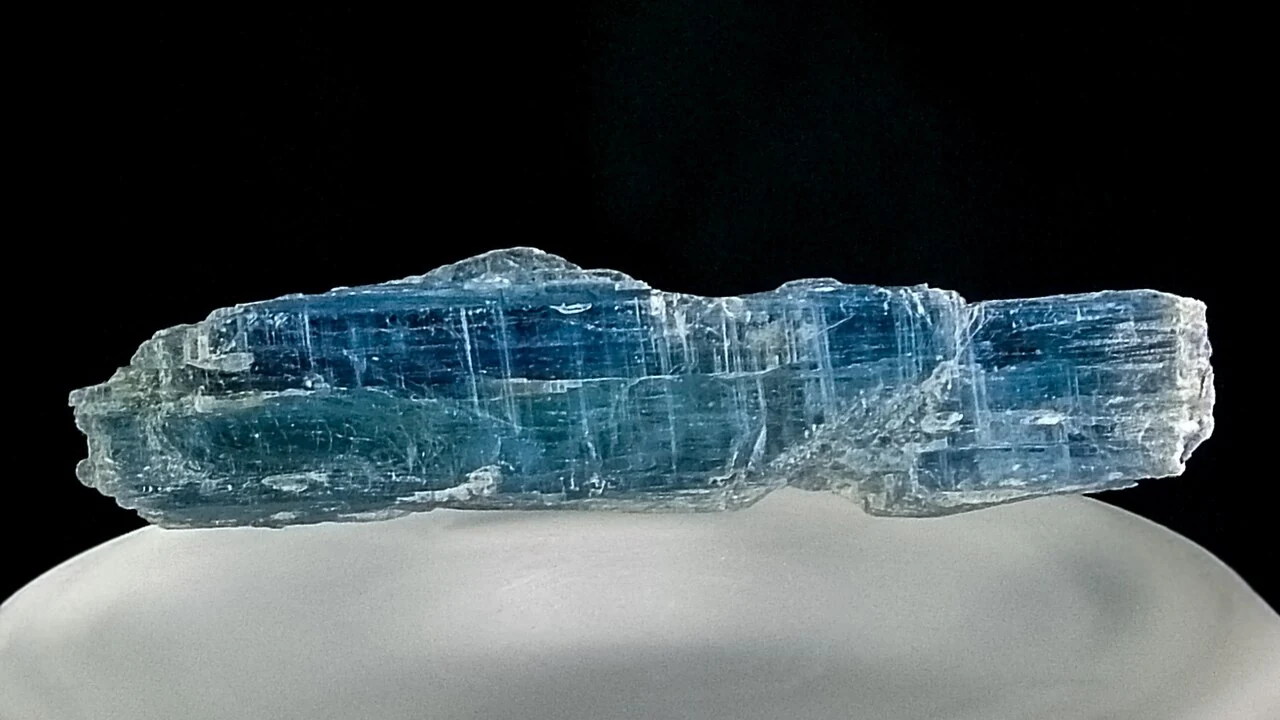
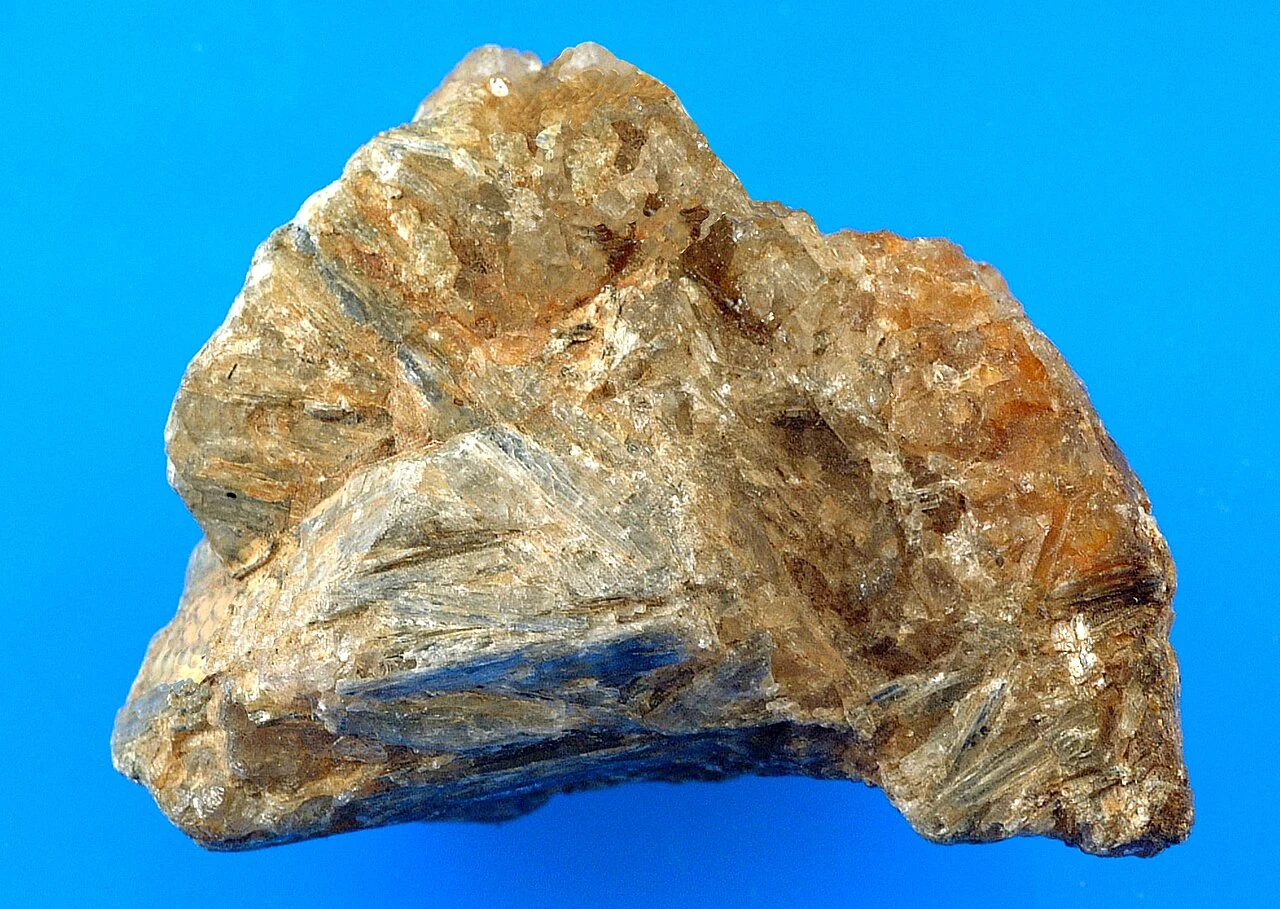
Kyanite, also called disthene, is an aluminium silicate often forming elongated bladed crystals. Blue is its best-known colour, but colour alone does not define the species. Disthene and kyanite are two names for this one atlas entry, not two additional stones.
Blue kyanite appears in accounts of intuition and communication between people. The comparison below presents both contemporary emphases.
Lithotherapy tradition
The authors’ meanings and correspondences are presented in the full lithotherapy extension. [273][274]
Meaning in lithotherapy
The Crystal Council describes blue kyanite as a stone of intuitive insight and dream work, mentioning the third eye and crown. This is a particular contemporary account of blue material, not a source for every colour variety. Messages from spirit guides remain the author’s beliefs rather than a method for establishing facts. In this account, dreams and personal imagery provide material for contemplation. The author encourages attentive contact with one’s inner world and naming the impressions that arise there. [273]
Correspondences and differences
Third eye and crown in the cited account of blue kyanite. This entry does not automatically assign the same set to green or orange specimens. [273][274]
A second contemporary approach
Crystal Vaults uses the image of a bridge between people, especially in conversations and disagreements. It also says kyanite retains no ‘negative energy’ and needs no energetic cleansing. This is a rule within that belief system, not a reason to neglect physical cleanliness. TCC places more emphasis on dreams and intuitive insight. For practitioners, this image offers a search for shared language despite differing beliefs. The source names fair treatment and loyalty as accompanying themes. [274]
An Avonoria editorial suggestion
Editorial suggestion — not a documented rite
An original journal practice: place kyanite securely beside your writing space. In the morning, note a remembered dream if you have one, separating dream imagery from events that actually occurred. Ask what feelings an image evokes without treating it as prediction. Do not put a cleavable crystal under a pillow or on a sleeping person’s forehead. After several days, compare your own notes: the focus is on the language of association and how it changes, not a supposed mineral frequency. If no dream is remembered, one quiet observation of the morning is enough. If the subject is a conversation, also prepare one open question whose answer you do not know. Allow for the other person to describe events differently. Kyanite may symbolise a bridge, but a bridge allows movement both ways. Do not use symbolism to convince someone that you know their ‘true energy’. Put the delicate specimen away before returning to other activities at the desk.
Scope of the sources: You can describe your own sensations as personal experience. The exercise does not require accepting every belief in both catalogues; choose meanings you understand and leave room to revise your interpretation.
Kyanite, also called disthene, is an aluminium silicate often forming elongated bladed crystals. Blue is its best-known colour, but colour alone does not define the species. Disthene and kyanite are two names for this one atlas entry, not two additional stones. [272]
Reference properties
Observe existing surfaces in neutral light. Mohs values are not instructions to scratch, break or heat.
Hardness is directional: the Handbook gives 5.5 parallel to [001] and 7 parallel to [100]. Perfect cleavage and splintery fracture call for care with blades. [272]
Typical material forms
Elongated bladed crystals and their aggregates. [272]
Common lookalikes and imitations
Iolite
Why it looks similar
Blue materials may look similar after fashioning.
What can help distinguish it
Kyanite hardness depends strongly on direction, while iolite identifies cordierite. These are reference data, not scratching instructions.
What a photograph cannot establish
A photograph does not establish composition, hardness or treatment.
The Handbook associates kyanite with regional metamorphism of clay-rich rocks at relatively high pressure. It occurs in schists and gneisses. It has the same ideal composition as andalusite and sillimanite but a different crystal structure. [272]
Editorial suggestion — not a documented rite
Examine the crystal’s base and termination and request disclosure of gluing. Choose a protected setting for wear and plan a stable stand for a spray of blades. Do not bend a blade or test it with a knife.
Personal / spiritual practice
You can describe your own sensations as personal experience. The exercise does not require accepting every belief in both catalogues; choose meanings you understand and leave room to revise your interpretation.
For rough blades we adopt an editorial precaution: use a soft dry cloth only on stable surfaces; do not scrub or detach fibrous fragments. Soaking suitability and the sunlight stability of every colour are not established here. Avoid salt, steam, ultrasound and ritual heating.
Storage and specimen form
Store separately on a stable surface away from strong heat and falls.
For rough blades we adopt an editorial precaution: use a soft dry cloth only on stable surfaces; do not scrub or detach fibrous fragments. Soaking suitability and the sunlight stability of every colour are not established here. Avoid salt, steam, ultrasound and ritual heating.
Do not grind, drill or break the specimen at home. Dust requires a separate exposure assessment. [37]
FAQ
What should I know before choosing?
Why is the Mohs range so broad? Kyanite’s scratch resistance varies with direction. This is neither unstable energy nor a reason for a home test.
What research says — in brief
The cited clinical trial concerned rose quartz, not this atlas entry. It does not establish a therapeutic effect for this material; the symbolism is presented for understanding traditions and personal practice. [159]
KyaniteMineral Data Publishing / Handbook of Mineralogy · accessed 2026-10-29
Mineralogical, gemological, institutional or scientific source. Its scope is recorded in the source index.
blue-kyanite — Meanings and Crystal PropertiesThe Crystal Council · accessed 2026-10-29
Commercial practitioner source: documents beliefs, not medical evidence. The site sells crystals, so we give a bibliographic description without an active link; the full address is kept in Avonoria’s source documentation.
kyanite — meanings and usesCrystal Vaults · accessed 2026-10-29
Commercial practitioner source: documents beliefs, not medical evidence. The site sells crystals, so we give a bibliographic description without an active link; the full address is kept in Avonoria’s source documentation.
CordieriteMineral Data Publishing / Handbook of Mineralogy · accessed 2026-10-29
Mineralogical, gemological, institutional or scientific source. Its scope is recorded in the source index.
Placebo effects in alternative medical treatments for anxiety: false hope or healing potential?Cambridge University Press / CNS Spectrums · 2025 · accessed 2026-10-29DOI: 10.1017/S1092852925100515
Mineralogical, gemological, institutional or scientific source. Its scope is recorded in the source index.