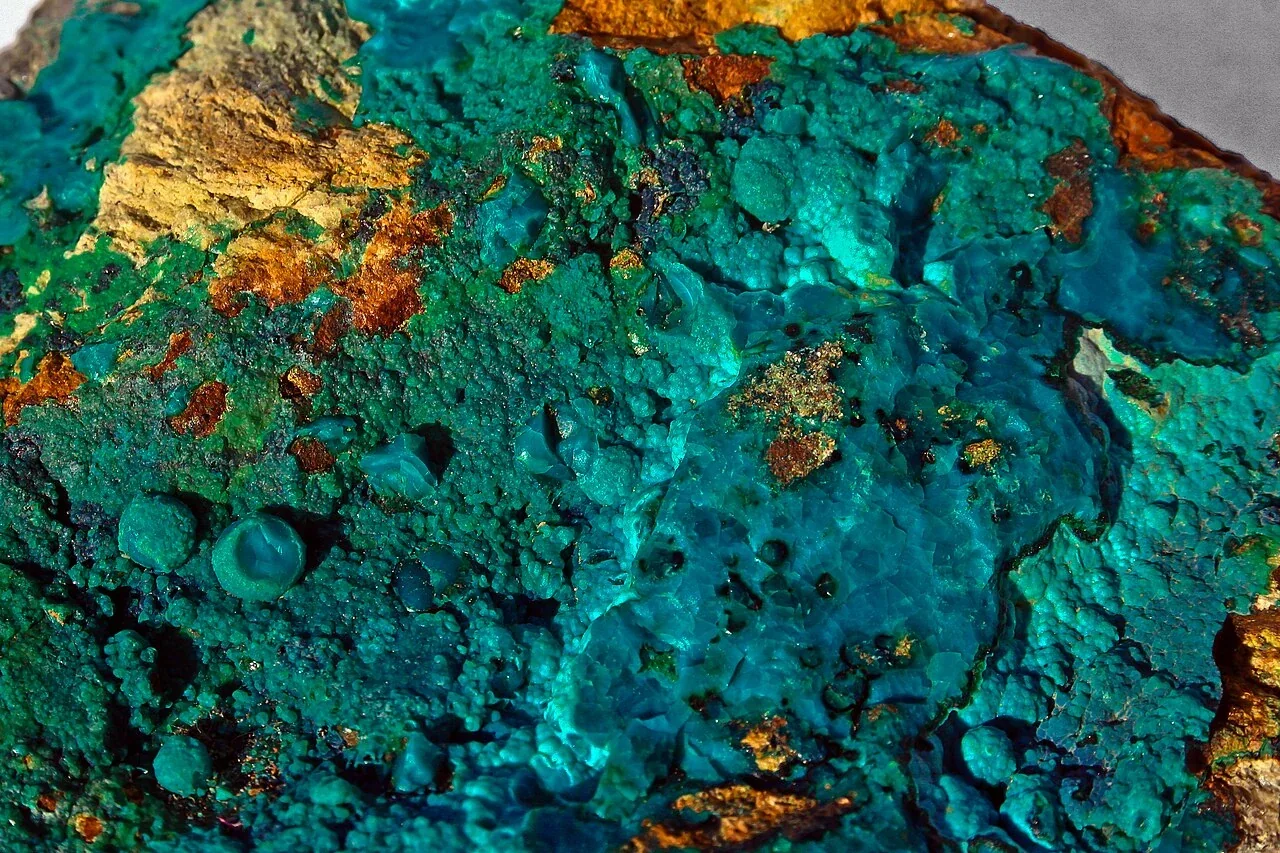
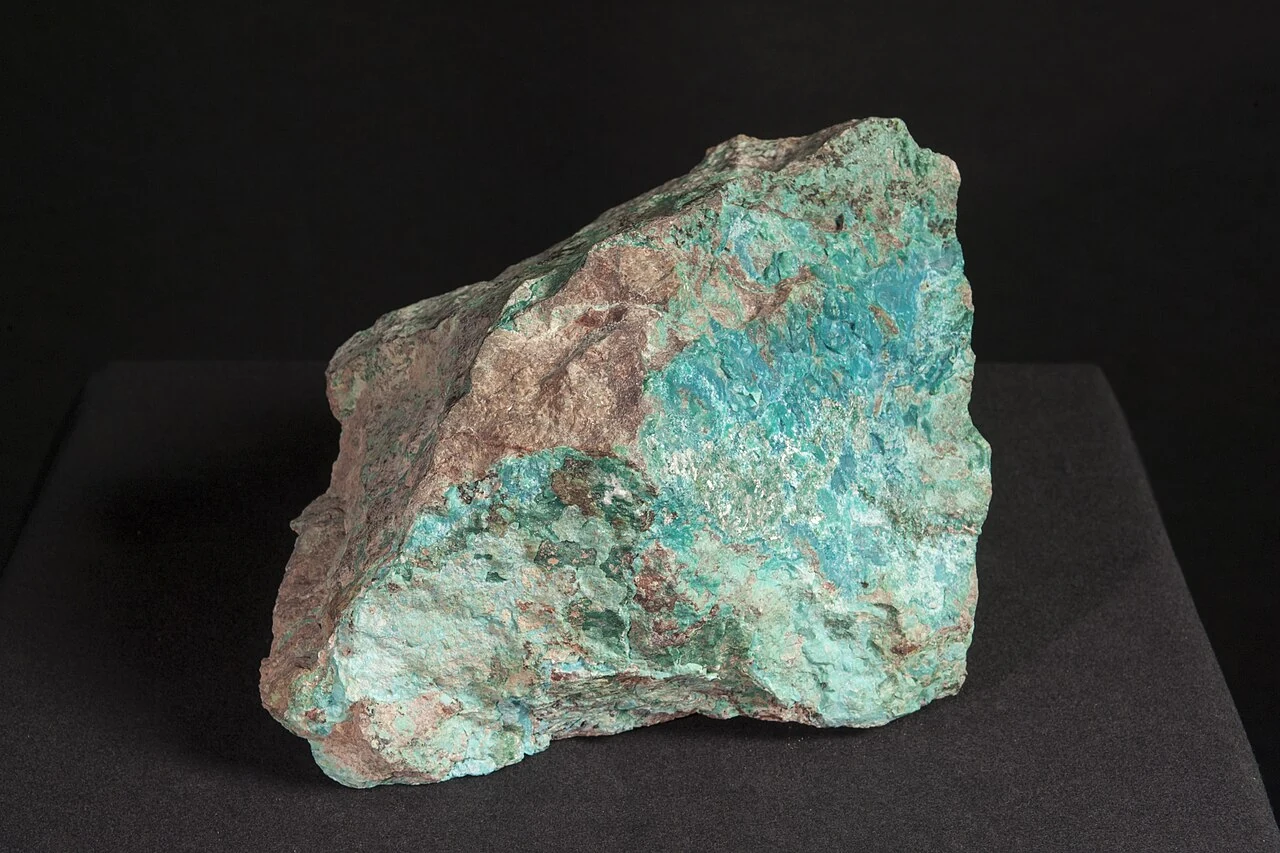
Chrysocolla attracts attention through blue-green surfaces, but specimens under this name can differ greatly in cohesion. The Handbook records uncertainty about its crystalline ordering. We keep that uncertainty visible rather than pretending every polished piece is an identical crystal.
The Crystal Council associates chrysocolla with calm communication, expressing one's voice and a sense of personal agency. The heart, throat and root connect feelings, their expression and stability in its account. The author presents the stone as a companion to speaking in accordance with oneself while retaining gentleness in delivery. What matters is not simply the sound of spoken words but their relationship with an inner intention. The blue-green material thus represents moving from quietly recognising feelings towards clear expression. [341]
A second author and the context of correspondences
Crystal Vaults primarily presents chrysocolla as a symbol of communication, teaching and conscious self-expression. It emphasises the effects of words and actions on others, linking them with compassion. Blue-green colour creates an image of calm in which personal wisdom can be heard. Its meditation section introduces grounding and maintaining conscious attention. TCC foregrounds empowerment more strongly, while CV adds the teacher’s role and sharing knowledge. Both approaches connect inner content with its expression. [342]
An Avonoria editorial suggestion
Editorial suggestion — not a documented rite
Original Avonoria interpretation. Calm communication includes both speech and room for a response. In our interpretation, chrysocolla directs attention towards agreement between words and intention. A short, concrete sentence can express a need more clearly than a long list of judgements.
Exercise. Observe the specimen through a closed display case or on its stand. Draft a difficult message in three sentences: what you notice, what you need and what you request. Remove diagnoses of the other person and the words ‘always’ or ‘never’ if inaccurate. Read it and leave it for later assessment. This is an original editing and reflection exercise using quiet observation.
Returning to everyday life. Return to the draft when there is time to read it calmly. Mark the key sentence and assess its clarity. After a conversation, record what became clearer and which response broadened your perspective.
Scope of the sources: We reject the practitioner page’s incorrect description of azurite and malachite as silicates. Crystal system remains unspecified because the mineralogical source marks it as uncertain.
Blue and green botryoidal, kidney-shaped or earthy aggregates. [340]
Reference properties
View under neutral lighting and compare existing surfaces only. Hardness and streak below are reference data: do not scratch, break, heat or grind the specimen. Ask a specialist to examine valuable or unidentified materials.
Kidney-shaped, botryoidal and earthy aggregates. [340]
Common lookalikes and imitations
Azurite
Why it looks similar
Blue copper-bearing materials can occur together.
What can help distinguish it
Azurite is a copper carbonate; chrysocolla is a silicate material with variable hydration. They can occur together; colour does not establish their proportions.
What a photograph cannot establish
A photograph does not establish composition, treatment or the provenance of an individual specimen.
Chrysocolla is secondary material found in oxidation zones of copper deposits.
Material facts
It forms in oxidised zones of copper deposits; occurrences include Arizona, Chile and the Democratic Republic of the Congo. [340]
Personal / spiritual practice
Ask about stabilisation, impregnation and quartz or other constituents. ‘Gem silica’ is not automatically a synonym for every chrysocolla specimen. Choose provenance information and, where appropriate, a gemmological opinion instead of home hardness testing. A delicate surface may look beautiful in a case while being unsuitable for daily wear. Shine does not prove the absence of resin.
Use only gentle dry care; do not rub friable surfaces. Avoid soaking, salt, acids, steam and ultrasonics. This is copper-bearing material: do not make elixirs, grind it or inhale dust. Keep shedding specimens enclosed and away from the kitchen; wash your hands after contact.
Storage and specimen form
A separate, stable labelled container; protect against falls and access by children or pets.
Care is a precautionary editorial policy for an intact specimen with unconfirmed treatment. Wash hands after handling rough material; do not perform scratch, heat or acid tests.
Do not grind or drill at home. Dust is a different exposure route from handling an intact specimen. [37]
FAQ
Can chrysocolla be carried loose with other stones?
For an unfamiliar specimen, a separate softly lined box is preferable. Material can be friable and varies in admixtures. Meditation can involve viewing it on a stand rather than carrying it in a pocket.
What research says — in brief
The cited clinical trial concerned rose quartz, not this atlas entry. It does not establish a therapeutic effect for this material; the symbolism is presented for understanding traditions and personal practice. [159]
ChrysocollaMineral Data Publishing / Handbook of Mineralogy · accessed 2026-10-29
Mineralogical, gemological, institutional or scientific source. Its scope is recorded in the source index.
Chrysocolla Meanings and Crystal PropertiesThe Crystal Council · accessed 2026-10-29
Commercial practitioner source: documents beliefs, not medical evidence. The site sells crystals, so we give a bibliographic description without an active link; the full address is kept in Avonoria’s source documentation.
AzuriteMineral Data Publishing / Handbook of Mineralogy · accessed 2026-10-29
Mineralogical, gemological, institutional or scientific source. Its scope is recorded in the source index.
Placebo effects in alternative medical treatments for anxiety: false hope or healing potential?Cambridge University Press / CNS Spectrums · 2025 · accessed 2026-10-29DOI: 10.1017/S1092852925100515
Mineralogical, gemological, institutional or scientific source. Its scope is recorded in the source index.
Chrysocolla — second practitioner accountCrystal Vaults · accessed 2026-10-29
Commercial practitioner source: documents beliefs, not medical evidence. The site sells crystals, so we give a bibliographic description without an active link; the full address is kept in Avonoria’s source documentation.