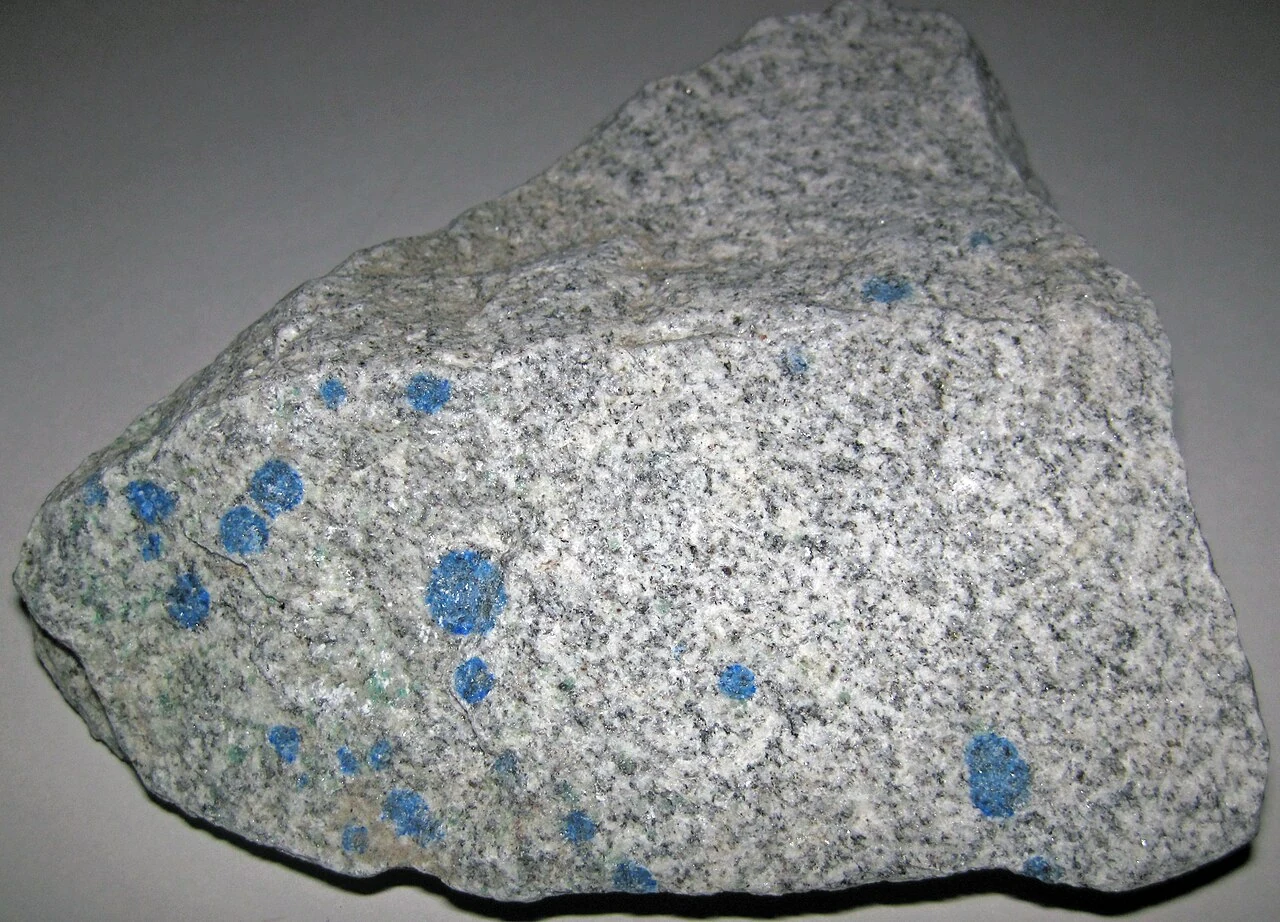
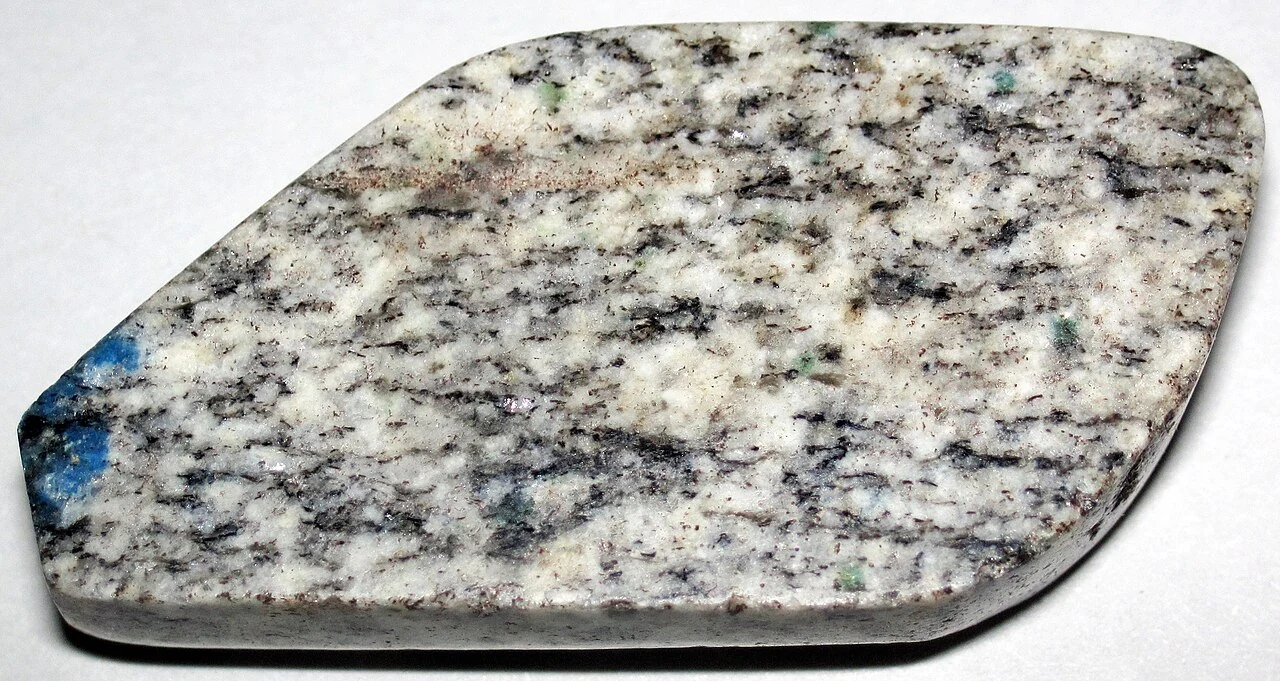
K2 stone is a granitic ornamental material with blue azurite areas, also known as ‘K2 jasper’. It is neither jasper nor lapis lazuli. This entry covers the whole rock, while another atlas entry addresses azurite itself. This distinguishes a practical material from a mineral.
K2 stone — the account below separates contemporary lithotherapy testimony from an original reflective exercise.
Lithotherapy tradition
Intuition and exploring spiritual perspective. [364]
Meaning and correspondences in the source
The Crystal Council links K2 with the third eye, crown and spiritual insight. In its narrative, the crown represents receiving spiritual knowledge and the third eye understanding it. The author describes meditation as gradually becoming acquainted with this map of experience and developing personal intuition. Communication with higher realms also appears, presented here as a practitioner belief. K2 becomes a companion to seeking a wider perspective and reflecting on meanings that practitioners assign to their experiences during concentration. [364]
A second author and the context of correspondences
Healing Crystals presents K2 through balance, grounding and communication, with the third eye as its main correspondence. Its affirmation portrays the person as stable and balanced. Practice involves brief focus before conversation, creativity or meditation, followed by displaying the stone as an intention reminder. TCC develops spiritual-knowledge narratives much more extensively, while HC centres a simple rite of presence. The difference shows how the same rock serves authors as a symbol of both spiritual exploration and everyday stability. [365]
An Avonoria editorial suggestion
Editorial suggestion — not a documented rite
Original Avonoria interpretation. We use the contrast between a pale background and blue points as a metaphor for a broad plan and the next step. K2 can recall a change of scale. We record personal reflection so a particular idea can readily be revisited.
Exercise. Choose one project and draw its broad boundary on paper. Mark a single point inside to represent the next verifiable step. Observe K2 on its stand and ask whether the plan includes a sufficiently concrete action. Add a time or starting condition, then end the session.
Returning to everyday life. After taking the first step, record the result beside the point in the plan. Review the whole project and mark the next stage. The broad-background and single-point metaphor can accompany later updates.
Scope of the sources: We do not adopt the practitioner account’s secondary-melting story as the explanation for azurite formation. The name does not guarantee where an individual object was collected.
Pale fine-grained rock with blue spots and dark biotite flakes. [363]
Reference properties
View under neutral lighting and compare existing surfaces only. Hardness and streak below are reference data: do not scratch, break, heat or grind the specimen. Ask a specialist to examine valuable or unidentified materials.
Mohs hardness
Crystal system
Not applicable / not a single crystal
Material property
Pale fine-grained rock with blue spots and dark biotite flakes. [363]
Blue azurite developed secondarily within previously crystallised granitic rock.
Material facts
The described material comes from northern Pakistan. Azurite formed secondarily in granite containing quartz, feldspars and micas. [363]
Personal / spiritual practice
Ask about rock identification and colour enhancement; ‘natural’ alone answers neither question. Do not test colour with solvent at home. Keep the actual specimen description and seller’s documentation. The whole rock should not be assigned azurite’s formula or properties of all its minerals added together like a recipe.
Clean gently while dry; protect against acids, salt, steam and ultrasonics. Because it contains azurite, do not use the rock in elixirs or in the kitchen. Do not grind or drill it yourself. A stand should prevent falls; wash your hands after handling rough material.
Storage and specimen form
A separate, stable labelled container; protect against falls and access by children or pets.
Care is a precautionary editorial policy for an intact specimen with unconfirmed treatment. Wash hands after handling rough material; do not perform scratch, heat or acid tests.
Do not grind or drill at home. Dust is a different exposure route from handling an intact specimen. [37]
FAQ
Do vivid blue spots prove K2 is authentic?
No. GIA has reported blue-dyed imitations. Ask about provenance and treatment; gemmological examination is worthwhile for a valuable piece. Do not try removing colour with solvent at home.
What research says — in brief
The cited clinical trial concerned rose quartz, not this atlas entry. It does not establish a therapeutic effect for this material; the symbolism is presented for understanding traditions and personal practice. [159]
K2 Granite: A white granite with azuriteGeology · accessed 2026-10-29
Mineralogical, gemological, institutional or scientific source. Its scope is recorded in the source index.
K2 stone Meanings and Crystal PropertiesThe Crystal Council · accessed 2026-10-29
Commercial practitioner source: documents beliefs, not medical evidence. The site sells crystals, so we give a bibliographic description without an active link; the full address is kept in Avonoria’s source documentation.
AzuriteMineral Data Publishing / Handbook of Mineralogy · accessed 2026-10-29
Mineralogical, gemological, institutional or scientific source. Its scope is recorded in the source index.
Placebo effects in alternative medical treatments for anxiety: false hope or healing potential?Cambridge University Press / CNS Spectrums · 2025 · accessed 2026-10-29DOI: 10.1017/S1092852925100515
Mineralogical, gemological, institutional or scientific source. Its scope is recorded in the source index.
Reconstructed Specimens and the Rise of Deceptive Practices in PakistanGIA / Gems & Gemology · accessed 2026-10-29
Mineralogical, gemological, institutional or scientific source. Its scope is recorded in the source index.
K2 stone — second practitioner accountHealing Crystals · accessed 2026-10-29
Commercial practitioner source: documents beliefs, not medical evidence. The site sells crystals, so we give a bibliographic description without an active link; the full address is kept in Avonoria’s source documentation.