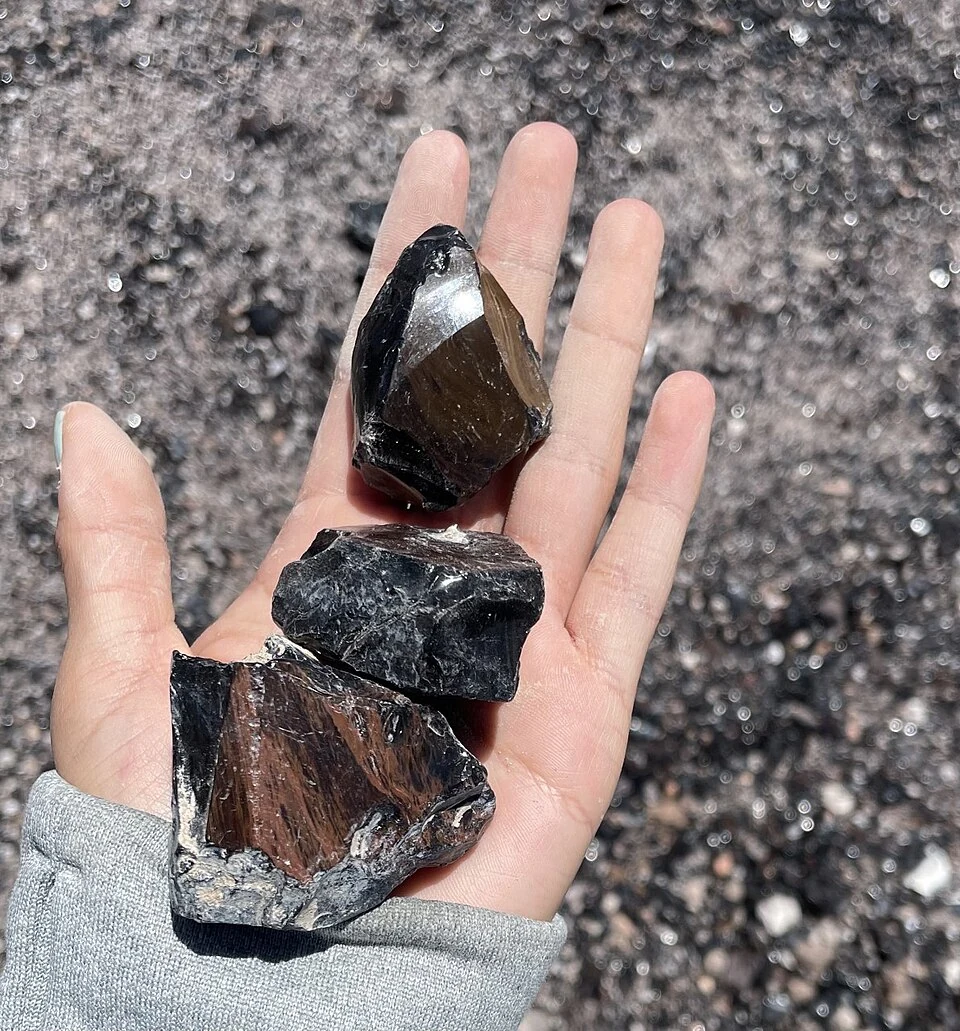
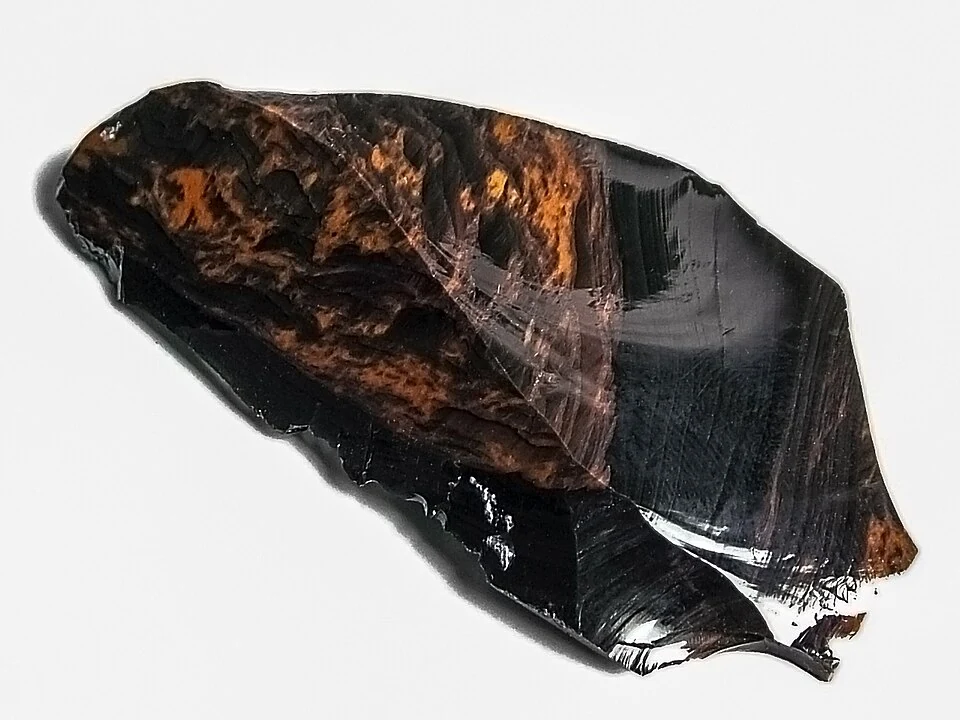
Mahogany obsidian is distinguished by reddish-brown patterns within dark glass. It is an appearance variety of obsidian, not another mineral species. This entry considers the symbolism of turning creative intention into a small first step.
The Crystal Council connects mahogany obsidian with grounding, passion and moving from a creative idea to action. Three lower chakras form its map: stability supports expression and personal will. The author describes moving beyond hesitation and finding courage to show personal abilities. Aura protection appears within its narrative of spiritual stability. In this contemporary account, the reddish-brown glass represents energy grounded in everyday life, accompanying the consistent development of interests and the practical pursuit of intentions. [372]
A second author and the context of correspondences
Healing Crystals associates mahogany material with grounding, protection and symbolically removing obstacles, naming the root. Its affirmation emphasises strength and shelter. A brief practice deliberately chooses a moment, uses the stone as a focus and later places it as an intention reminder. Compared with TCC’s three lower chakras and creative passion, this is a more concentrated image of stability. Both sites portray the variety as a personal-growth companion, while HC gives greater emphasis to quiet confidence and spiritual protection. [373]
An Avonoria editorial suggestion
Editorial suggestion — not a documented rite
Original Avonoria interpretation. Creative courage can begin with an imperfect attempt. We suggest treating obsidian's warm pattern as a cue to start a small project. A rough draft gives an idea concrete form and helps identify what to develop next.
Exercise. Prepare materials for a safe small project: paper, an ordinary pencil or an open notebook. Place obsidian beside them and decide to make only a rough draft for three minutes. Begin with the easiest element. Afterwards mark one thing worth keeping and one to change later. Put the stone away to signal completion. This original starting exercise gives an idea its first form.
Returning to everyday life. Leave a next-step note beside the rough draft. When returning to the project, begin with the marked element. This simple trace helps maintain continuity between short creative sessions.
Scope of the sources: Field sources describe local varieties. Sexual correspondences on the practitioner website are not health instructions or promises of an effect.
Dark glass with reddish-brown areas associated with iron oxides in the local account. [371]
Reference properties
View under neutral lighting and compare existing surfaces only. Hardness and streak below are reference data: do not scratch, break, heat or grind the specimen. Ask a specialist to examine valuable or unidentified materials.
Mohs hardness
Crystal system
Not applicable / not a single crystal
Material property
Dark glass with reddish-brown areas associated with iron oxides in the local account. [371]
Mahogany material belongs to volcanic glasses; reddish-brown areas are associated with iron oxides.
Material facts
The Millard County guide describes mahogany material in the Black Rock Desert; the US Forest Service also records it at Glass Buttes in Oregon. [371][354]
Personal / spiritual practice
Ask about natural glass, surface treatment and provenance when claimed. Inspect both dark and brown areas, along with edges and the base. Not every dark glass with red is automatically this variety. Choose a safe shape; a blade or ceremonial name adds no necessary value to ordinary reflection.
Keep separate from objects that could strike the glass. After damage, do not use it against skin. A gentle dry cloth is sufficient; avoid boiling water, flame, salt and ultrasonics. Do not break or grind at home. Do not immerse in drinking water.
Storage and specimen form
A separate, stable labelled container; protect against falls and access by children or pets.
Care is a precautionary editorial policy for an intact specimen with unconfirmed treatment. Wash hands after handling rough material; do not perform scratch, heat or acid tests.
Do not grind or drill at home. Dust is a different exposure route from handling an intact specimen. [37]
FAQ
Is mahogany obsidian a separate mineral?
No. It names volcanic glass with reddish-brown patterning. Inspect edges after any fall; keep a damaged piece for protected display.
What research says — in brief
The cited clinical trial concerned rose quartz, not this atlas entry. It does not establish a therapeutic effect for this material; the symbolism is presented for understanding traditions and personal practice. [159]
Obsidian WondersMillard County Tourism · accessed 2026-10-29
Mineralogical, gemological, institutional or scientific source. Its scope is recorded in the source index.
Mahogany obsidian Meanings and Crystal PropertiesThe Crystal Council · accessed 2026-10-29
Commercial practitioner source: documents beliefs, not medical evidence. The site sells crystals, so we give a bibliographic description without an active link; the full address is kept in Avonoria’s source documentation.
Obsidian in the Black Rock Desert, Millard CountyUtah Geological Survey · accessed 2026-10-29
Mineralogical, gemological, institutional or scientific source. Its scope is recorded in the source index.
Placebo effects in alternative medical treatments for anxiety: false hope or healing potential?Cambridge University Press / CNS Spectrums · 2025 · accessed 2026-10-29DOI: 10.1017/S1092852925100515
Mineralogical, gemological, institutional or scientific source. Its scope is recorded in the source index.
Rocks & Minerals: Central Oregon Rockhound MaterialsUSDA Forest Service · accessed 2026-10-29
Mineralogical, gemological, institutional or scientific source. Its scope is recorded in the source index.
Mahogany obsidian — second practitioner accountHealing Crystals · accessed 2026-10-29
Commercial practitioner source: documents beliefs, not medical evidence. The site sells crystals, so we give a bibliographic description without an active link; the full address is kept in Avonoria’s source documentation.