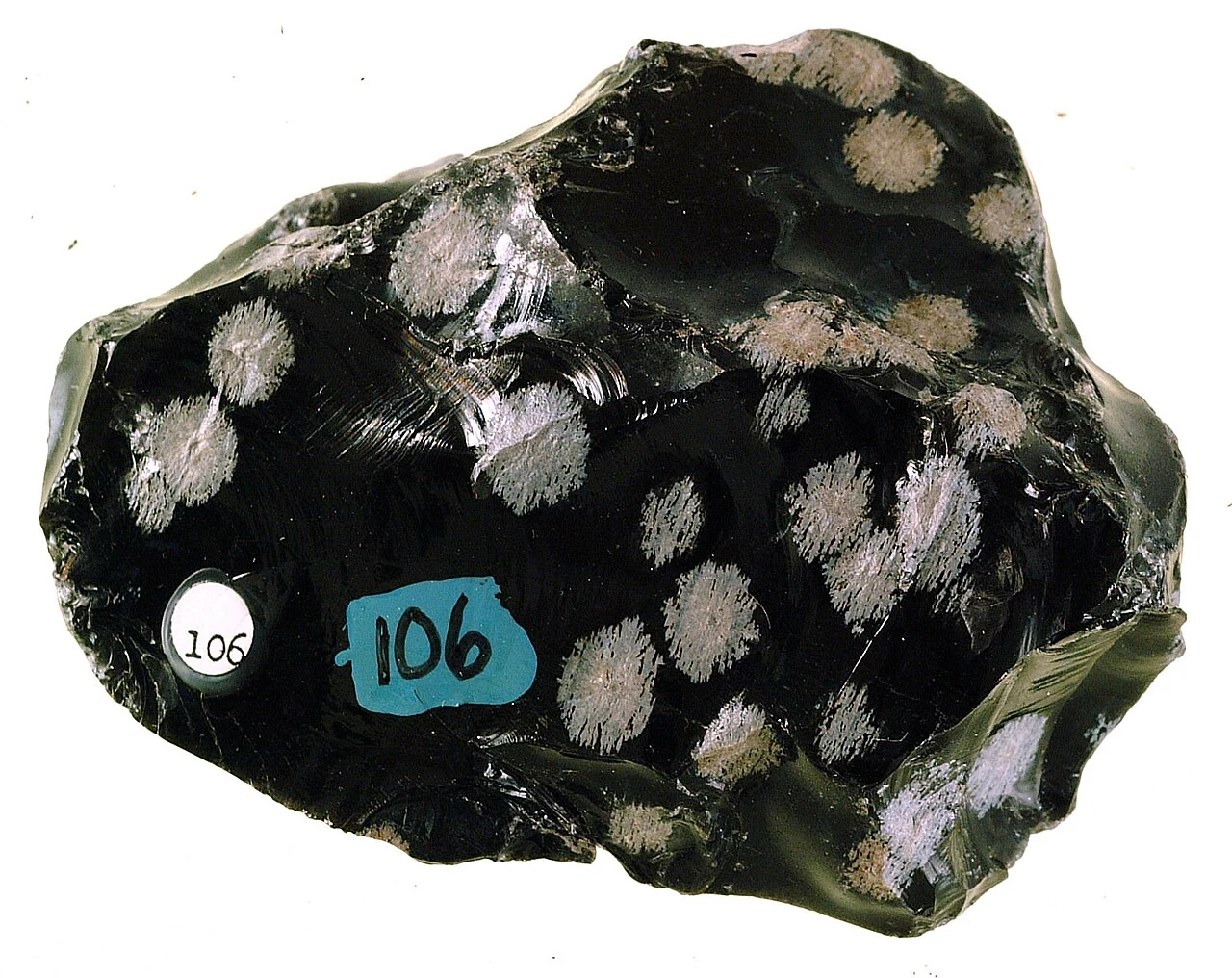
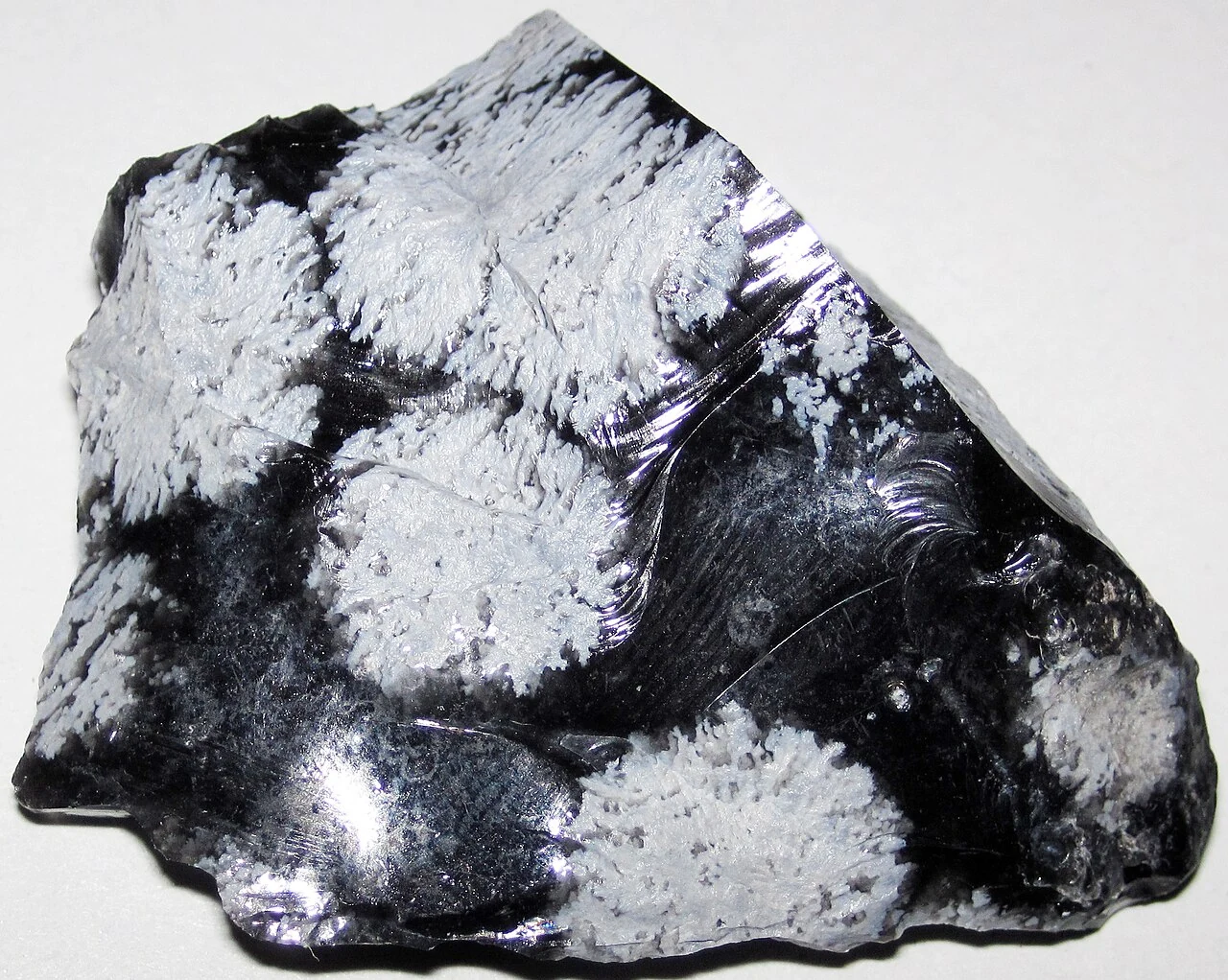
Snowflake obsidian is a variety of natural volcanic glass containing pale crystalline aggregates. It is not a new mineral species or a separate substance with pure quartz’s formula. Its contrasting pattern invites reflection on exceptions to everyday generalisations.
The Crystal Council associates snowflake obsidian with balance, focus and grounding, naming the root and third eye. An important theme is returning from wandering daydreams to the task at hand and maintaining a chosen direction. Pale spots and a dark background accompany a narrative of bringing different aspects of experience together. The site also develops past-life narratives within its spiritual system. A common theme is seeking meaning in inward imagery while returning to presence and consistent action in everyday life. [369]
A second author and the context of correspondences
Healing Crystals describes snowflake obsidian through balance, centring and support, naming the root. Its affirmation emphasises strength and adaptability. The author proposes a moment before conversation, meditation or creativity in which the stone becomes a physical focus. Displaying it afterwards recalls the intention. Compared with TCC’s dreams and past-life narrative, this is a simpler everyday form of practice. Light and dark patterning accompanies a search for balance in both accounts, although their spiritual emphases differ. [370]
An Avonoria editorial suggestion
Editorial suggestion — not a documented rite
Original Avonoria interpretation. We suggest using contrasting light and dark areas to describe a day more fully. Alongside difficulties, one might notice a small success or quiet moment. This original interpretation of balance makes room for several different experiences together.
Exercise. Write one mild generalisation about your day, such as ‘I finished nothing’. Find one small exception and note it alongside, without dismissing difficulties. Briefly observe the difference between pale and dark areas, then compose a more accurate sentence. This original practice needs only an example from today and a stone lying safely on the table.
Returning to everyday life. Read the more precise sentence about the day in the evening. Add one detail that emerged later. The note can accommodate different shades of experience and quietly close the short practice.
Scope of the sources: Cristobalite presence is not an invitation to generate dust. Accounts of past lives and addiction treatment are not adopted as established effects.
Black glass with whitish-grey spherulites of radiating cristobalite. [368]
Reference properties
View under neutral lighting and compare existing surfaces only. Hardness and streak below are reference data: do not scratch, break, heat or grind the specimen. Ask a specialist to examine valuable or unidentified materials.
Mohs hardness
Crystal system
Not applicable / not a single crystal
Material property
Black glass with whitish-grey spherulites of radiating cristobalite. [368]
Volcanic glass forms through rapid lava cooling; pale spherulites are crystalline structures within that material.
Material facts
The Utah Geological Survey describes this variety in the Black Rock Desert, where rapidly cooled lava formed volcanic glass. [368]
Personal / spiritual practice
Choose a finished smooth piece without sharp chips. A photograph can show a pattern but cannot establish natural glass or provenance. Ask about identification and any coating. Do not perform breaking or scratch tests. The number of ‘snowflakes’ is visual, not a scale of efficacy; the priority is an object you enjoy observing.
Obsidian can produce sharp chips: after a fall inspect visually without running a finger along an edge. Clean with a soft dry cloth; avoid impact, thermal shock, salt and ultrasonics. Do not massage with a damaged piece. No elixirs or home grinding of glass or cristobalite.
Storage and specimen form
A separate, stable labelled container; protect against falls and access by children or pets.
Care is a precautionary editorial policy for an intact specimen with unconfirmed treatment. Wash hands after handling rough material; do not perform scratch, heat or acid tests.
Do not grind or drill at home. Dust is a different exposure route from handling an intact specimen. [37]
FAQ
What are the pale snowflakes in obsidian?
The Utah Geological Survey describes spherulites of radiating cristobalite. These are structures within volcanic glass, rather than snow or separate white stones inserted into obsidian.
What research says — in brief
The cited clinical trial concerned rose quartz, not this atlas entry. It does not establish a therapeutic effect for this material; the symbolism is presented for understanding traditions and personal practice. [159]
Obsidian in the Black Rock Desert, Millard CountyUtah Geological Survey · accessed 2026-10-29
Mineralogical, gemological, institutional or scientific source. Its scope is recorded in the source index.
Snowflake obsidian Meanings and Crystal PropertiesThe Crystal Council · accessed 2026-10-29
Commercial practitioner source: documents beliefs, not medical evidence. The site sells crystals, so we give a bibliographic description without an active link; the full address is kept in Avonoria’s source documentation.
Obsidian WondersMillard County Tourism · accessed 2026-10-29
Mineralogical, gemological, institutional or scientific source. Its scope is recorded in the source index.
Placebo effects in alternative medical treatments for anxiety: false hope or healing potential?Cambridge University Press / CNS Spectrums · 2025 · accessed 2026-10-29DOI: 10.1017/S1092852925100515
Mineralogical, gemological, institutional or scientific source. Its scope is recorded in the source index.
Snowflake obsidian — second practitioner accountHealing Crystals · accessed 2026-10-29
Commercial practitioner source: documents beliefs, not medical evidence. The site sells crystals, so we give a bibliographic description without an active link; the full address is kept in Avonoria’s source documentation.