A green copper hydroxycarbonate, often in banded aggregates. Copper is part of the mineral; this does not mean touching every polished specimen causes poisoning. Dust, ingestion and unknown impurities require different assessment.
Malachite, a green copper mineral with characteristic bands, is in lithotherapy a stone of transformation and protection. Its protective role is old: beliefs recorded by Kunz made it a talisman for children and an amulet against the “evil eye”.
Meaning in lithotherapy
The Crystal Council regards malachite as one of the most important minerals for protection against negative energy — it is meant to surround the wearer with a “cloak of invisibility”. It opens the heart and allows balance on all levels. Its themes include travel, balance, creativity, intuition, transformation, protection, confidence, leadership, self-discipline and prosperity. [56]
Crystal Vaults calls it the “Stone of Transformation”, helping in changing situations and in spiritual growth and carrying the deep green of nature. It encourages change and emotional risk-taking, shows what blocks growth, helps overcome shyness and build relationships based on love rather than need. Its patterns are also used for gazing: letting the eye travel along its convoluted bands is meant to free the mind and open it to insight from the subconscious. [140]
Ways of working with the stone
Crystal Vaults links malachite above all with meditation: holding it, one speaks one’s fears and sorrows aloud each day. The stone is worn as jewellery or held as a talisman, and as an amulet it is meant to protect loved ones, possessions and physical security. Placed on the forehead it is said to stimulate visualisation, and on the solar plexus to support deep emotional release. Crystal Vaults also recommends it for children’s rooms and for placing near microwaves and televisions. [140]
Chakras, elements and astrology
Both sources link malachite with the heart chakra, but differ on sign and element: The Crystal Council gives Scorpio, Capricorn, fire and Venus, Crystal Vaults Taurus and the element of wood. Crystal Vaults also invokes the Egyptian Hathor, called the “Lady of Malachite” and patron of miners. [56][140]
Chakras
heart and solar plexus (The Crystal Council); heart, with work also on the third eye and solar plexus (Crystal Vaults) [56][140]
Element
fire (The Crystal Council); wood in feng shui — growth and new beginnings (Crystal Vaults) [56][140]
Zodiac signs
Scorpio, Capricorn (The Crystal Council); Taurus (Crystal Vaults) [56][140]
an image of the sun — an old talisman against enchantment and venomous creatures (Kunz) [120]
Cleansing in the tradition
In this tradition malachite is regarded as a stone that readily absorbs negative energy but does not release it. The Crystal Council therefore stresses that it must be cleansed constantly if worn or carried daily, and Crystal Vaults that it should be cleansed after every use. Crystal Vaults also mentions leaving it overnight in a sheltered place outdoors. [56][140]
Older beliefs
History and beliefs
Kunz wrote that, for reasons not easy to fathom, malachite was considered a talisman especially suited to children: a piece of the stone tied to a cradle was meant to keep evil spirits away so that the child slept peacefully. In parts of Germany, like turquoise, it was believed to protect against falls and to warn of disaster by breaking into pieces. In Italy — for example in Bettona — people wore malachite “peacock stones”, triangular amulets set in silver whose eye-like markings were meant to guard against the spell of the evil eye. [120]
Kunz also recalls that the Egyptians knew malachite well — mines between Suez and Sinai were worked as early as about 4000 BC — and often made amulets of it; he even cites the conjecture that the biblical “shoham” stones may have been malachites. The most fitting design to engrave on malachite was the sun: a stone so decorated was believed to protect against enchantment, evil spirits and venomous creatures. [120]
Pliny the Elder (Natural History, book 37, chapter 36) already described “molochitis” — malachite, according to his translators — as an opaque stone of a deeper green than smaragdus, named after the colour of the mallow and highly esteemed for seals. He wrote that Nature had endowed it with properties that protect infants from certain dangers — a theme of caring for children that also appears in the later customs described by Kunz. [145]
Where the sources differ
Here the contemporary practitioner and the historical source overlap unusually closely: Crystal Vaults repeats from Kunz the cradle, the German protection against falls and the Italian “peacock stones”. It adds, however, elements we did not find in Kunz — pharaohs’ headdresses, the tsars’ malachite halls, and a link with St Francis and the language of animals. The Crystal Council limits itself to a brief mention of Egypt and medieval protection against the evil eye. [140][120][56]
An Avonoria editorial suggestion
Editorial suggestion — not a documented rite
Watch the bands of a securely placed, polished specimen and let your eyes follow them for a while. Then write down one change you want to make and what balance means to you in everyday actions.
Scope of the sources: Health claims from Crystal Vaults, including those about childbirth and illnesses, are not reproduced. We do not present the medieval use of malachite as a “medicine”, mentioned by The Crystal Council, as a practice.
Light to dark green; massive material often shows bands and concentric patterns. Rough surfaces can be earthy, botryoidal or fibrous, with lustre depending on form. A polished section reveals the pattern, but the pattern alone does not establish authenticity. [6]
Reference properties
View under neutral lighting and compare existing surfaces only. Hardness and streak below are reference data: do not scratch, break, heat or grind the specimen. Ask a specialist to examine valuable or unidentified materials.
Perfect cleavage in one and fair cleavage in another documented direction. [6]
Forms shown in the gallery
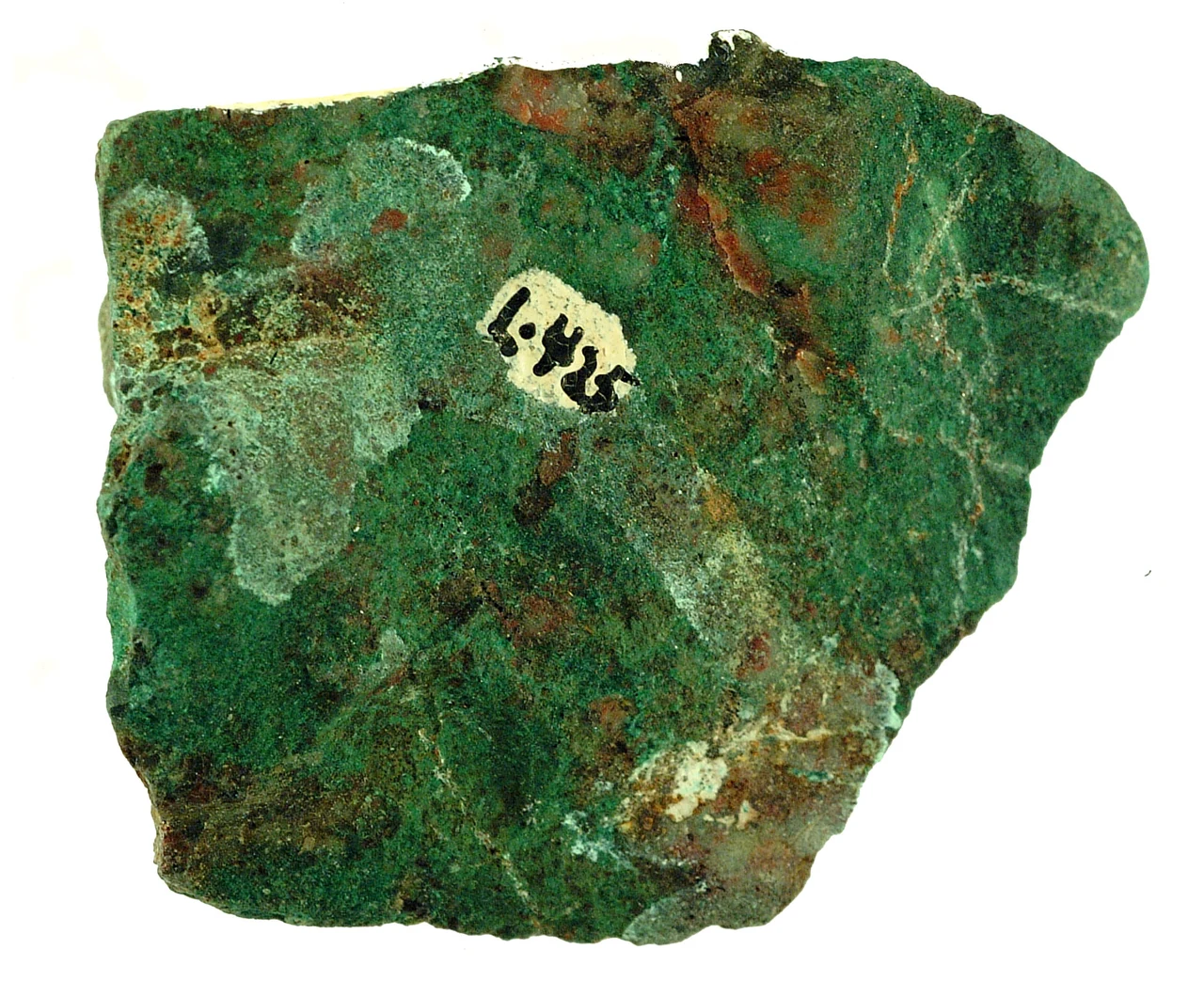
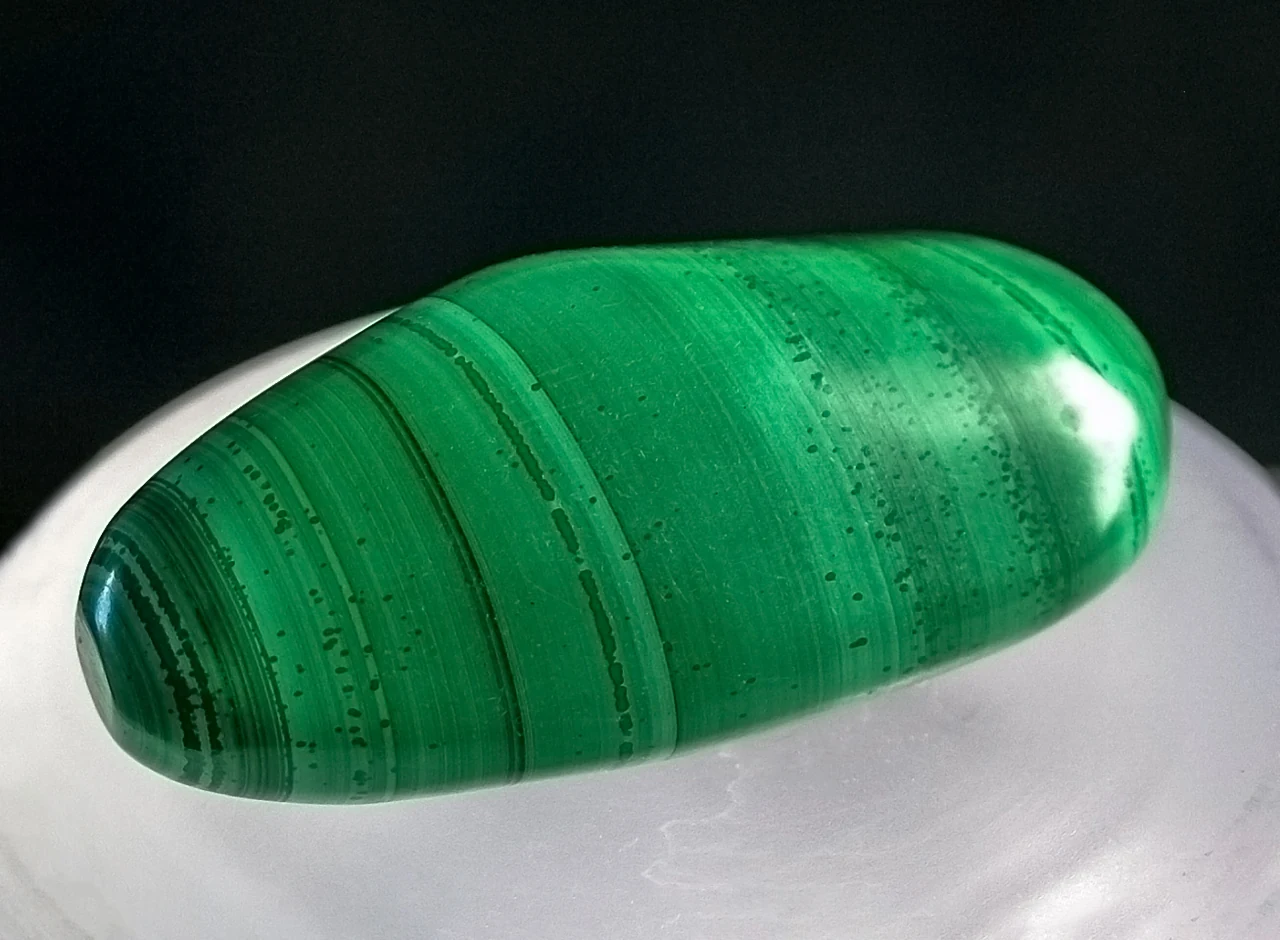
Rough green malachite specimen with an uneven fine-grained surface. Polished green malachite with darker parallel bands. [104][105]
Common lookalikes and imitations
Banded glass imitating malachite
Why it looks similar
Layers of glass can reproduce green bands; GIA documents this example.
What can help distinguish it
Malachite has a characteristic copper-bearing composition, pale green streak and density about 4.05 g/cm³. A specialist should confirm composition and measurements.
What a photograph cannot establish
Band regularity or contrast is not conclusive proof of authenticity.
Forms in oxidised zones of copper deposits. The Handbook lists the Democratic Republic of the Congo and the Urals among occurrences. Individual provenance needs seller documentation. [6]
This catalogue adopts dry cleaning as a precaution. It is not a universal claim that brief water contact poisons or immediately destroys every specimen.
Storage and specimen form
Separate from other specimens and protect from drops and abrupt temperature changes.
Do not grind at home or use in drinks. Dust or ingestion assessment requires knowledge of composition and exposure route; this card is not a specimen safety certificate.
Do not grind or drill at home. Dust is a different exposure route from handling an intact specimen. [37]
FAQ
Is the name enough to identify a specimen?
No. This card describes a material and does not authenticate your specimen. For a valuable purchase, request provenance, treatment disclosure and, when appropriate, gemological testing.
What research says — in brief
We found no studies of malachite in lithotherapy. Search results for the name mostly concern the dye malachite green — an entirely different substance from the mineral — and drug trials of that name. [129]
Mineralogical, gemological, institutional or scientific source. Its scope is recorded in the source index.
Malachite — contemporary practitioner accountThe Crystal Council · accessed 2026-09-30
Commercial practitioner source: documents beliefs, not medical evidence. The site sells crystals, so we give a bibliographic description without an active link; the full address is kept in Avonoria’s source documentation.
Photograph identity and usage-rights source; not a test of specimen composition.
Malachite meaning and uses — practitioner accountCrystal Vaults · accessed 2026-10-04
Commercial practitioner source: documents beliefs, not medical evidence. The site sells crystals, so we give a bibliographic description without an active link; the full address is kept in Avonoria’s source documentation.