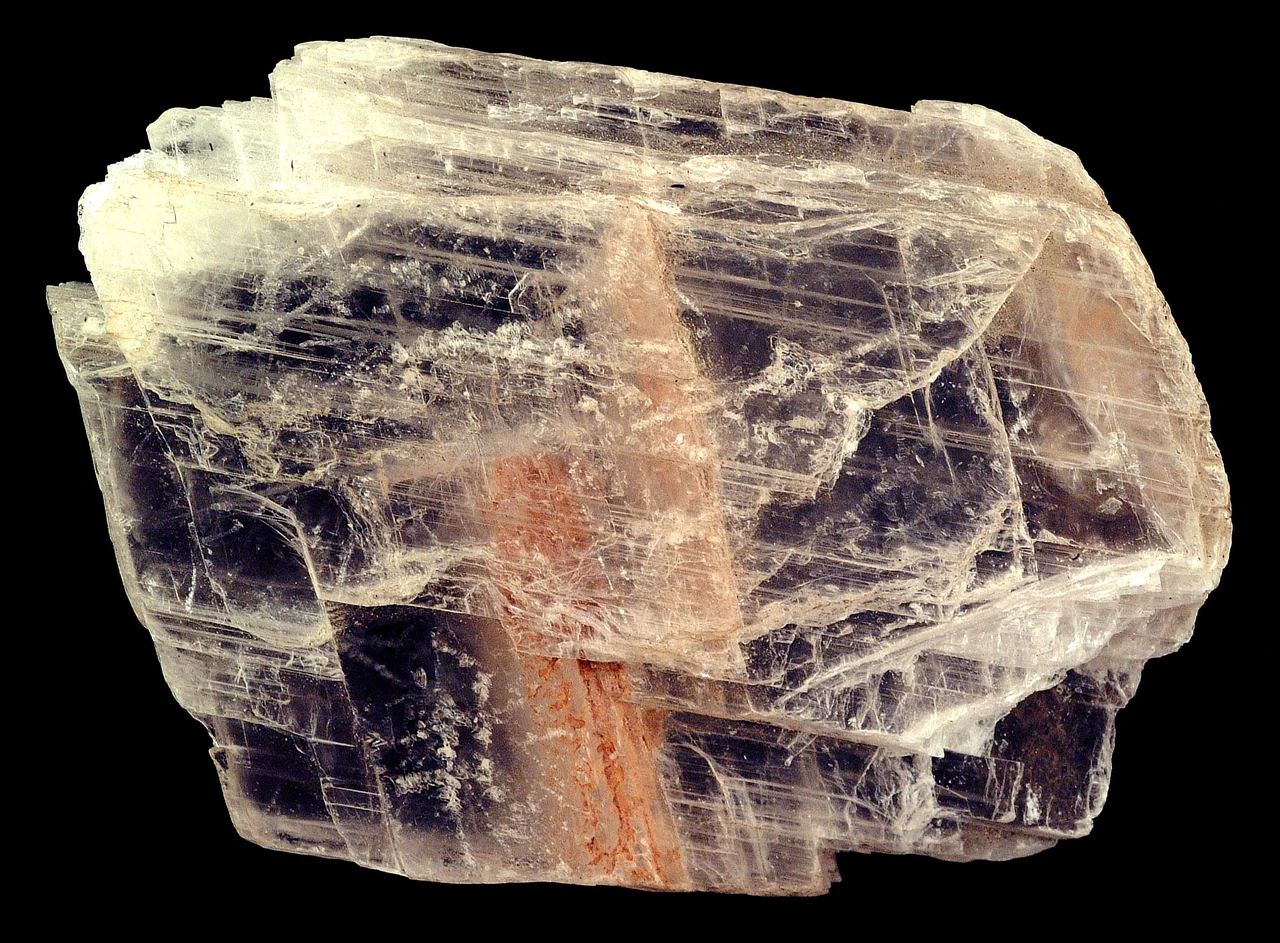
A crystalline gypsum variety, very soft and easily damaged. Museum Wales distinguishes selenite from fibrous satin spar; trade labels often blur the distinction. Selenite is not a selenium mineral.
Selenite, the transparent variety of gypsum, is in lithotherapy a stone of light and cleansing. Contemporary practitioners see it as a tool for clearing spaces and other crystals, and its name has long linked it with the Moon.
Meaning in lithotherapy
The Crystal Council describes selenite as “pure white light encapsulated in physical form” and a stone every spiritual practitioner should have. It is meant to restore the aura and the spiritual body, and to “slice through” the air, cleansing and refreshing any environment. In this description it strengthens intuition and clarity of thoughts, ideas and visions — both awake and asleep. [45]
Crystal Vaults (Linda Mason) speaks of the “liquid Light of Spirit” dwelling between light and matter. Selenite is meant to calm erratic emotions, dispel confusion, feelings of inadequacy, jealousy and doubt, and lend flexibility and strength to decisions. [125]
Ways of working with the stone
For meditation The Crystal Council advises placing selenite on the forehead or the crown of the head. It also suggests carrying a piece during the day and keeping another by the bed at night. The most characteristic practice is placing other stones on or beside selenite to cleanse and “charge” them; the description also gives combinations with other stones for particular purposes, such as with black tourmaline. [45]
Crystal Vaults recommends natural selenite wands for all kinds of energetic cleansing: they can be used to gently “comb” the aura, or one can lie with a wand on the heart, pointing towards the head. Selenite placed in the corners of a house or room is meant to create a safe, uplifting space, and the stones are used for grids that can be taken apart and rebuilt. [125]
Chakras, elements and astrology
Chakras
crown and etheric (both sources); The Crystal Council adds the third eye [45][125]
Element
air (“wind”) according to The Crystal Council; metal (in the feng shui system) according to Crystal Vaults [45][125]
Zodiac signs
Gemini and Cancer (The Crystal Council); Taurus, also Cancer, Aquarius and Gemini (Crystal Vaults) [45][125]
Planet
the Moon (The Crystal Council; also an old “Chaldean” planetary table in Kunz, where the name may denote another “moon stone”) [45][120]
Deity
Selene, the Greek Moon goddess (Crystal Vaults) [125]
Cleansing and “charging” in the tradition
In this tradition selenite is regarded as self-charging, a stone that itself cleanses other crystals. Crystal Vaults adds that it, too, benefits from occasional cleansing in moonlight or in sage smoke; it allows sunlight only for short periods. [125][45]
Older beliefs
History and beliefs
The name refers to Selene, the Greek goddess of the Moon, and older authors did connect “selenite” with the Moon. Kunz relates Antoine Mizauld’s account of a “selenite or moonstone” with a white spot that waxed and waned with the Moon, as well as a column of transparent selenite in a temple described by Rabelais, and a ritual necklace of pearls, crystals and selenites for Monday, the Moon’s day. [120]
Pliny the Elder (Natural History, book 37, chapter 67) described “selenitis”, the “moon stone”: white and transparent with a honey-coloured sheen, with a figure like the Moon inside, which — “if what we are told is true” — reflected the Moon’s face according to its phases. His translators thought it probably our selenite (crystallised gypsum), but the identification is uncertain. [145]
Where the sources differ
In older texts the word “selenite” did not always mean today’s transparent gypsum; in Kunz it is also another name for moonstone. Medieval and Renaissance beliefs that Crystal Vaults attaches to selenite may therefore not concern the same mineral. The sources also differ on element and signs: The Crystal Council links selenite with air, Gemini and Cancer, Crystal Vaults with metal and above all with Taurus. [120][125][45]
An Avonoria editorial suggestion
Editorial suggestion — not a documented rite
At the end of the day, take off your jewellery and lay the stones you use on or beside a selenite plate. Let this simple gesture mark the boundary between the day and rest.
Scope of the sources: Medieval and Renaissance beliefs are given only from Kunz, with the caveat about the old, ambiguous name. Health claims from Crystal Vaults are not reproduced.
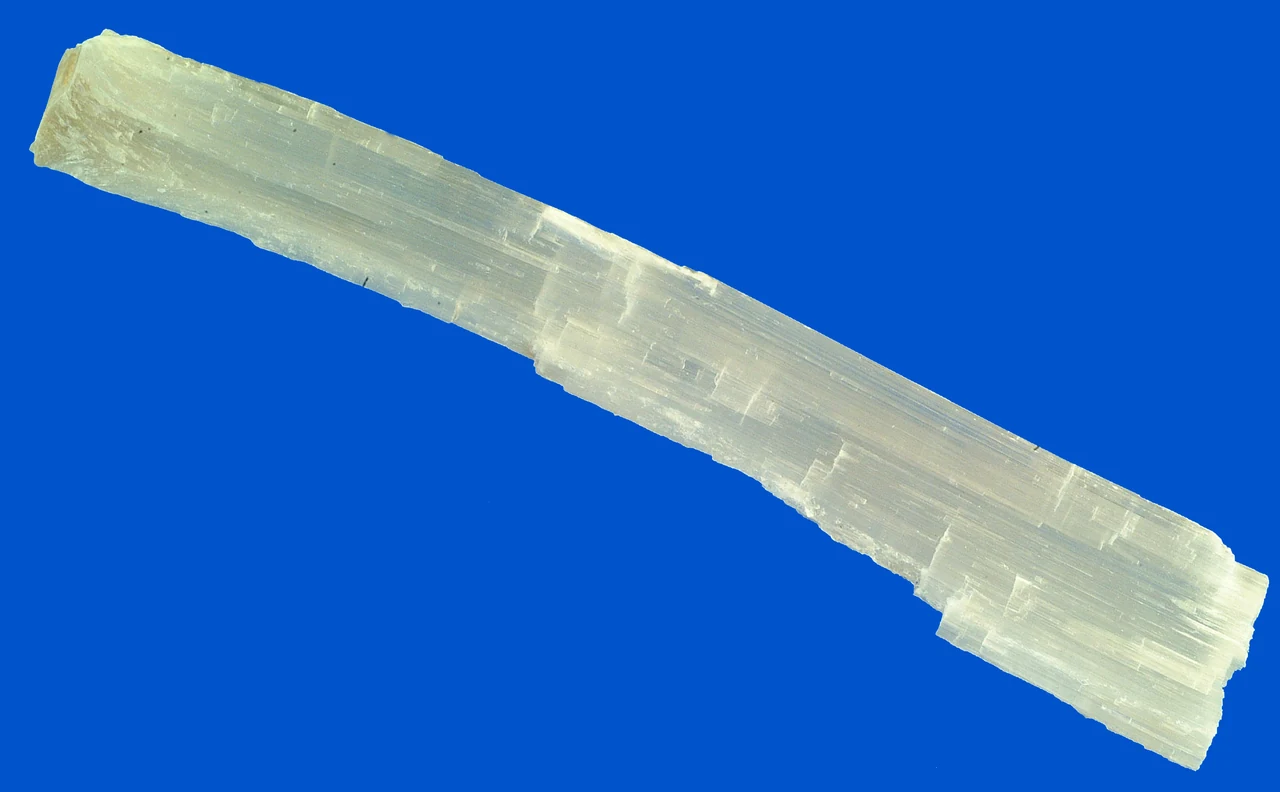
Selenite is the transparent, usually colourless variety of gypsum. It can form plates, elongated crystals and clear cleavage fragments, with glassy to pearly lustre. Do not automatically equate it with white fibrous sticks sold as selenite, which may be satin spar. [10][33]
Reference properties
View under neutral lighting and compare existing surfaces only. Hardness and streak below are reference data: do not scratch, break, heat or grind the specimen. Ask a specialist to examine valuable or unidentified materials.
Clear elongated selenite cleavage fragment against a blue background. Transparent, layered selenite specimen — the clear variety of gypsum — about 8 cm across. [116][117]
Common lookalikes and imitations
Satin spar — fibrous gypsum
Why it looks similar
Both varieties are gypsum, while fibrous sticks are often sold as selenite.
What can help distinguish it
Here selenite means the transparent variety; satin spar has a fibrous, silky texture. That does not make satin spar artificial gypsum.
What a photograph cannot establish
A photograph and shop label cannot replace a description of variety and texture.
Gypsum has Mohs 1.5–2 and perfect cleavage; calcite is Mohs 3 and quartz 7. Compare documented properties and existing surfaces rather than scratching delicate gypsum.
What a photograph cannot establish
A photograph does not establish composition, hardness or treatment.
Gypsum forms in evaporite deposits and in some caves and secondary settings. The Handbook records material from the Tarnobrzeg region and Naica. [10][33]
This catalogue adopts dry cleaning as a precaution. It is not a universal claim that brief water contact poisons or immediately destroys every specimen.
Storage and specimen form
Separate from other specimens and protect from drops and abrupt temperature changes.
Store the intact specimen securely; wash hands after handling rough material. Do not generalise care advice to unidentified materials or coatings.
Do not grind or drill at home. Dust is a different exposure route from handling an intact specimen. [37]
FAQ
Is the name enough to identify a specimen?
No. This card describes a material and does not authenticate your specimen. For a valuable purchase, request provenance, treatment disclosure and, when appropriate, gemological testing.
What research says — in brief
We found no studies of selenite in lithotherapy; search results for the name concern the chemistry of selenium compounds. [129]
Mineralogical, gemological, institutional or scientific source. Its scope is recorded in the source index.
Selenite — practitioner accountThe Crystal Council · accessed 2026-09-30
Commercial practitioner source: documents beliefs, not medical evidence. The site sells crystals, so we give a bibliographic description without an active link; the full address is kept in Avonoria’s source documentation.
Photograph identity and usage-rights source; not a test of specimen composition.
Selenite meaning and uses — practitioner accountCrystal Vaults · accessed 2026-10-04
Commercial practitioner source: documents beliefs, not medical evidence. The site sells crystals, so we give a bibliographic description without an active link; the full address is kept in Avonoria’s source documentation.