A colourless, transparent variety of quartz. Rock crystal is a variety name rather than a separate mineral species. Its regular form reflects the crystal structure of quartz.
Rock crystal — pure, colourless quartz — holds a special place in lithotherapy: it is seen as a universal stone that amplifies intentions and other stones. It also has one of the longest documented histories of belief, from the ancient idea of “eternal ice” to the crystal balls of seers.
Meaning in lithotherapy
The Crystal Council calls clear quartz the strongest enhancing stone in the mineral kingdom. Its clear energy is meant to amplify whatever is placed into it, which is why in this current it symbolises strengthening intentions and expressing personal goals. It is also said to awaken and “supercharge” the whole chakra system, dispel harmful energies and help one rediscover one’s true identity on the path towards enlightenment. [47]
Crystal Vaults describes rock crystal as the “supreme gift of Mother Earth” and the “Perfect Jewel”: even the smallest crystal is meant to be a master and teacher. Worn, carried or used in meditation, it opens the mind and heart to higher guidance. The quartz is said to attune itself to a person’s needs and to amplify the intention programmed into it; it is also described as a deep soul cleanser that clarifies thought and brings energy, perseverance and patience. [130]
Ways of working with the stone
The most characteristic practice is “programming”. According to Crystal Vaults, during meditation one visualises an image of one’s intention or desired outcome inside the crystal; the stone is said to “remember” and magnify this pattern, and repeated work allows the focused intention to take shape in reality. Placed on the forehead over the third eye, the quartz is meant to filter out distractions and help empty the mind. [130]
Rock crystal is also a stone that accompanies others. The Crystal Council describes points set at the tops of staves and wands, placed between stones in grids and laid on key energy points of the body. Crystal Vaults recommends it for amplifying other stones and groups of stones, for carrying as a tumbled stone to touch for an instant lift, for adding to bath water, and for hanging in windows as a disperser of light and energy in the spirit of feng shui. [47][130]
Chakras, elements and astrology
Rock crystal’s universality shows in its correspondences: The Crystal Council links it with every chakra, every zodiac sign and every planet, and names its element as “storm”. Crystal Vaults gives the crown chakra, noting that its prismatic nature lets quartz harmonise all the chakras. The older astrological tradition was more specific: according to Kunz’s tables, rock crystal was dedicated above all to the Moon. [47][130][120]
Chakras
all of them, including the etheric and Earthstar chakras (The Crystal Council); crown, harmonising all (Crystal Vaults) [47][130]
all signs and all planets (The Crystal Council); the Moon in old tables; Wednesday, Mercury and Gemini in an old Roman list of weekdays (Kunz) [47][120]
Cleansing and “charging” in the tradition
Because quartz is believed to amplify whatever is recorded in it, practitioners attach great importance to cleansing it. The Crystal Council recommends doing so often — in moonlight, with incense smoke or in a water bath — because crystals are said to absorb unwanted vibrations even when no one is using them. [47]
Older beliefs
History and beliefs
The ancients believed rock crystal was water frozen for ever in cold, dark caves; Kunz cites this idea from St Jerome, who repeated Pliny: “a stone to the touch, water to the eye”. In Japan small crystals were thought to be the congealed breath of the White Dragon and larger ones the saliva of the Violet Dragon; rock crystal was the “perfect jewel” (tama), a symbol of purity, of the infinity of space, and of patience and perseverance. [120]
Crystal balls have been found in graves — in the fifth-century tomb of the Frankish king Childeric and in Saxon graves in England — which Kunz links with belief in their magical power. Crystal gazing was known in the Middle Ages; the English scholar John Dee began his sessions with a crystal ball in 1581. Kunz also recorded that the Cherokee regarded rock crystal as a living fetish that aided hunting and divination, kept wrapped in deerskin and “fed”. [120]
Much earlier, Pliny the Elder (Natural History, book 37, chapters 9–10; English translation by Bostock and Riley, 1855) recorded the Roman belief that crystal forms from intense cold as a kind of ice — hence its Greek name, from the word for cold. He wrote that crystal from the Alps was valued most and was sometimes extracted by men suspended on ropes, that physicians of his day considered a crystal ball exposed to the sun’s rays the best cautery for the body, and that Nero, on hearing that all was lost, smashed two crystal cups. [145]
Where the sources differ
Crystal Vaults also places rock crystal in stories of Atlantis and Lemuria; this belongs to contemporary crystal mythology and is not confirmed by the historical source we read. Elsewhere the sources meet: both Crystal Vaults and Kunz mention the Japanese “tama” and the Cherokee hunters’ crystals. Kunz, himself a collector of these beliefs, observed that images seen in a crystal ball usually reflected the gazer’s expectations, hopes or fears. [130][120]
An Avonoria editorial suggestion
Editorial suggestion — not a documented rite
Place the specimen on a stable surface and write down one intention and an action you can take. The stone can serve as a personal reminder of that note.
Scope of the sources: The Crystal Vaults quartz page has no single author; it is a compilation footnoting books we have not read. Elixir instructions and health claims are not reproduced; Crystal Vaults also gives no cleansing methods for quartz.
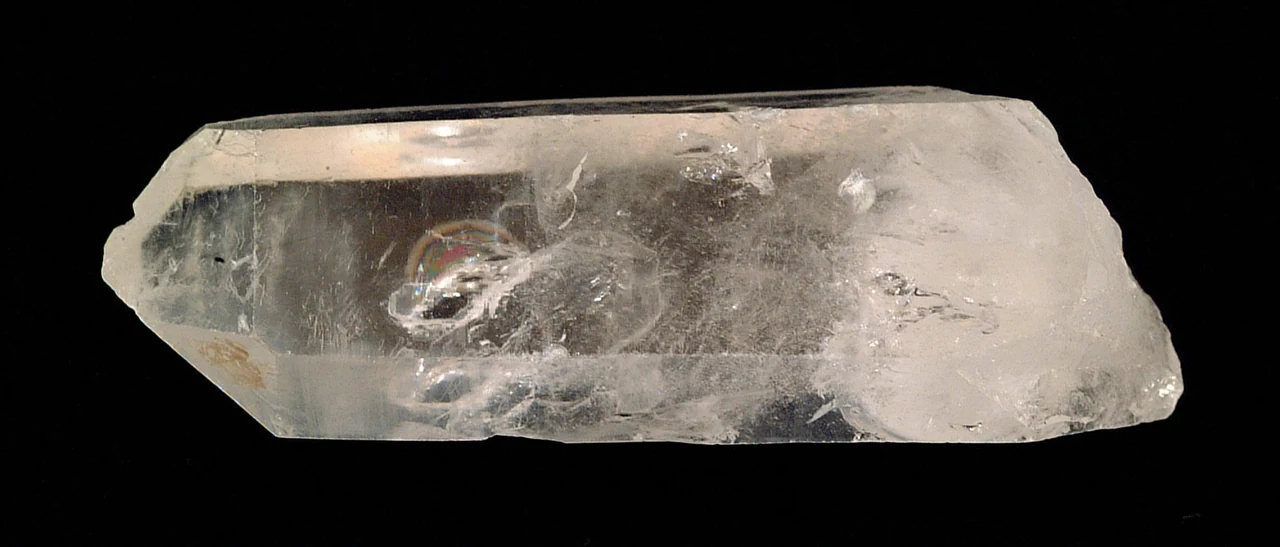
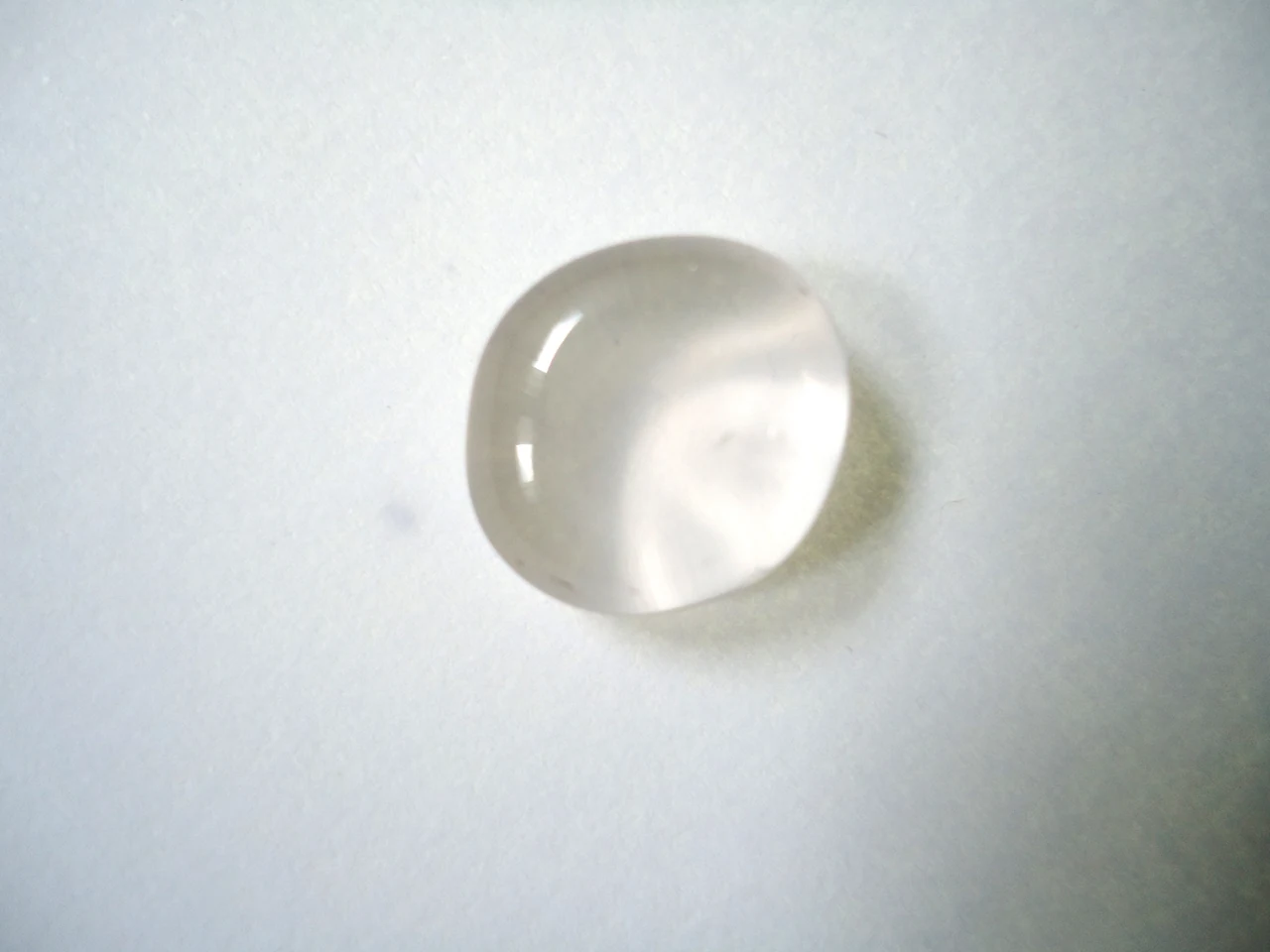
Colourless, usually transparent quartz with a glassy lustre. Natural prisms may have six sides and pointed terminations; fractures and inclusions do not rule out quartz. Polishing removes the natural crystal outline. [1][31]
Reference properties
View under neutral lighting and compare existing surfaces only. Hardness and streak below are reference data: do not scratch, break, heat or grind the specimen. Ask a specialist to examine valuable or unidentified materials.
Natural colourless quartz crystal with a visible termination and internal fractures. Polished colourless quartz pebble with a rounded surface. [80][81]
Common lookalikes and imitations
Colourless calcite
Why it looks similar
Both can be colourless, transparent and glassy.
What can help distinguish it
Calcite has perfect cleavage and Mohs 3; quartz has Mohs 7 and commonly conchoidal fracture. These are reference properties, not a suggestion to scratch a specimen.
What a photograph cannot establish
A photograph does not establish composition, hardness or treatment.
Quartz forms in many settings, including hydrothermal veins, pegmatites and igneous rocks. It also occurs in sediments and metamorphic rocks. A variety name cannot establish the origin of an individual specimen. [1][31]
Start with a soft, dry cloth. Unknown coatings, adhesives and settings need separate assessment.
Storage and specimen form
Separate from other specimens and protect from drops and abrupt temperature changes.
Store the intact specimen securely; wash hands after handling rough material. Do not generalise care advice to unidentified materials or coatings.
Do not grind or drill at home. Dust is a different exposure route from handling an intact specimen. [37]
FAQ
Is the name enough to identify a specimen?
No. This card describes a material and does not authenticate your specimen. For a valuable purchase, request provenance, treatment disclosure and, when appropriate, gemological testing.
What research says — in brief
We found no studies of rock crystal in lithotherapy; results for “quartz” mostly concern technology and physics. [129]
Mineralogical, gemological, institutional or scientific source. Its scope is recorded in the source index.
Rock crystal — contemporary practitioner accountThe Crystal Council · accessed 2026-09-30
Commercial practitioner source: documents beliefs, not medical evidence. The site sells crystals, so we give a bibliographic description without an active link; the full address is kept in Avonoria’s source documentation.
Commercial practitioner source: documents beliefs, not medical evidence. The site sells crystals, so we give a bibliographic description without an active link; the full address is kept in Avonoria’s source documentation.