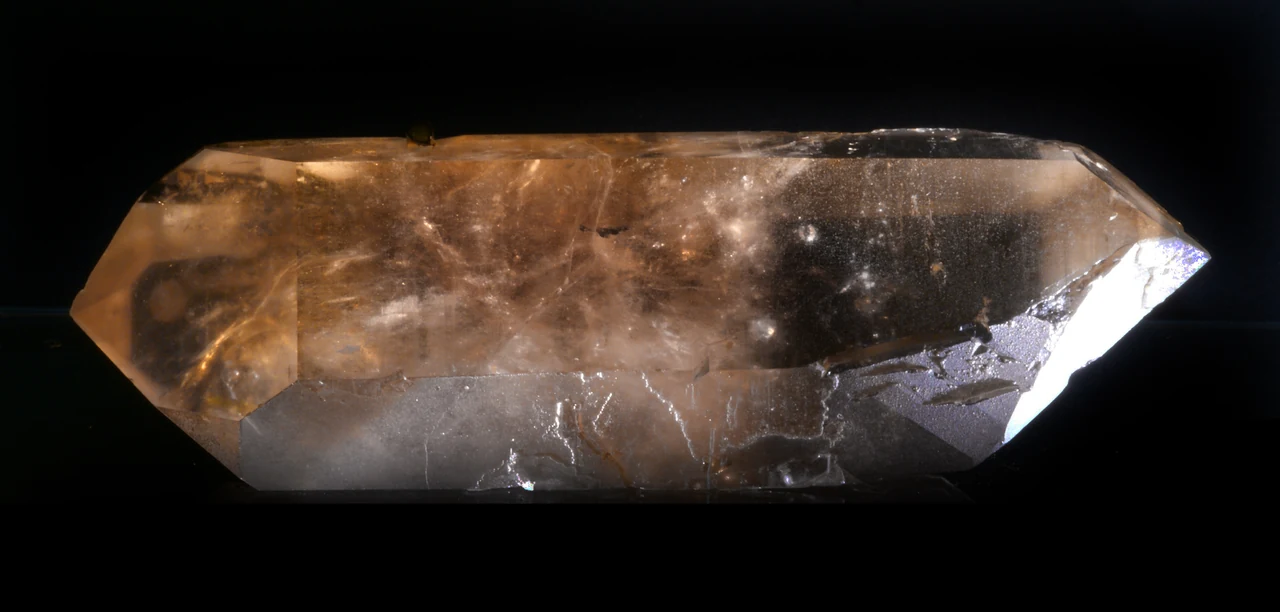
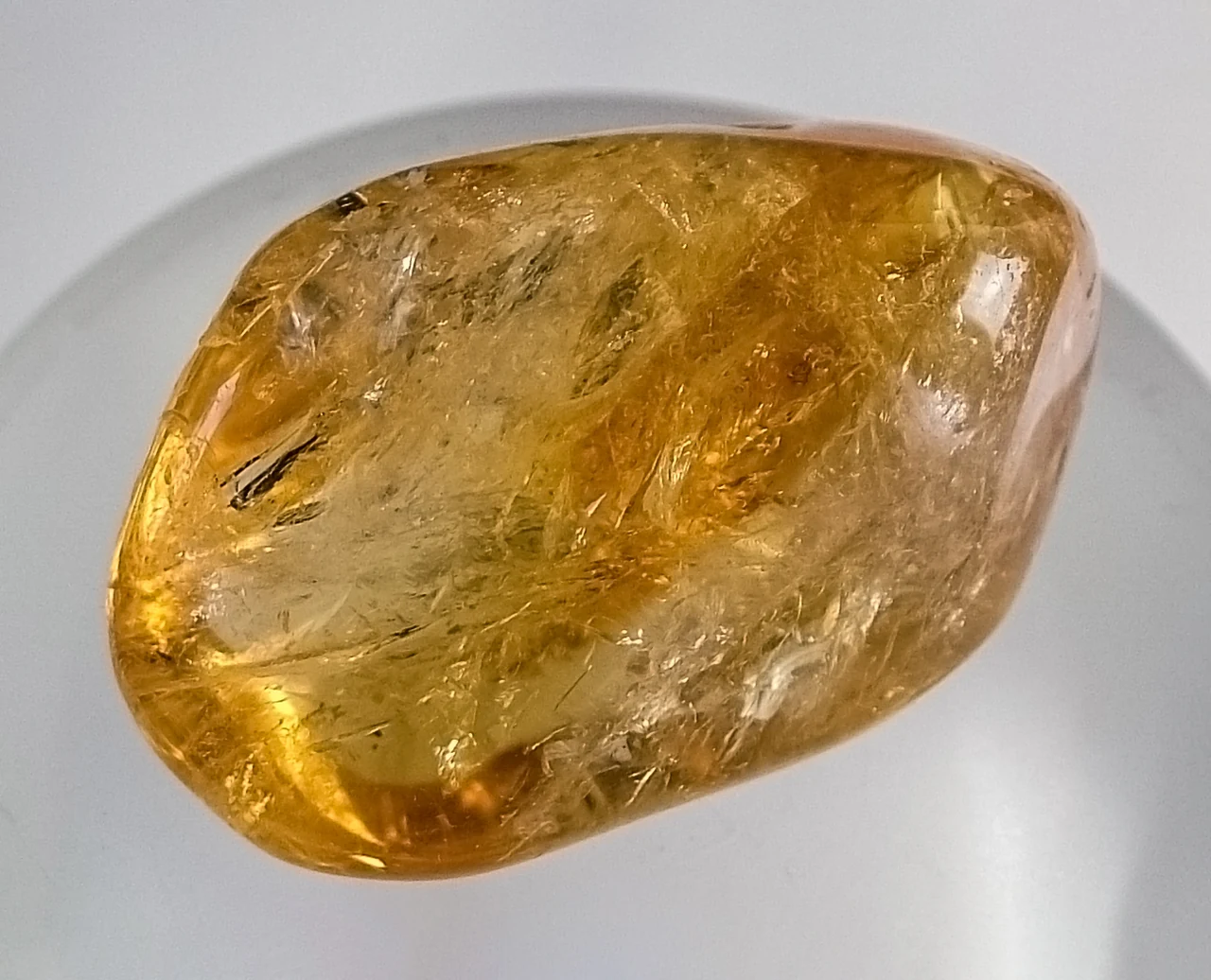
Transparent quartz ranging from pale yellow to brownish orange. Natural citrine is rare; many commercial specimens obtain their colour by heating amethyst. Disclosed treatment does not automatically mean imitation.
Natural specimen / collector formElongated, double-terminated citrine quartz crystal from Minas Gerais, Brazil (about 18 × 6 cm), transparent and pale yellow-brown. Heat-treatment status of this specimen is unverified.Photograph — author, source and licenceDidier Descouens · Citrine bresil.jpg↗ (external link, opens in a new tab) · Wikimedia Commons · licence: CC BY-SA 4.0↗ (external link, opens in a new tab)Resized and converted to WebP. No colour or content changes.
Citrine, the yellow variety of quartz, is in lithotherapy a stone of the sun: of creativity, will and joy. Contemporary practitioners link it especially strongly with “manifestation” — turning intentions into action.
Meaning in lithotherapy
The Crystal Council calls citrine the “master of one’s creativity centre” and the stone with the strongest manifesting energy. It is meant to help release personal will and uncover one’s truest desires, while giving a deep connection with Mother Earth through the lower chakras. Its themes include creativity, inspiration, dreams, joy, clarity, abundance, luck and the transmutation of negative energy. [48]
Crystal Vaults (Linda Mason) sees citrine as the “premier stone of manifestation, imagination and personal will”, carrying the power of the sun. Its relationship with heavy energy is distinctive: citrine is said not to hold it but to transmute, dissipate and ground it. It opens the “higher mind” to joy, helps release anger and deep-seated fears, eases sensitivity to criticism and encourages creativity and self-expression. [131]
Crystal Vaults calls citrine the “Merchant’s Stone”: in this current it is meant to help not only to acquire but to keep abundance, while encouraging generosity and sharing. It is also meant to ease tensions in families and groups, protect against envy, and, for people very sensitive to outside influences, to “increase the light around the body” and give confidence. The same source adds a warning rare in this literature: citrine may heighten aggressiveness in some, so it is not recommended for quick-tempered people or those inclined to gossip. The divinatory meaning of citrine: “A time to communicate your ideas and needs clearly.” [131]
Colour matters in this account: yellow citrine is meant to bring clarity and optimism to new interests and relationships (light yellow — a good start to an acquaintance, dark yellow — decisiveness and persuasiveness), golden — success, enthusiasm and mature commitment. The golden ray of good faceted citrine is said by Crystal Vaults also to stimulate the crown chakra and bring its energy down to the solar plexus and sacral chakras. [131]
Ways of working with the stone
The Crystal Council suggests holding citrine every day and “letting the universe hear” your goals, and meditating with it outdoors, ideally at dawn or dusk. Crystal Vaults describes meditation with citrine as an easy entry into the meditative state. Everyday practices include carrying it in a purse or wallet as a symbol of attracting money, and placing it where it catches the light and in the corner of the home associated with wealth. [48][131]
Crystal Vaults recommends a “manifestation bowl” with citrine and — in feng shui — a stone in the centre of a room to brighten the whole space. A single-point crystal can be set in gold and worn with the termination pointing down to “channel” crown energy into the body. A custom from the same source is to give a newborn a citrine angel or sphere, and tumbled stones placed where they catch the light are meant to clear a place of “unfriendly ghosts”. In intention work Crystal Vaults stresses using this “power of attraction” only for the highest good. [131]
Chakras, elements and astrology
Both sources give citrine fire and the solar plexus, but they diverge in astrology: The Crystal Council lists Aries, Gemini, Leo and Libra and the Sun, while Crystal Vaults gives Cancer and summer birth periods. [48][131]
Chakras
third eye, solar plexus, sacral, root (The Crystal Council); solar plexus, sacral, crown (Crystal Vaults) [48][131]
Element
fire (both sources; “subdued” in Crystal Vaults) [48][131]
Zodiac signs
Aries, Gemini, Leo, Libra (The Crystal Council); Cancer (Crystal Vaults) [48][131]
“subdued” Fire energy — the centre of a home or room (Crystal Vaults) [131]
Cleansing in the tradition
Citrine has an exceptional place in this tradition: Crystal Vaults counts it among only two crystals that “never need to be cleared or cleansed”, because they do not hold negative energy but transmute it. [131]
History
History and beliefs
In the sources we read there is no older tradition of belief about citrine, but the stone does appear in history. Kunz (1913), following Benvenuto Cellini’s autobiography, relates that an enemy of the imprisoned goldsmith had a diamond ground up to put the dust in his food; the poor gem-cutter kept the diamond and ground a citrine instead — to which Cellini attributed his escape. [120]
The Metropolitan Museum of Art holds an intaglio portrait of Luigi Sommariva engraved in citrine around 1820 by Giovanni Beltrami of Cremona. It shows citrine as a material of fine nineteenth-century gem engraving; the museum record says nothing about beliefs attached to the stone. [151]
Where the sources differ
Crystal Vaults points out that much commercial citrine is in fact heat-treated amethyst or smoky quartz (see “How to identify”). The Crystal Council emphasises personal will and the joy of creating; Crystal Vaults adds money and wealth. Both sources’ references to ancient use of citrine find no confirmation in the historical source we read — in Kunz citrine has no separate tradition of belief. [131][48][120]
An Avonoria editorial suggestion
Editorial suggestion — not a documented rite
Beside the stone, write down an idea and the first step needed to explore it. This suggested intention practice depends on your own action, rather than a promise made by the stone.
Scope of the sources: The history rests on an anecdote related by Kunz and a museum object record, not on old beliefs. Elixirs, financial promises and health claims from Crystal Vaults are not reproduced.
Transparent to translucent yellow, orangy yellow or brownish yellow quartz with a glassy lustre. It may retain a quartz prism shape or be cut and polished. Colour and shape do not establish that a specimen is unheated. [18][1]
Reference properties
View under neutral lighting and compare existing surfaces only. Hardness and streak below are reference data: do not scratch, break, heat or grind the specimen. Ask a specialist to examine valuable or unidentified materials.
Elongated, double-terminated citrine quartz crystal from Minas Gerais, Brazil (about 18 × 6 cm), transparent and pale yellow-brown. Heat-treatment status of this specimen is unverified. Golden yellow tumbled citrine with visible internal fractures. Heat-treatment status of this specimen is unverified. [86][87]
Common lookalikes and imitations
Quartz produced by heating amethyst
Why it looks similar
Heating can turn purple quartz into yellow or orange citrine.
What can help distinguish it
This is quartz treatment, not automatically glass or an imitation. Request treatment disclosure; colour is not a reliable test for its absence.
What a photograph cannot establish
A photograph cannot establish that the yellow colour is untreated.
Quartz forms in many settings, including hydrothermal veins, pegmatites and igneous rocks. It also occurs in sediments and metamorphic rocks. A variety name cannot establish the origin of an individual specimen. [1][31][18]
GIA permits brief cleaning with warm, mild soapy water. This is not advice to soak, make drinks or apply it to specimens with unknown treatment. Dry carefully; check the setting and coatings. [26]
Storage and specimen form
Separate from other specimens and protect from drops and abrupt temperature changes.
Store the intact specimen securely; wash hands after handling rough material. Do not generalise care advice to unidentified materials or coatings.
Do not grind or drill at home. Dust is a different exposure route from handling an intact specimen. [37]
FAQ
Is the name enough to identify a specimen?
No. This card describes a material and does not authenticate your specimen. For a valuable purchase, request provenance, treatment disclosure and, when appropriate, gemological testing.
What research says — in brief
We found no studies of citrine in lithotherapy; the only result for the name concerned an antibody with a similar label. [129]
Mineralogical, gemological, institutional or scientific source. Its scope is recorded in the source index.
Citrine — contemporary practitioner accountThe Crystal Council · accessed 2026-09-30
Commercial practitioner source: documents beliefs, not medical evidence. The site sells crystals, so we give a bibliographic description without an active link; the full address is kept in Avonoria’s source documentation.
Photograph identity and usage-rights source; not a test of specimen composition.
Citrine meaning and uses — practitioner accountCrystal Vaults · accessed 2026-10-04
Commercial practitioner source: documents beliefs, not medical evidence. The site sells crystals, so we give a bibliographic description without an active link; the full address is kept in Avonoria’s source documentation.