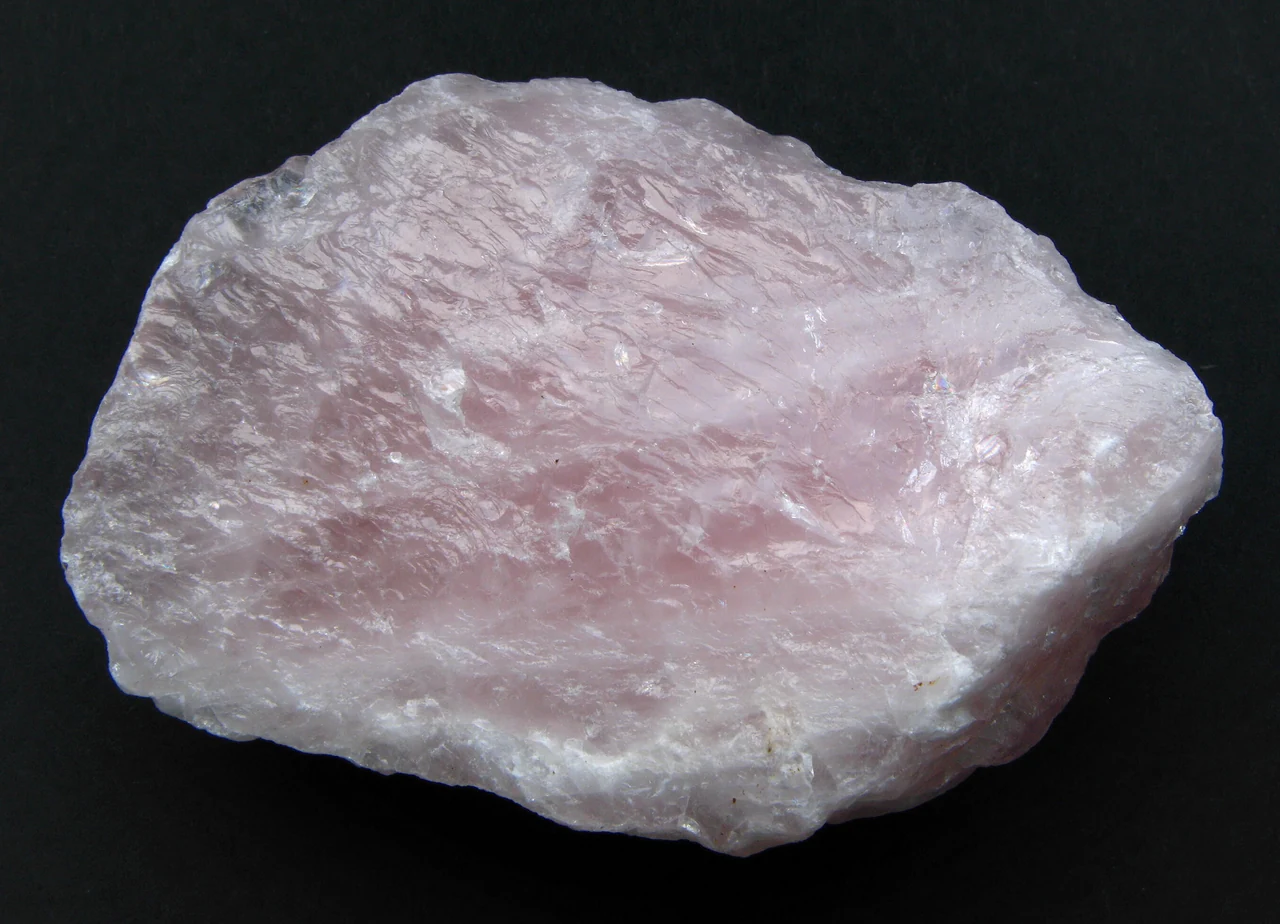
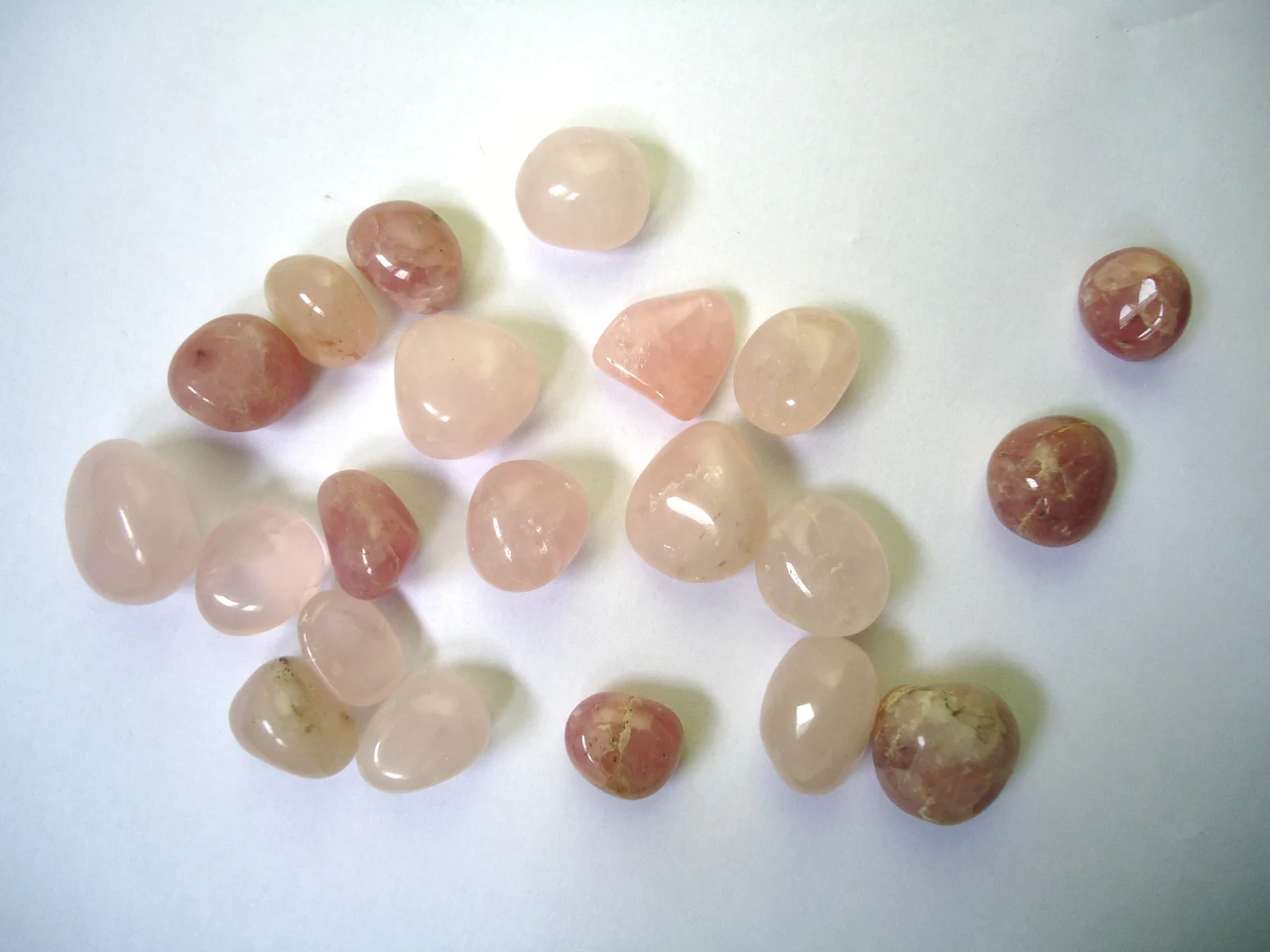
A pink quartz variety, often with a cloudy appearance. Its colour does not imply a physiological effect. Contemporary lithotherapy associates it with kindness.
In lithotherapy rose quartz is the stone of the heart: the tradition gives it gentleness, love and care, both for others and for oneself. We describe it as contemporary practitioners present it.
Meaning in lithotherapy
The Crystal Council calls rose quartz “a stone of pure love” that awakens the heart to its fullest capacity for love. It brings a sense of fulfilment and contentment, as well as spiritual attunement to the Earth, the Universe and the divine. In this description it encourages compassion, peace and tenderness, helps release tension, dissolve anger and resentment, and dispel fear and suspicion, so that hope and trust can be reborn. [43]
Crystal Vaults (Linda Mason) speaks of a “Crystal of Unconditional Love” and a “Heart Stone” carrying a soft, feminine energy of compassion. Its task is to dissolve emotional wounds, worries and resentment, and to remind the heart of its own innate love — including love directed towards oneself. [122]
Crystal Vaults widens this picture: rose quartz is meant to inspire the love of beauty — in oneself, in others, in nature and especially in art, music and the written word; to be a stone of the “Great Mother” linking the human heart with the heart of the Earth and the Universe; and to balance yin and yang. It gives special attention to people who were not loved in childhood: according to this source the stone helps “reprogram” the heart, because only love for oneself makes it possible truly to love others. It is also meant to comfort in crisis, in grief and during a mid-life upheaval. Divinatory meaning: “Forgive yourself for past mistakes and do not accept the blame others try to offload on you.” [122]
The Crystal Council adds that carrying rose quartz is meant to make one more aware of negative energies and that the stone “harmonises with all stones”: with emerald it deepens the heart’s awakening and the link with Venus, with tiger’s eye it helps move from the heart’s desires to action, and with blue tiger’s eye it helps recognise and clear heavy energies from the aura. [43]
Ways of working with the stone
In meditation rose quartz is said to “connect” with the heart at once and envelop it in soothing energy, which is why The Crystal Council advises holding or wearing it close to the heart. The same description presents it as a stone for attracting new love, romance and intimacy. [43]
Crystal Vaults extends the practices to the home and daily life: the stone is placed by the bed or in the “relationship corner” of the home to restore trust and harmony, and it is recommended for bath rituals and as jewellery. It also describes a simple layout for couples — a shared photograph surrounded by a heart shape made of small rose-quartz crystals. [122]
Crystal Vaults describes a “love altar”: pink roses, twin rose-quartz hearts and lit pink candles (never leave candles unattended). Rose quartz is there also a “sleep crystal” for adults and children — meant to bring beautiful dreams and help children not to fear the dark — and a large unpolished piece at work is meant to protect against intrusion and gossip. Meditation with rose quartz is meant to bring “resonance with compassion” and release emotional patterns that hold one back. [122]
Chakras, elements and astrology
Both authors link rose quartz with the heart chakra and with Taurus, Libra and Scorpio. They differ on the element — water for The Crystal Council, “subdued fire” for Crystal Vaults — and Crystal Vaults also associates the stone with goddesses of love such as Aphrodite. [43][122]
Chakras
heart (both sources); Crystal Vaults also names the root chakra [43][122]
Element
water according to The Crystal Council; “subdued fire” according to Crystal Vaults [43][122]
Zodiac signs
Taurus, Libra, Scorpio (The Crystal Council); Scorpio as the main sign, also supporting Taurus and Libra (Crystal Vaults) [43][122]
“natural birthstone” for people born 22 October – 20 November (Crystal Vaults) [122]
Deities
Aphrodite (Venus) and Astarte (Crystal Vaults) [122]
Feng shui
“subdued” Fire energy — the south of the home, the Fame and Reputation area (Crystal Vaults) [122]
Cleansing and “charging” in the tradition
Crystal Vaults recommends cleansing rose quartz with water but not with salt water, and for “charging” it particularly recommends the sound of a singing bowl. It treats sunlight as acceptable, with the caveat that the colour may fade over time. [122]
History
History and beliefs
We found no older beliefs about rose quartz in the historical sources we read (in Kunz it appears only in modern lists), but museum collections document its early use. The Metropolitan Museum of Art holds a gold double-bird pendant of the Coclé (Macaracas) culture of Panama, dated 950–1100, set with rose quartz, and Chinese vessels carved in rose quartz from the Qing dynasty — an eighteenth-century vase and an incense burner of the Qianlong period (1736–1795). The museum records document the material and date; they say nothing about beliefs attached to the stone. [148][149][150]
Where the sources differ
Crystal Vaults retells a myth in which rose quartz arose when Aphrodite was wounded rescuing Adonis from Ares, and the belief that Egyptians and Romans used it for a beautiful complexion. In the historical source we read (Kunz, 1913) rose quartz appears only in modern tables, without such stories — so we treat them as part of the practitioners’ contemporary narrative, not as confirmed history. [122][120]
An Avonoria editorial suggestion
Editorial suggestion — not a documented rite
For one week, begin each day with a moment holding the stone: name one thing you will do kindly for yourself today and one for someone close to you. In the evening, check what happened.
Scope of the sources: The history rests on museum object records (material, culture, date), not on accounts of beliefs. Crystal Vaults practices concerning pregnancy, birth and infants are deliberately omitted pending a safety review; elixirs and health claims are not reproduced.
Usually pale to stronger pink, translucent and massive, without well-developed crystal faces. Rough surfaces can be glassy or waxy; polishing reveals rounded edges and internal cloudiness. [17][1]
Reference properties
View under neutral lighting and compare existing surfaces only. Hardness and streak below are reference data: do not scratch, break, heat or grind the specimen. Ask a specialist to examine valuable or unidentified materials.
Quartz forms in many settings, including hydrothermal veins, pegmatites and igneous rocks. It also occurs in sediments and metamorphic rocks. A variety name cannot establish the origin of an individual specimen. [1][31][17]
GIA permits brief cleaning with warm, mild soapy water. This is not advice to soak, make drinks or apply it to specimens with unknown treatment. Dry carefully; check the setting and coatings. [25]
Storage and specimen form
Separate from other specimens and protect from drops and abrupt temperature changes.
Store the intact specimen securely; wash hands after handling rough material. Do not generalise care advice to unidentified materials or coatings.
Do not grind or drill at home. Dust is a different exposure route from handling an intact specimen. [37]
FAQ
Is the name enough to identify a specimen?
No. This card describes a material and does not authenticate your specimen. For a valuable purchase, request provenance, treatment disclosure and, when appropriate, gemological testing.
What research says — in brief
Rose quartz is the only crystal in this atlas tested in a larger controlled study: in 2025, 138 adults carried it or a similar glass pebble for 14 days. Anxiety fell only among people who believed in crystals — whether or not they had the real stone — and no difference between the groups was shown. Participants did not have diagnosed anxiety disorders. [36]
Mineralogical, gemological, institutional or scientific source. Its scope is recorded in the source index.
Rose Quartz — practitioner accountThe Crystal Council · accessed 2026-09-30
Commercial practitioner source: documents beliefs, not medical evidence. The site sells crystals, so we give a bibliographic description without an active link; the full address is kept in Avonoria’s source documentation.
Photograph identity and usage-rights source; not a test of specimen composition.
Rose Quartz meaning and uses — practitioner accountCrystal Vaults · accessed 2026-10-04
Commercial practitioner source: documents beliefs, not medical evidence. The site sells crystals, so we give a bibliographic description without an active link; the full address is kept in Avonoria’s source documentation.