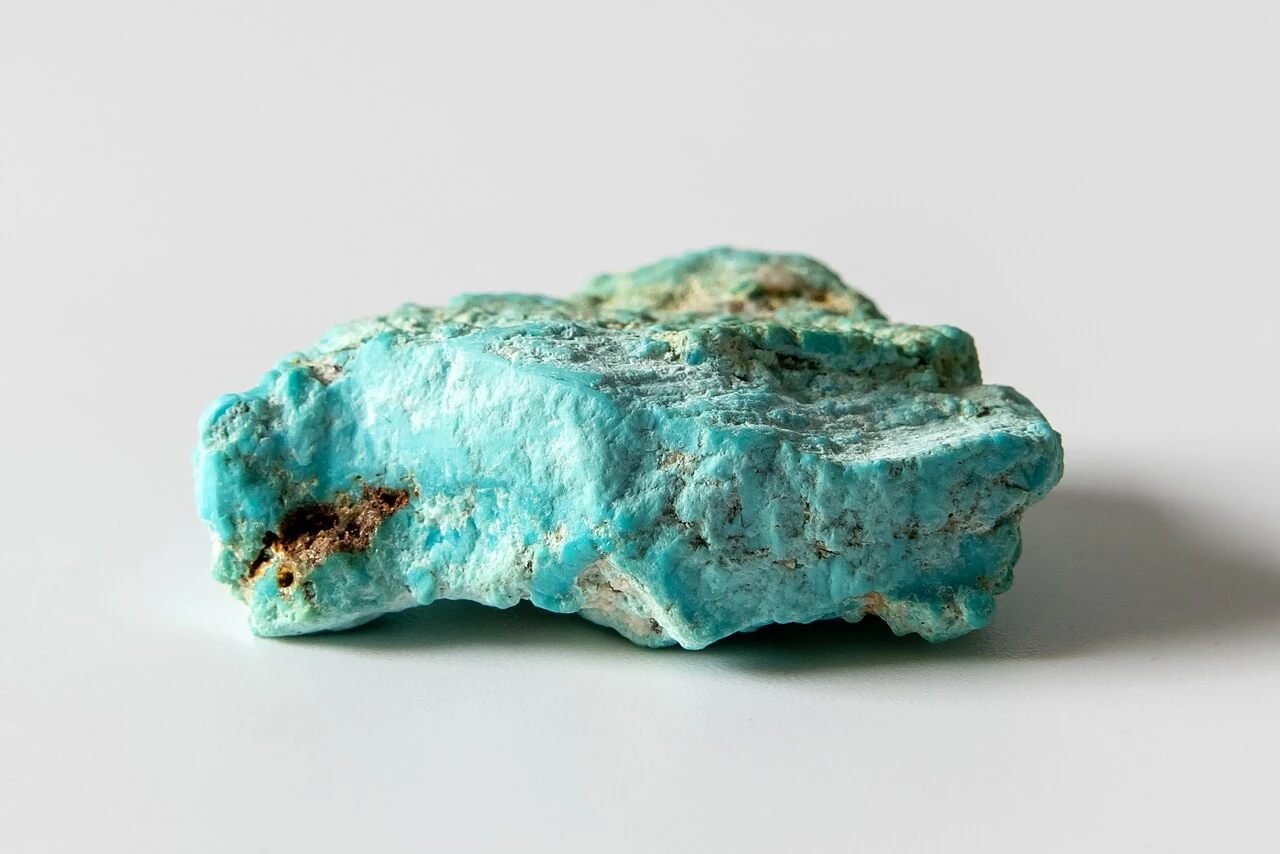
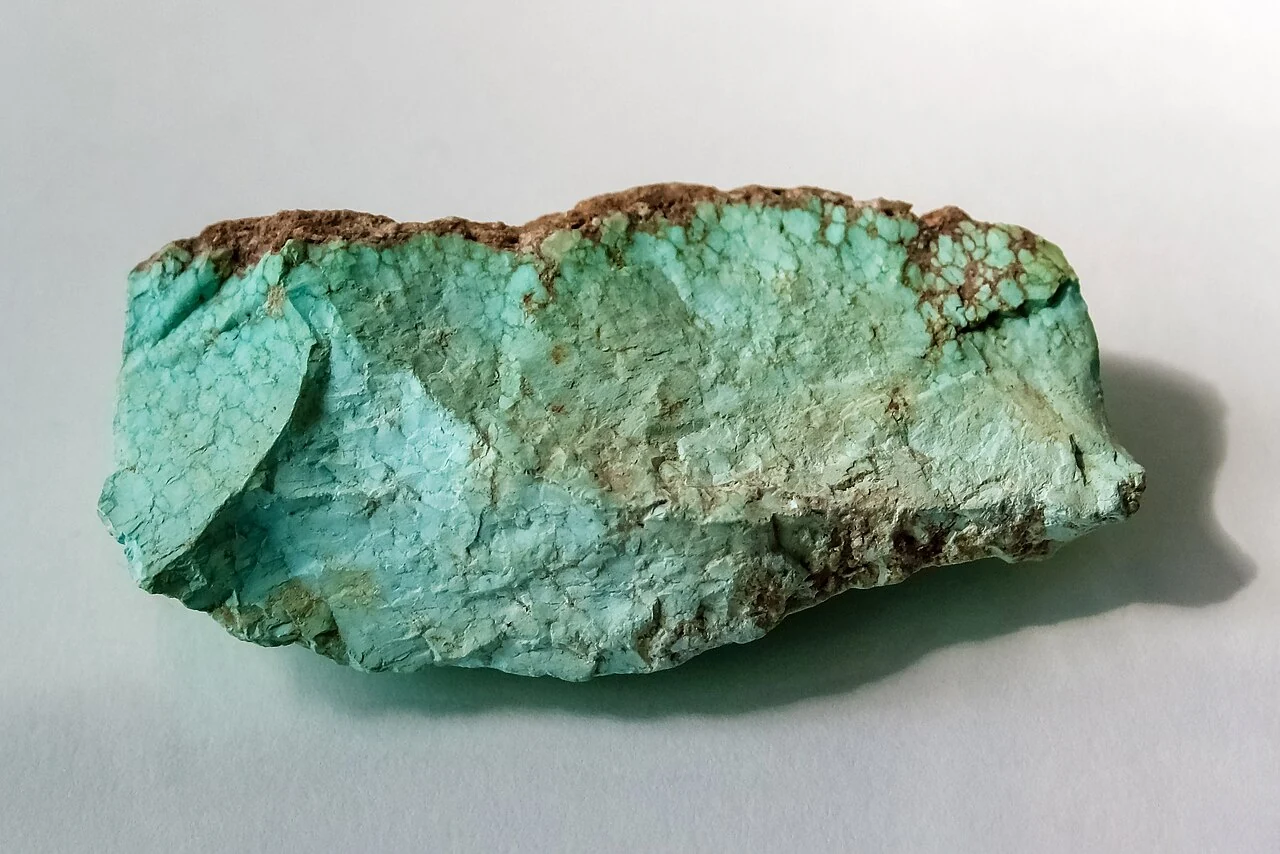
Turquoise is a hydrated copper aluminium phosphate, usually seen as an opaque blue or greenish aggregate. It is not a name for any turquoise-coloured stone. Host-rock veining and porosity influence the appearance of a finished ornament.
Truthful expression and friendship provide the starting point. The communication practice was written for this entry; it does not reconstruct a particular community’s ceremony.
Lithotherapy tradition
The authors’ meanings and correspondences are presented in the full lithotherapy extension. [252][253]
Meaning in lithotherapy
The Crystal Council describes turquoise as a stone of truthfulness and expressing thoughts. Practitioners link it with the throat chakra and a sense of wholeness. This can be read as symbolic language about communication: a reminder to name one’s position. The page also contains claims about health and historical communities; these are not adopted as established facts. The author also presents it as a stone of wholeness and calm self-acceptance. Symbolic truth includes expressing one’s view and recognising what has previously been difficult to name. [252]
Correspondences and differences
TCC assigns turquoise to the throat within its contemporary spiritual system. [252][253]
A second contemporary approach
Crystal Vaults emphasises turquoise as a talisman of friendship and protection, including stories about giving it to someone close. Alongside TCC’s truth theme, this creates two emphases: how we speak and the quality of a bond. We do not repeat promises of protection from falls or claims that colour change diagnoses health. A friend’s gift and a personal talisman carry different shades of the same account of connection. The catalogue also includes turquoise among good-fortune symbols. [253]
An Avonoria editorial suggestion
Editorial suggestion — not a documented rite
An original communication practice: place turquoise beside a notebook before an important conversation. Write three sentences: what happened, what you want to communicate and what you are asking for. Separate observation from assumptions about another person’s intentions. Read the text aloud, then shorten it to one calm statement. The stone can stay on the desk; it need not be held against your throat. Afterwards, note whether your request was understood. This gives truth symbolism a concrete direction without assuming that a mineral will change someone else’s behaviour. Before speaking, also check whether the timing is appropriate. A brief request to arrange a conversation can be better than unexpectedly starting a difficult exchange. When listening, put the prepared note aside so the conversation does not become a script-reading exercise. Turquoise is not meant to persuade someone for you. Its role ends with reminding you of the chosen speaking style; an ordinary blue mark in a notebook can do the same.
Scope of the sources: You can describe your own sensations as personal experience. The exercise does not require accepting every belief in both catalogues; choose meanings you understand and leave room to revise your interpretation.
Turquoise is a hydrated copper aluminium phosphate, usually seen as an opaque blue or greenish aggregate. It is not a name for any turquoise-coloured stone. Host-rock veining and porosity influence the appearance of a finished ornament. [250][251]
Reference properties
Observe existing surfaces in neutral light. Mohs values are not instructions to scratch, break or heat.
It forms secondarily in alteration zones associated with copper deposits. GIA describes copper-bearing waters interacting with rocks containing phosphorus and aluminium. The term Persian blue can describe colour rather than establish Iranian origin. [250][251]
Editorial suggestion — not a documented rite
Request a written material description and disclosure of all declared treatments. If a mine name matters to your choice, ask for documentation. Examine the matrix and setting as well; compare the price with the description of the actual item.
Personal / spiritual practice
You can describe your own sensations as personal experience. The exercise does not require accepting every belief in both catalogues; choose meanings you understand and leave room to revise your interpretation.
GIA permits warm soapy-water cleaning but excludes steam and ultrasound. Cosmetics, perspiration and oils can discolour the stone; strong heat damages its surface. With unknown impregnation, begin with a dry cloth. Salt, ritual baths and solvents are not care methods here.
Storage and specimen form
Store separately on a stable surface away from strong heat and falls.
GIA permits warm soapy-water cleaning but excludes steam and ultrasound. Cosmetics, perspiration and oils can discolour the stone; strong heat damages its surface. With unknown impregnation, begin with a dry cloth. Salt, ritual baths and solvents are not care methods here.
Do not grind, drill or break the specimen at home. Dust requires a separate exposure assessment. [37]
FAQ
What should I know before choosing?
Does dark veining prove authenticity? No. Pattern and colour alone do not establish the material. Reliable disclosure and, depending on value, testing are needed.
What research says — in brief
The cited clinical trial concerned rose quartz, not this atlas entry. It does not establish a therapeutic effect for this material; the symbolism is presented for understanding traditions and personal practice. [159]
TurquoiseMineral Data Publishing / Handbook of Mineralogy · accessed 2026-10-29
Mineralogical, gemological, institutional or scientific source. Its scope is recorded in the source index.
Turquoise DescriptionGemological Institute of America · accessed 2026-10-29
Mineralogical, gemological, institutional or scientific source. Its scope is recorded in the source index.
turquoise — Meanings and Crystal PropertiesThe Crystal Council · accessed 2026-10-29
Commercial practitioner source: documents beliefs, not medical evidence. The site sells crystals, so we give a bibliographic description without an active link; the full address is kept in Avonoria’s source documentation.
turquoise — meanings and usesCrystal Vaults · accessed 2026-10-29
Commercial practitioner source: documents beliefs, not medical evidence. The site sells crystals, so we give a bibliographic description without an active link; the full address is kept in Avonoria’s source documentation.
Turquoise Care and CleaningGemological Institute of America · accessed 2026-10-29
Mineralogical, gemological, institutional or scientific source. Its scope is recorded in the source index.
FluorapatiteMineral Data Publishing / Handbook of Mineralogy · accessed 2026-10-29
Mineralogical, gemological, institutional or scientific source. Its scope is recorded in the source index.
Placebo effects in alternative medical treatments for anxiety: false hope or healing potential?Cambridge University Press / CNS Spectrums · 2025 · accessed 2026-10-29DOI: 10.1017/S1092852925100515
Mineralogical, gemological, institutional or scientific source. Its scope is recorded in the source index.