A green to blue-green microcline variety in the feldspar group. We do not generalise colour mechanisms or lead content to every specimen without material-specific analysis.
Amazonite, a blue-green feldspar, is in lithotherapy a stone of calm, truth and courage in speaking. Contemporary practitioners call it the “peacemaker stone”; its name is linked with the Amazon.
Meaning in lithotherapy
The Crystal Council describes amazonite as a stone of peace, truth, harmony and communication that gently soothes the nerves and radiates rejuvenating “blue rays” — hence the nickname “peacemaker stone”. It is meant to encourage adventure, love, inspiration and free speech, strengthen intention-setting and help chart a path to one’s greatest dreams, and to bring inner peace, joy and relaxation. [61]
Crystal Vaults (Linda Mason) calls it the Stone of Courage and the Stone of Truth: it helps one discover one’s own truths and integrity, search the self and express thoughts and feelings freely. It is meant to calm the mind, ease worry and fear, strengthen self-esteem and help set appropriate boundaries. [144]
Crystal Vaults also describes amazonite as a healer of the chakras, meant to align the physical body with the etheric, balance masculine and feminine energies and awaken compassion by letting one see both sides of a problem and accept another’s point of view. Its spiritual energy is “personal truth”: a harmonious interplay of intellect and intuition that lets one find what is right within oneself and communicate it lovingly to others. Its turquoise colour — the colour of the world at the spring equinox — is meant, according to this source, to temper extremes, restore calm after a storm and bring one back to the centre. [144]
In the same source amazonite is a stone of good fortune at work: it is meant to dispel irritation, protect against unfair business practices, attract new customers and help one be in the right place at the right time. One legend quoted by Crystal Vaults calls it the “Hope Stone” — after its spring-sky colour. [144]
Ways of working with the stone
The Crystal Council advises keeping amazonite in a pocket during difficult conversations, voicing one’s wish while holding the stone firmly, and laying it on the throat to fully “unlock” the chakra; placed in a room, it is meant to calm the atmosphere. Crystal Vaults describes meditation with amazonite as bringing keen awareness of everything in consciousness; it recommends wearing it as jewellery, keeping it at work to dispel irritation, and placing it by computers. [61][144]
Crystal Vaults stresses that because amazonite works through the throat chakra, intentions must be spoken aloud: one holds the stone and clearly affirms what one wants to create. Sleeping with amazonite is meant to let matters that need resolving appear in the symbolism of dreams. A good-luck charm for games of chance and financial ventures: three amazonites with a little basil and mint in a small pouch, left in front of a turquoise candle until it burns down (never leave a candle unattended). Household customs include hiding an amazonite in a child’s or teenager’s room “for tidiness” and keeping a dish of amazonites on the kitchen table so that others help more with chores. [144]
Water energy — the north of the home, the Career and Life Path area (Crystal Vaults) [144]
History
History and beliefs
The firmest trace of early use we found is a museum object: the Metropolitan Museum of Art holds a head-shaped ornament of the Tolita-Tumaco culture (the borderland of present-day Colombia and Ecuador, 500 BCE – 300 CE), made, according to the museum’s record, of gold and amazonite. The record documents the material and the date, not beliefs. [147]
In illustration captions Kunz (1913) lists Egyptian necklaces with “amazon stones” (an old trade name for amazonite) — one with rock crystal and emeralds, another with emeralds and gold beads of the first century AD. He also writes that green feldspar, called uat in Egypt and often used for amulets, was in his view more likely than emerald to have been the third stone of the original high priest’s breastplate. This is Kunz’s hypothesis and concerns “green feldspar”, not amazonite as such; Crystal Vaults transfers it directly to amazonite. [120]
Where the sources differ
Both sources agree on the chakras and element and differ in emphasis: The Crystal Council speaks of peace and peacemaking, Crystal Vaults of courage and truth. Both link the name with the Amazon and mention an amazonite scarab ring in Tutankhamun’s tomb; Crystal Vaults adds the shields of the mythical Amazons and tablets of the Book of the Dead. The historical source we read does not confirm these threads — in Kunz the “green stone of the Amazons” described by Walter Raleigh was in fact jade. [61][144][120]
An Avonoria editorial suggestion
Editorial suggestion — not a documented rite
Place the stone beside a writing space and express one intention in a clear, ordinary sentence. Before a conversation that worries you, read the sentence and put the stone in your pocket.
Scope of the sources: The history rests on a museum object record and on Kunz’s captions and hypothesis; the legends of the Amazons, Book of the Dead tablets and Tutankhamun’s tomb have not been verified. None of the sources we read gives a ritual cleansing for amazonite, so none is added; its physical care is not established in the catalogue, so do not immerse it in water. Health claims from Crystal Vaults are not reproduced.
A green to blue-green variety of microcline; a specimen may have pale streaks or mottled colour. It is usually translucent to opaque. Lustre is glassy and may be pearly on cleavage surfaces. Rough specimens often retain angular feldspar forms. [11]
Reference properties
View under neutral lighting and compare existing surfaces only. Hardness and streak below are reference data: do not scratch, break, heat or grind the specimen. Ask a specialist to examine valuable or unidentified materials.
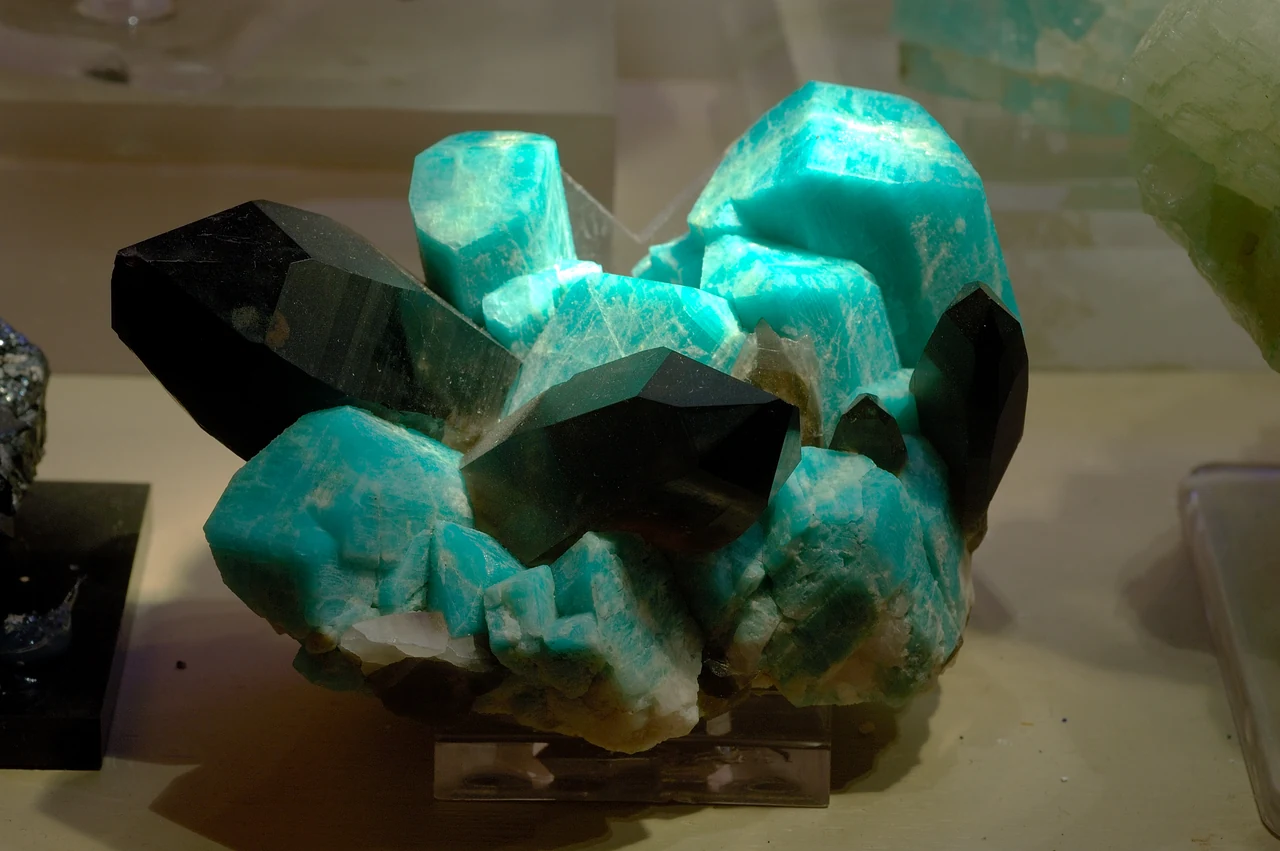
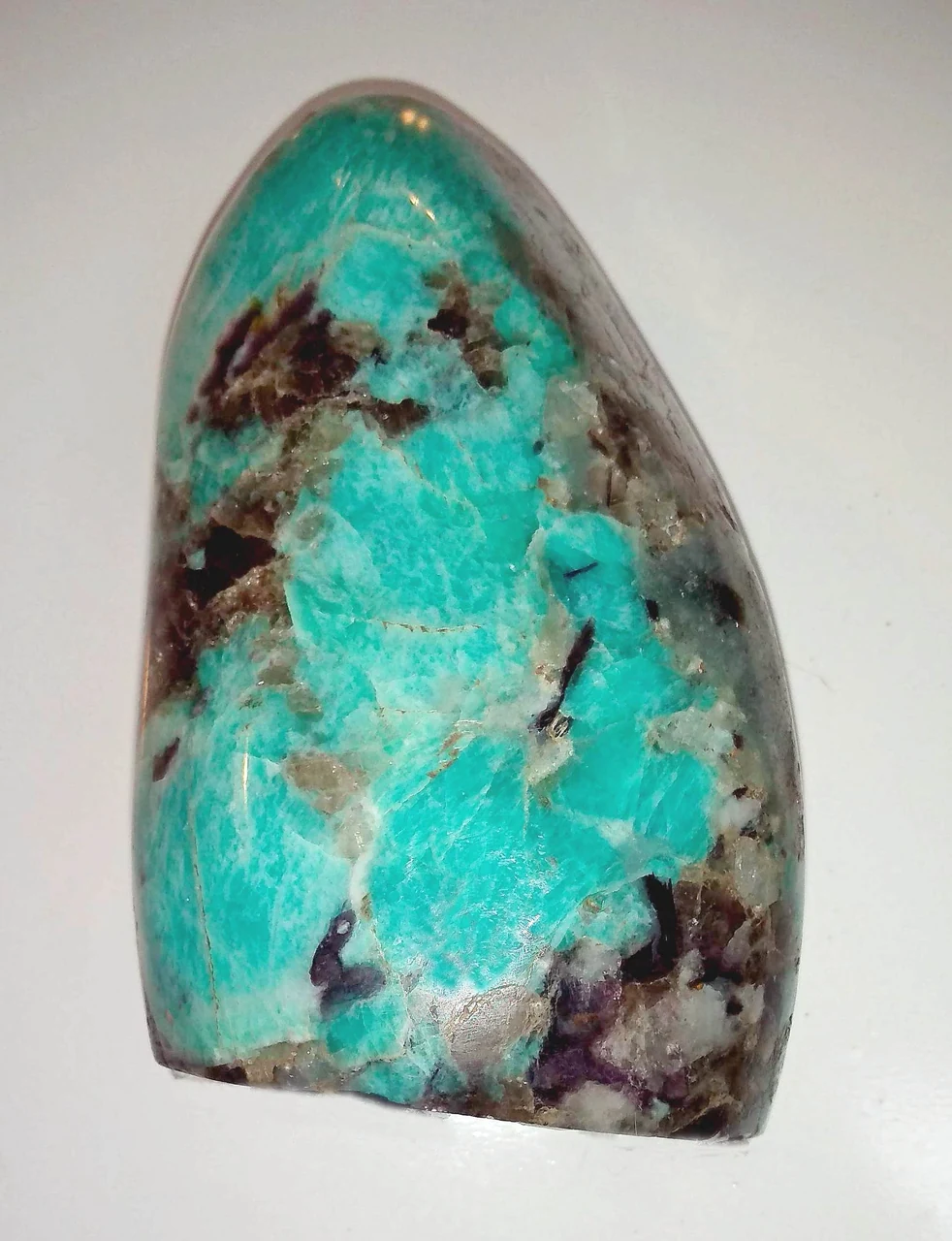
Blue-green amazonite crystals with dark smoky quartz from the Halpern collection. Polished amazonite specimen with blue-green and dark matrix areas. [118][119]
Common lookalikes and imitations
Turquoise
Why it looks similar
Blue-green colour and opacity can be similar.
What can help distinguish it
Amazonite is a feldspar with two perfect cleavage directions; turquoise differs in composition and is usually massive or fine-grained. Polishing can hide these features.
What a photograph cannot establish
A photograph does not establish composition, hardness or treatment.
Microcline has density about 2.54–2.57 g/cm³, compared with 3.24–3.43 for jadeite in the Handbook. A professional measurement is more useful than judging apparent weight in a photograph.
What a photograph cannot establish
A photograph does not establish composition, hardness or treatment.
Start with a soft, dry cloth. GIA, describing feldspar care using sunstone as the example, notes that feldspars are relatively soft, have cleavage in two directions (poor toughness) and are rapidly attacked by hydrochloric acid — so avoid cleaners containing bleach and protect the stone from knocks. We found no separate GIA guidance for this material, so we do not transfer water advice to it; unknown coatings, adhesives and settings need separate assessment. [155]
Storage and specimen form
Separate from other specimens and protect from drops and abrupt temperature changes.
Store the intact specimen securely; wash hands after handling rough material. Do not generalise care advice to unidentified materials or coatings.
Do not grind or drill at home. Dust is a different exposure route from handling an intact specimen. [37]
FAQ
Is the name enough to identify a specimen?
No. This card describes a material and does not authenticate your specimen. For a valuable purchase, request provenance, treatment disclosure and, when appropriate, gemological testing.
What research says — in brief
In the PubMed searches we found no studies of amazonite at all, including any testing whether a stone by a computer “blocks” anything. [129]
Mineralogical, gemological, institutional or scientific source. Its scope is recorded in the source index.
Amazonite — contemporary practitioner accountThe Crystal Council · accessed 2026-09-30
Commercial practitioner source: documents beliefs, not medical evidence. The site sells crystals, so we give a bibliographic description without an active link; the full address is kept in Avonoria’s source documentation.
Mineralogical, gemological, institutional or scientific source. Its scope is recorded in the source index.
Amazonite meaning and uses — practitioner accountCrystal Vaults · accessed 2026-10-04
Commercial practitioner source: documents beliefs, not medical evidence. The site sells crystals, so we give a bibliographic description without an active link; the full address is kept in Avonoria’s source documentation.