A name for a plagioclase compositional range, often showing striking colour play. Museum Wales describes labradorite as an informal term for An50–70 composition, rather than a separate currently approved mineral species.
Labradorite, a feldspar whose play of colour recalls the aurora, is in lithotherapy a stone of transformation and magic. Contemporary practitioners see it as protection for sensitive people and fuel for intuition.
Meaning in lithotherapy
The Crystal Council calls labradorite “the Magician’s Fuel”. It is meant to unlock the true potential of our power to transform and to help with anxiety and self-doubt, reminding us that we only need to see ourselves and others in the right light to see what truly makes us shine. Its themes are transformation, protection, intuition, synchronicity, expanded awareness, connection with nature and creativity. [51]
Crystal Vaults presents labradorite as the “Stone of Magic”, a crystal of shamans, diviners and healers and one of the strongest protectors of the mineral kingdom. It is meant to calm an overactive mind while energising the imagination and bringing new ideas; to restore joy and spontaneity and to banish fears and insecurities. [134]
Crystal Vaults calls labradorite the “matriarch of the subconscious mind”: it is meant to bring forgotten memories to light and help one understand them, encourage contemplation and dispel illusion, so that one can reach the root of a problem and find peace. In its role as protector of the aura it is meant to prevent energy “leakage” and others draining it, and in this source’s view to temper the dark sides of the personality that sap one’s strength. It is sometimes called the “temple of the stars”; according to beliefs reported by Crystal Vaults, its play of colour was of extraterrestrial origin. The divinatory meaning of labradorite in this source: “You may have to make the best of a less-than-ideal situation for a while, but soon you will be able to do things your way.” [134]
The Crystal Council develops the “Magician’s Fuel” theme: a practitioner of magic needs amulets and tools to conjure and channel energy, and labradorite is meant to provide a protective “cloak” of light whatever the size of the stone. The second axis of its account is self-worth — the reminder that one need only look in the right direction to see one’s own “flash”, just as labradorite’s colours appear only at the right angle. [51]
Ways of working with the stone
The Crystal Council advises holding labradorite and rubbing it between the fingers in a moment of sudden anxiety. Crystal Vaults describes a meditation in which labradorite lets one see humanity as a being of light; worn or carried, it is meant to let one’s innate “magical” abilities surface, and placed in spaces for rest, quiet reflection and prayer, to support stillness. [51][134]
Crystal Vaults distinguishes practices by variety. With golden labradorite one meditates to “open channels” to the archangels and moves the stone in a spiral above the hair to “mend” tears in the aura; spectrolite is meant for meditative journeying. At work labradorite is meant to encourage courtesy and attentiveness to customers and help temporary staff feel part of the team; it is also recommended to physiotherapists and all who work with touch, as it is said to sensitise the hands. [134]
Chakras, elements and astrology
Labradorite’s correspondences clearly diverge. The Crystal Council links it with seven chakras, air, five zodiac signs and Uranus and the Moon; Crystal Vaults names above all the throat chakra and the element of water, and stresses that the stone is tied to no sign, although Cancers are “drawn” to it. [51][134]
Chakras
crown, third eye, throat, heart, solar plexus, sacral, root (The Crystal Council); throat (Crystal Vaults) [51][134]
Element
air (“wind”) according to The Crystal Council; water in feng shui (the north of the home) according to Crystal Vaults [51][134]
Zodiac signs
Taurus, Leo, Scorpio, Sagittarius, Pisces (The Crystal Council); none — although Cancers are “drawn” to its colours (Crystal Vaults) [51][134]
“natural birthstone” 19 February – 19 March (Crystal Vaults); Saturday in one of the modern weekday lists in Kunz [134][120]
Deities and angels
Arianrhod and Cerridwen (Welsh); the angel Zadkiel (Crystal Vaults) [134]
Crystal type
“Barrier–Filter” in the Crystal Vaults system [134]
Cleansing and “charging” in the tradition
Crystal Vaults recommends cleansing labradorite in salt water and “charging” it in sunlight or moonlight, avoiding only chlorinated pool water. [134]
History
History and beliefs
In the sources we read labradorite has no older tradition of belief — as a mineral it was described in Europe only at the end of the eighteenth century. Kunz (1913) places it in modern lists: as the “phenomenal gem” for Saturday (beside moonstone for Monday and alexandrite for Friday) and among the “gems of winter”. These are jewellery-fashion lists of Kunz’s time, not old beliefs. [120]
Where the sources differ
Crystal Vaults retells an Inuit story in which labradorite fell from the “frozen fire” of the northern lights, and states that the stone was found in Labrador by Moravian missionaries in 1770, and the spectrolite variety in Finland in the 1940s. The Crystal Council also mentions its discovery in Labrador and a name given by a missionary. In the historical source we read, labradorite appears only in modern tables, without older beliefs — its rich symbolism is above all the work of contemporary lithotherapy. [134][51][120]
Crystal Vaults presents Saturday and winter as “ancient lore” and “Oriental culture”; in Kunz, however, these are modern lists. The same source quotes a second Inuit legend — of a warrior who struck labradorite with his spear and created the aurora — and states that the stone was used by the so-called Red Paint People of Maine; we have not checked these threads. [134][120]
An Avonoria editorial suggestion
Editorial suggestion — not a documented rite
Observe the changing colours as you gently turn the specimen, and write down another way of viewing a situation. This is a suggestion for personal reflection.
Scope of the sources: The Crystal Vaults labradorite page has no single author. We have not checked the Inuit story in ethnographic sources; we quote it only from the practitioner. Health claims are not reproduced.
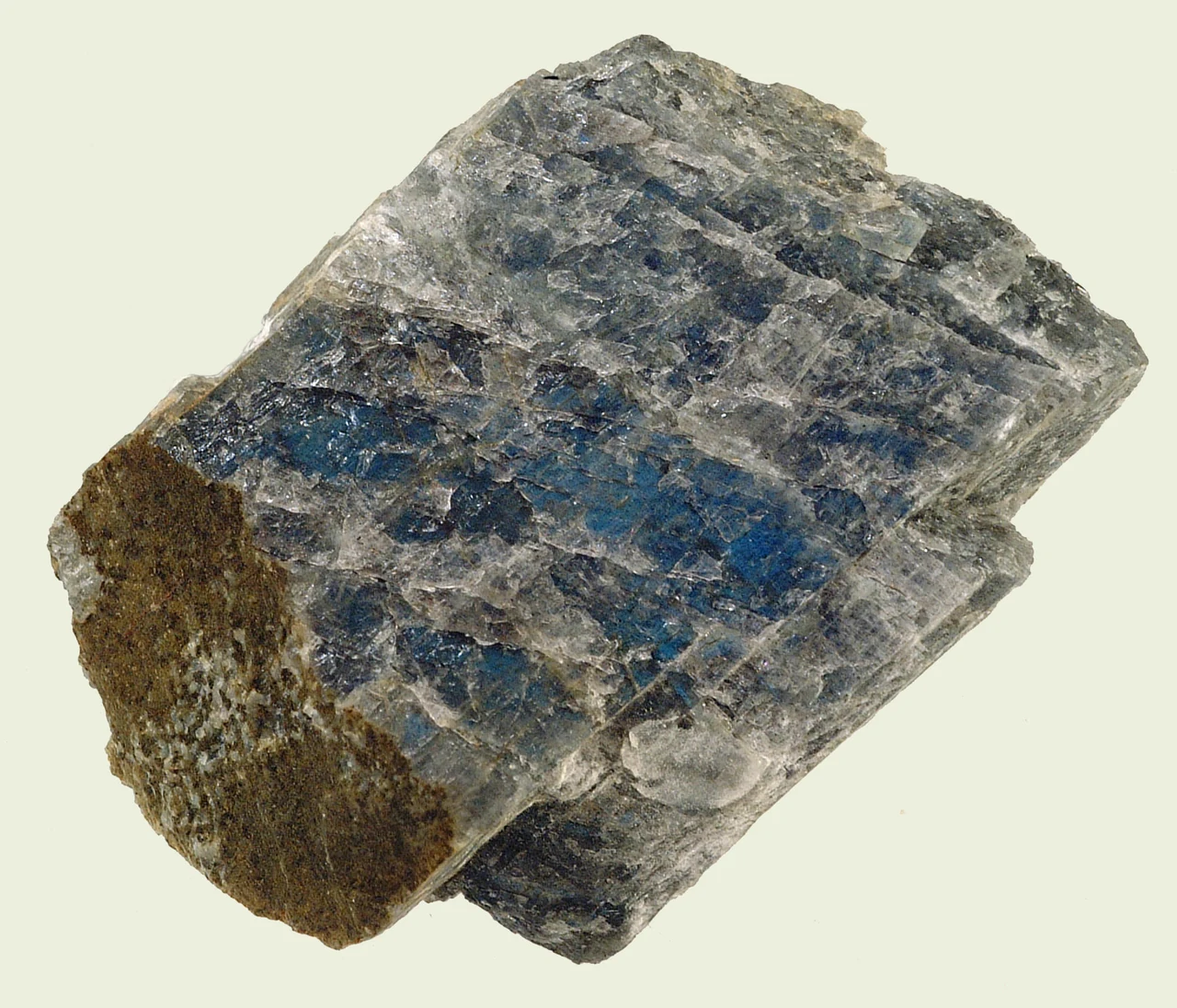
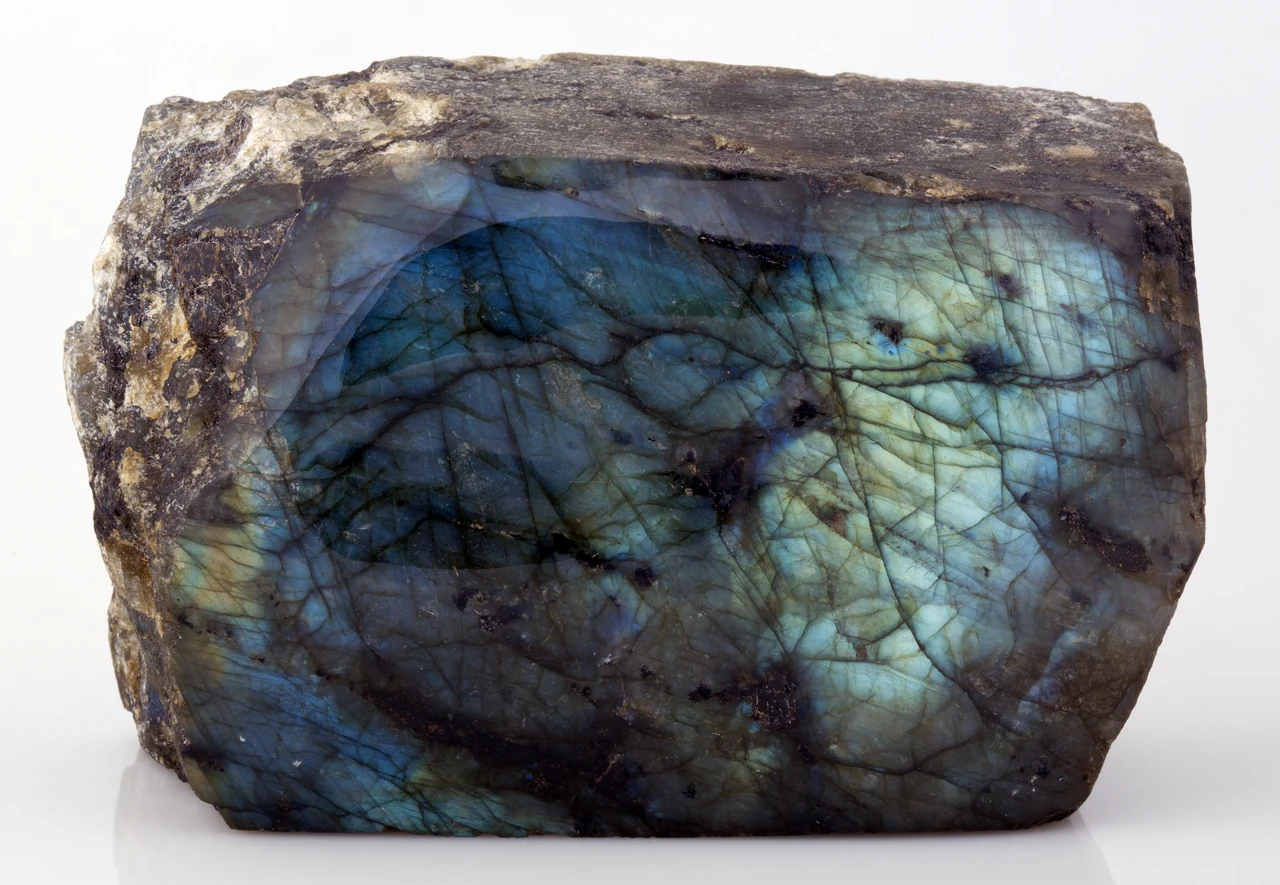
Usually a grey feldspar that may show blue, green, yellow or other coloured flashes at suitable lighting angles: labradorescence. The effect is directional, so one surface can look dark or intensely colourful. It is not equally obvious in every fragment. [32][3]
Reference properties
View under neutral lighting and compare existing surfaces only. Hardness and streak below are reference data: do not scratch, break, heat or grind the specimen. Ask a specialist to examine valuable or unidentified materials.
Angular labradorite specimen with a grey body and blue flashes. Cut and polished labradorite from the UCL collection, showing blue-green labradorescence. [94][95]
Common lookalikes and imitations
Moonstone
Why it looks similar
Feldspars can show a shifting glow or coloured flashes.
What can help distinguish it
Classic adularescence is a milky glow; labradorescence often shows more distinct coloured planes. Rainbow moonstone may itself be labradorite.
What a photograph cannot establish
A still photograph does not show the full effect as the specimen is turned.
A component of igneous rocks including anorthosites and mafic rocks. The name refers to Labrador, Canada. The formula is a general expression for variable composition. [3][32]
Start with a soft, dry cloth. GIA, describing feldspar care using sunstone as the example, notes that feldspars are relatively soft, have cleavage in two directions (poor toughness) and are rapidly attacked by hydrochloric acid — so avoid cleaners containing bleach and protect the stone from knocks. We found no separate GIA guidance for this material, so we do not transfer water advice to it; unknown coatings, adhesives and settings need separate assessment. [155]
Storage and specimen form
Separate from other specimens and protect from drops and abrupt temperature changes.
Store the intact specimen securely; wash hands after handling rough material. Do not generalise care advice to unidentified materials or coatings.
Do not grind or drill at home. Dust is a different exposure route from handling an intact specimen. [37]
FAQ
Is the name enough to identify a specimen?
No. This card describes a material and does not authenticate your specimen. For a valuable purchase, request provenance, treatment disclosure and, when appropriate, gemological testing.
What research says — in brief
We found no studies of labradorite in lithotherapy or medicine. [129]
Mineralogical, gemological, institutional or scientific source. Its scope is recorded in the source index.
Labradorite — contemporary practitioner accountThe Crystal Council · accessed 2026-09-30
Commercial practitioner source: documents beliefs, not medical evidence. The site sells crystals, so we give a bibliographic description without an active link; the full address is kept in Avonoria’s source documentation.
Mineralogical, gemological, institutional or scientific source. Its scope is recorded in the source index.
Labradorite meaning and uses — practitioner accountCrystal Vaults · accessed 2026-10-04
Commercial practitioner source: documents beliefs, not medical evidence. The site sells crystals, so we give a bibliographic description without an active link; the full address is kept in Avonoria’s source documentation.