Aquamarine, the sea-blue variety of beryl, is in lithotherapy a stone of calm speech, courage and water. Contemporary practitioners link it with speaking the truth from the heart, and older beliefs with protecting sailors and banishing fear.
Meaning in lithotherapy
According to The Crystal Council, aquamarine opens a clear channel between the heart and throat chakras so that one can speak from the heart and of the highest truths. It helps resolve conflicts, arguments and disagreements by “cooling” fiery emotions, and gives confidence in speaking — which is why it is recommended for teachers, managers, therapists and anyone who speaks in public. [59]
Crystal Vaults (Linda Mason) sees in it the purity of crystalline waters: a stone of truth, trust and letting go, and at the same time an old sailors’ talisman of good luck, fearlessness and protection. It is meant to calm, soothe and cleanse, help with excessive anger or fear and ease the passage through change; Crystal Vaults also calls it a stone of eternal youth and happiness. [142]
Crystal Vaults also sees aquamarine as a mirror: a stone of symmetries that reflects the sky on the surface of the water and allows hidden meanings to be discovered — which is why it is meant to be a stone of prophets, shamans and mystics. It is also a “stone of natural justice”, favouring compromise and negotiation and giving quiet courage and carefully reasoned words in confrontation. The divinatory meaning of aquamarine: “Go with what is on offer rather than waiting for the ideal opportunity.” [142]
Ways of working with the stone
The Crystal Council advises wearing or carrying aquamarine daily to find the right words, tone and ideas more easily. Crystal Vaults recommends it for meditation and describes it as an amulet for everyone who travels by, over or near water — as sailors once carried it. [59][142]
Crystal Vaults gives practices for resolving disputes: pass aquamarine over a written complaint received or about to be sent, and carry it when visiting somewhere about a complaint or a neighbourhood dispute. As a travel stone it is meant to protect on journeys by sea, by air and on long drives, and to help when learning to swim; according to one tradition one can see one’s guardian angel through an aquamarine crystal pointing north. The Crystal Council recommends meditating with aquamarine together with “heart stones” — rhodonite, green opal, rose quartz, pink halite, chrysocolla and green calcite — and wearing it for public speaking to ease stage fright. [142][59]
Chakras, elements and astrology
Both sources see aquamarine as a stone of water and of the throat chakra; they part in astrology. Among older traditions, Kunz notes that the virtues of the beryl were governed by the sign of Libra — though in old texts “beryl” covered more than aquamarine. [59][142][120]
Chakras
throat and heart (The Crystal Council); throat (Crystal Vaults) [59][142]
Element
water (both sources; in Crystal Vaults also the north of the home in feng shui) [59][142]
Zodiac signs
Aries, Gemini, Pisces (The Crystal Council); Scorpio (Crystal Vaults); Libra for beryl in an older tradition (Kunz) [59][142][120]
Planets
Neptune (The Crystal Council); the Moon (Crystal Vaults) [59][142]
Month stone
March (Crystal Vaults; also a modern list in Kunz, alongside bloodstone) [142][120]
“Seeker–Energizer” in the Crystal Vaults system [142]
Older beliefs
History and beliefs
Kunz describes an old set of amulets, one of which bore a “transparent, brilliant beryl of a sea-green hue” — evidently, he notes, aquamarine — which banished fear; another amulet in the set protected sailors from drowning. Around 1220 Arnoldus Saxo, following older lapidaries, wrote that beryl helped against foes in battle and in litigation, made the wearer unconquerable yet amiable, quickened the intellect and cured laziness; an old German translation of Thomas of Cantimpré adds that beryl “reawakens the love of married people”. [120]
Beryl was also an old seers’ stone: polished beryl spheres were often preferred for gazing into visions, and an old belief held that beryl gave more visions than any other mineral. Kunz mentions a “consecrated beryl” kept in seventeenth-century Herefordshire and the “Stones of Power” in the Scottish regalia that Highlanders regarded as amulets. [120]
Pliny the Elder (Natural History, book 37, chapter 20) wrote that the most esteemed beryls are those resembling “the pure green of the sea”, and that lapidaries cut them in hexagonal form because the angles heighten the colour. The people of India, he said, were especially fond of elongated beryls, which they pierced and strung on elephant bristles. The translators connect this sea-green beryl with the name aquamarine. [145]
Where the sources differ
The sailing theme unites all the sources: Crystal Vaults speaks of a sailors’ talisman and “mermaids’ treasure”, and Kunz of a fear-banishing amulet in a set protecting sailors. Astrological correspondences diverge (Pisces and Neptune in The Crystal Council, Scorpio and the Moon in Crystal Vaults). Some older beliefs concern beryl in general, not only its blue variety. [142][120][59]
Crystal Vaults adds threads we have not checked: Roman fishermen who are said to have named the stone, a link with St Thomas the Apostle as patron of sea voyages, beads from Egyptian tombs, and a recipe from the “Magick of Kiram” (1685): engrave a crow with a crab beneath its feet on the stone to bring joy and prosperity. [142]
An Avonoria editorial suggestion
Editorial suggestion — not a documented rite
Before a difficult conversation, write down what you want to convey and one question for the other person. Hold the stone, take a few calm breaths and read your note aloud.
Scope of the sources: Health claims from Crystal Vaults, including placing the stone on the eyelids, are not reproduced. None of the sources we read describes how to cleanse aquamarine; GIA allows a brief wash with warm water and mild soap.
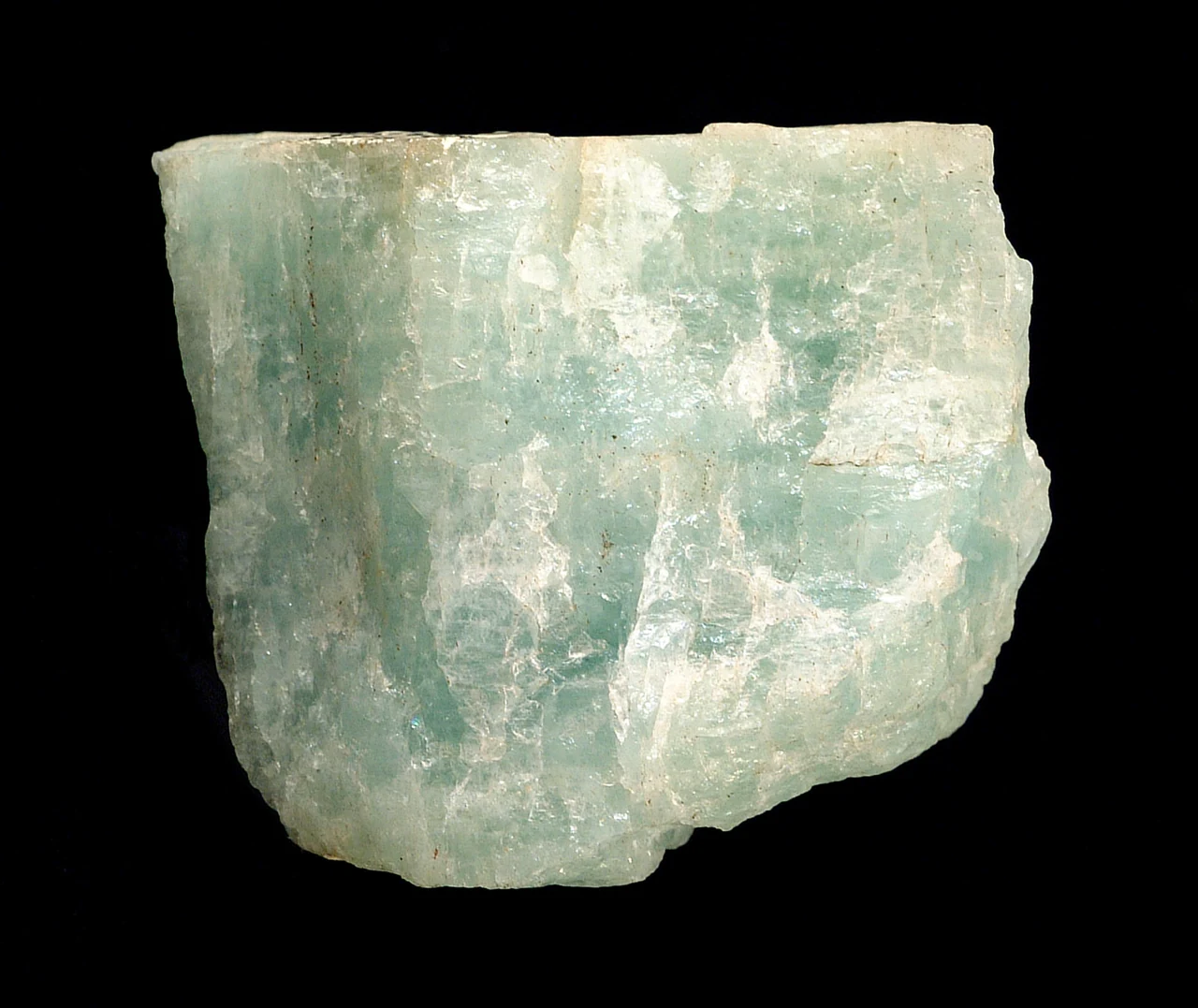
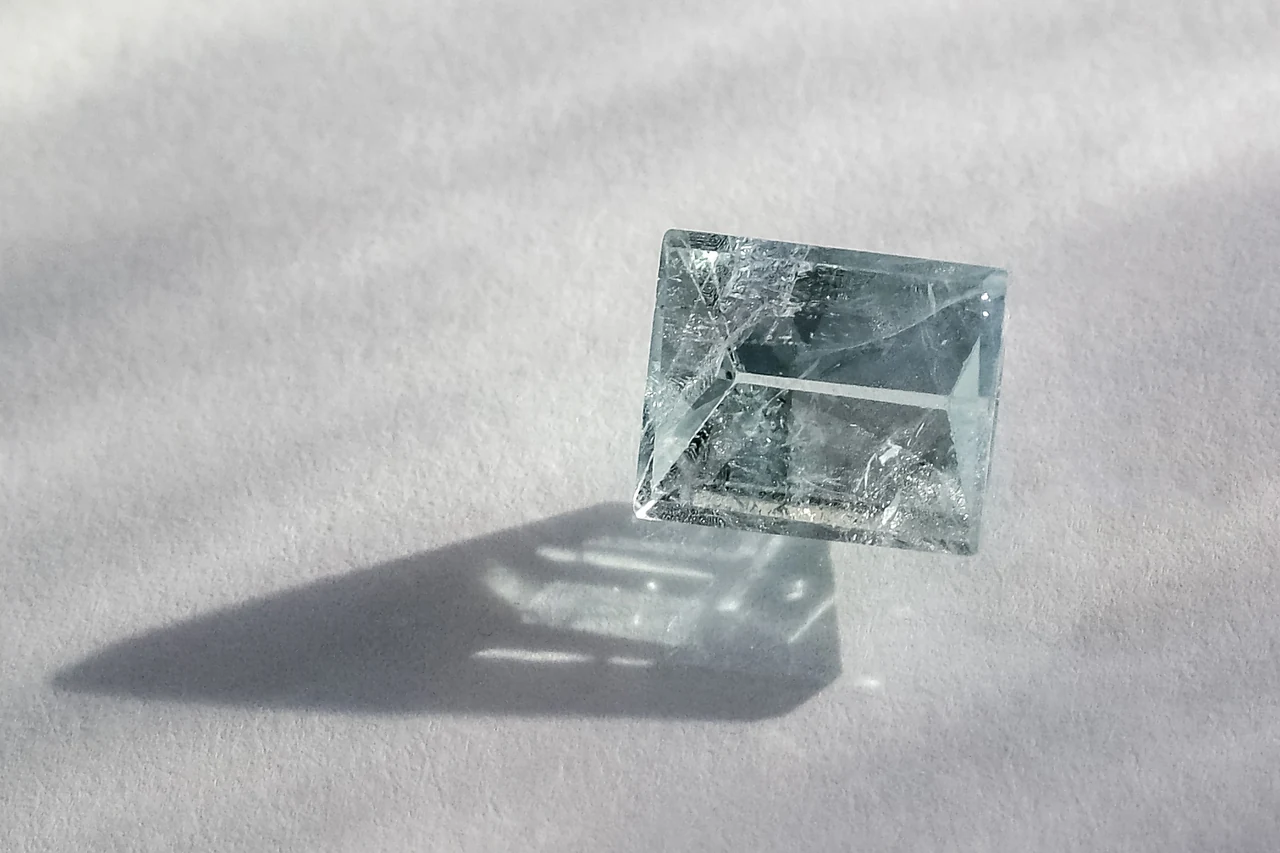
Blue to greenish blue beryl, usually with a glassy lustre. Natural crystals are prismatic, often six-sided; gem material can be highly transparent. Fractures and cloudiness occur in collecting specimens. Colour cannot establish treatment or geographical origin. [21][8]
Reference properties
View under neutral lighting and compare existing surfaces only. Hardness and streak below are reference data: do not scratch, break, heat or grind the specimen. Ask a specialist to examine valuable or unidentified materials.
Rough, angular aquamarine specimen with a pale blue-green colour. Transparent pale bluish aquamarine cut into a square gem. [110][111]
Common lookalikes and imitations
Blue topaz
Why it looks similar
Blue colour and high transparency can look similar.
What can help distinguish it
Beryl and topaz differ in optical properties and cleavage: topaz has perfect basal cleavage, beryl imperfect cleavage. Similar Mohs hardness is not decisive.
What a photograph cannot establish
A photograph does not establish composition, hardness or treatment.
Beryl is associated with pegmatites among other settings. GIA traces aquamarine’s name to Latin words for water and sea. Stories about protecting sailors are folklore, not efficacy evidence. [8][21]
GIA permits brief cleaning with warm, mild soapy water. This is not advice to soak, make drinks or apply it to specimens with unknown treatment. Dry carefully; check the setting and coatings. [29]
Storage and specimen form
Separate from other specimens and protect from drops and abrupt temperature changes.
Store the intact specimen securely; wash hands after handling rough material. Do not generalise care advice to unidentified materials or coatings.
Do not grind or drill at home. Dust is a different exposure route from handling an intact specimen. [37]
FAQ
Is the name enough to identify a specimen?
No. This card describes a material and does not authenticate your specimen. For a valuable purchase, request provenance, treatment disclosure and, when appropriate, gemological testing.
What research says — in brief
We found no studies of aquamarine in lithotherapy; results for the name concerned drug trials with that acronym. [129]
Mineralogical, gemological, institutional or scientific source. Its scope is recorded in the source index.
Aquamarine — contemporary practitioner accountThe Crystal Council · accessed 2026-09-30
Commercial practitioner source: documents beliefs, not medical evidence. The site sells crystals, so we give a bibliographic description without an active link; the full address is kept in Avonoria’s source documentation.
Photograph identity and usage-rights source; not a test of specimen composition.
Aquamarine meaning and uses — practitioner accountCrystal Vaults · accessed 2026-10-04
Commercial practitioner source: documents beliefs, not medical evidence. The site sells crystals, so we give a bibliographic description without an active link; the full address is kept in Avonoria’s source documentation.