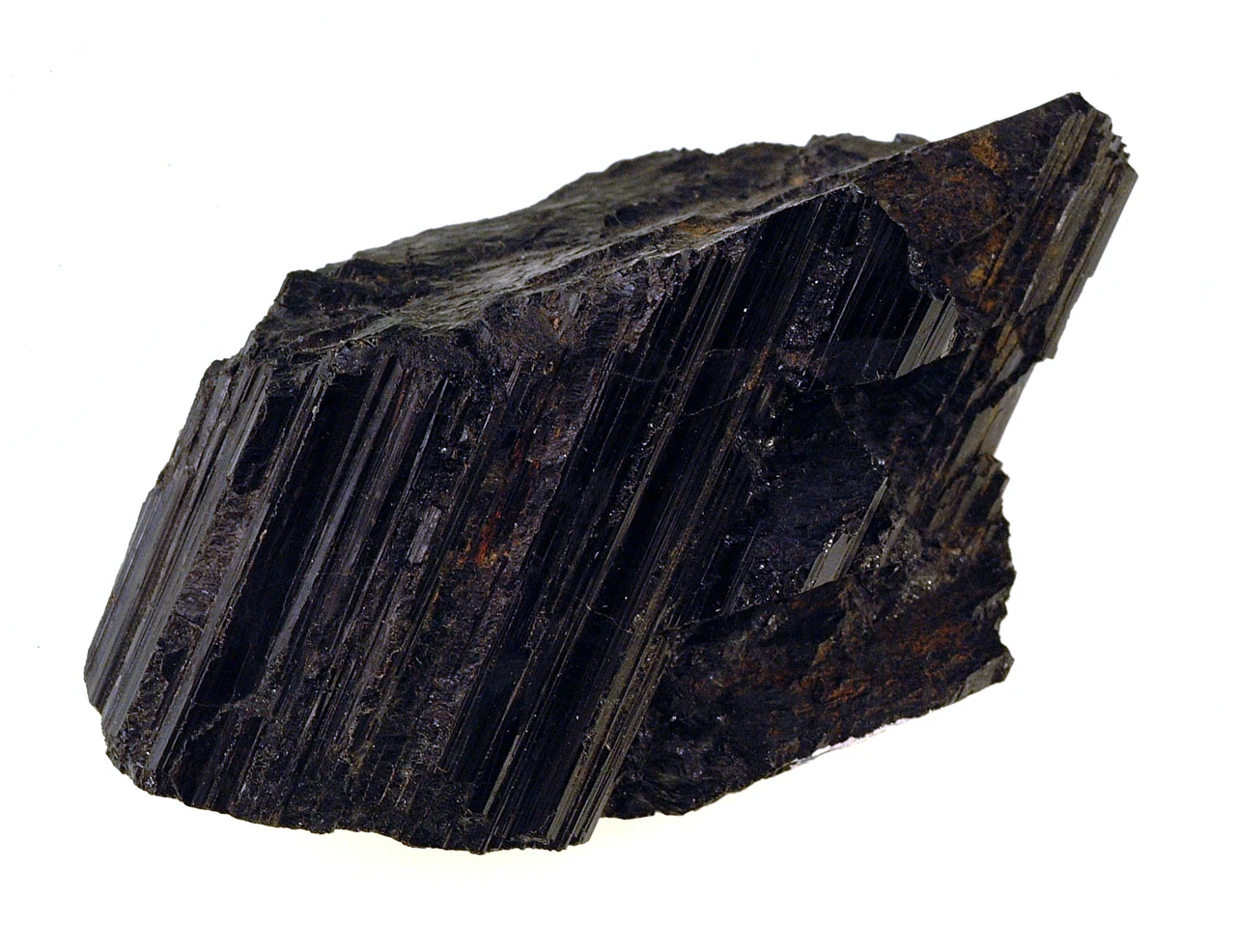
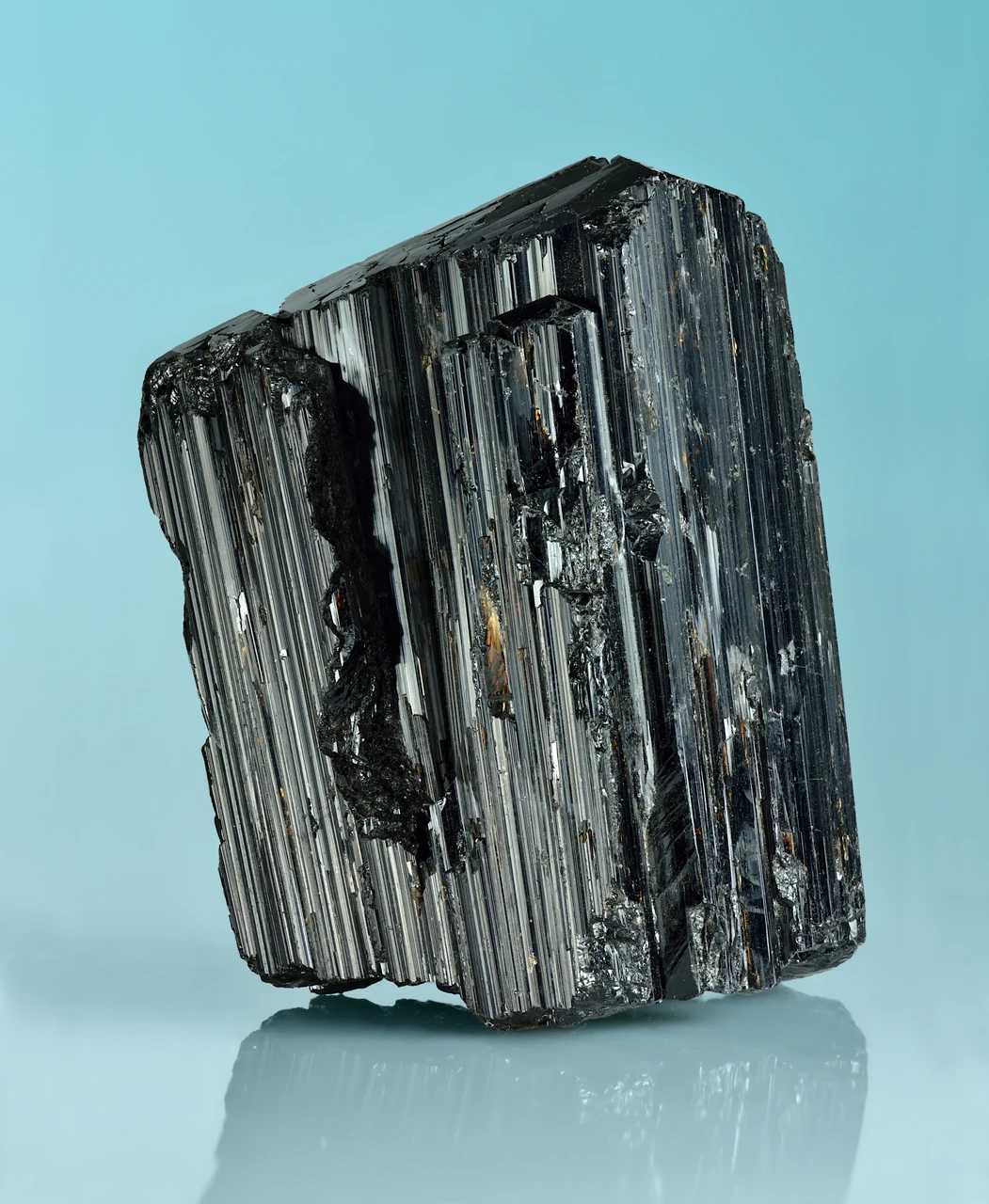
In this record, black tourmaline means schorl. Tourmalines form a mineral group; black colour or a trade name alone cannot confirm the species. Claims of protection from device radiation are not established.
In lithotherapy black tourmaline is above all a stone of protection and grounding. Contemporary practitioners present it as a shield meant to protect against other people’s tension and help keep one’s own balance.
Meaning in lithotherapy
According to The Crystal Council, black tourmaline is one of the most popular stones in spiritual practice and above all a stone of protection. It is meant to act as a deterrent to negativity: cleansing and protecting the aura, and transmuting and purifying heavy energy around a person. The description links it with mastering fear, anger and unwanted thoughts. [44]
Crystal Vaults (Linda Mason) calls it the “premier talisman of protection” and a psychic shield, and at the same time a powerful grounding stone with an “electrical” nature. In this description it clears the emotional body of negative thoughts, anxiety and anger, gives a sense of strength and self-confidence, and helps anchor spiritual experience in daily life. [123]
Crystal Vaults develops this picture: black tourmaline is meant to give a sense of strength and a calm, objective view of the world, to stimulate altruism and practical creativity, and to let one “remain radiant in the darkest of circumstances”. Tourmaline was also a “teller” stone — according to this source it was traditionally meant to point out the cause of trouble or an offender and a good direction to move in, and to be used for scrying. Quartz with needles of black tourmaline unites light and dark; this “polarity” is regarded as a sign of good fortune. The divinatory meaning of black tourmaline: “A confusing or clouded issue will be made clear and you will receive an insight to overcome the problem.” [123]
Ways of working with the stone
Practitioners recommend keeping black tourmaline with you wherever the atmosphere can be difficult — The Crystal Council names the workplace in particular — and during long use of electronic devices. It also mentions a wand combining tourmaline with selenite and rose quartz to strengthen its effect. [44]
Crystal Vaults describes it as one of the most common meditation stones. Worn, it is meant to protect against people who drain others with complaints; held for a few minutes, it is said to “wake up” the mind. Eight small tumbled stones form a protection circle or are placed on an altar, and in body layouts stones are set at the knees or feet with the points towards the toes to “draw” heavy energy away. In feng shui the stone belongs in the northern area of the home, associated with one’s life path. [123]
According to Crystal Vaults, rare double-terminated black tourmaline crystals are especially valued in body layouts because energy is meant to flow in both directions; tourmaline wands are also directed from the crown towards the base chakra to “rebalance the meridians”. The stone is meant to reassure people who fear confined or dark places or a visit to the doctor or dentist, and at work it is recommended especially to miners and telephone workers. The Crystal Council recommends it wherever one needs to shield oneself from the tension of colleagues or clients. [123][44]
Chakras, elements and astrology
On the chakra the sources agree: black tourmaline belongs to the root chakra. They differ on the element (earth or water) and on the sign: The Crystal Council gives Capricorn, Crystal Vaults gives Libra and also mentions Scorpio and Capricorn. A modern birthstone list assigned tourmaline to October, which Kunz himself considered unfortunate because the stone had only been known as a gem since the eighteenth century. [44][123][120]
a “gem of autumn” and the gem of the sixth hour of the night in Kunz’s modern lists; Crystal Vaults calls this “antiquity” [120][123]
Older beliefs
History and beliefs
Kunz stressed that tourmaline had only been known as a gem since the eighteenth century, which is why it fits poorly with old birthstone traditions. From that period also comes an observation quoted by Crystal Vaults: Dutch traders called tourmaline “aschentrekker”, the “ash puller”, because when warmed it attracted ash; Crystal Vaults links this to its pyroelectric properties. [120][123]
Where the sources differ
Practitioners readily give tourmaline an ancient history: The Crystal Council mentions a carving of Alexander the Great, Crystal Vaults an Egyptian rainbow legend and ancient shamans. The historical source we read does not confirm this and points rather to a modern beginning of the stone’s use as a gem. Tourmaline’s protective role is therefore above all a feature of contemporary lithotherapy. [44][123][120]
Crystal Vaults also reports entirely contemporary beliefs — that tourmaline “is not indigenous to Earth” but was brought here by higher beings for the transition into the Age of Aquarius — and old stories of magicians protecting themselves with schorl from “earth demons”. We give them as an example of the diversity of this current, not as facts. [123]
An Avonoria editorial suggestion
Editorial suggestion — not a documented rite
Place the tourmaline by the door or on your desk. Before you start work, write down one boundary you want to keep today (for example a break from your phone), and let the stone remind you of it whenever you look at it.
Scope of the sources: None of the practitioner sources we read describes how to cleanse black tourmaline, and its care is not established in this catalogue, so we give no cleansing ritual here. Claims about blocking radiation and about healing effects are not reproduced.
Schorl is typically black, sometimes brownish or bluish black. Natural crystals are elongated, often with lengthwise striations and rounded triangular cross-sections. Lustre is glassy to resinous. Black colour alone cannot establish the tourmaline species. [2]
Reference properties
View under neutral lighting and compare existing surfaces only. Hardness and streak below are reference data: do not scratch, break, heat or grind the specimen. Ask a specialist to examine valuable or unidentified materials.
Schorl occurs in granites, pegmatites and altered or hydrothermal settings. The formula given here is the ideal species formula; real specimens can show substitutions. [2]
According to GIA, warm soapy water is best; ultrasonic and steam cleaners are not recommended. Tourmaline is generally stable to light, but high heat and sudden temperature change can damage it (fractures). Dry carefully; check the setting. [153]
Storage and specimen form
Separate from other specimens and protect from drops and abrupt temperature changes.
Store the intact specimen securely; wash hands after handling rough material. Do not generalise care advice to unidentified materials or coatings.
Do not grind or drill at home. Dust is a different exposure route from handling an intact specimen. [37]
FAQ
Is the name enough to identify a specimen?
No. This card describes a material and does not authenticate your specimen. For a valuable purchase, request provenance, treatment disclosure and, when appropriate, gemological testing.
What research says — in brief
The popular claim that black tourmaline blocks electromagnetic waves from phones and computers found no support in the literature we searched: publications on tourmaline concern its technical uses, not the effect of wearing the stone on people. We also found no studies of tourmaline in lithotherapy. [129]
Mineralogical, gemological, institutional or scientific source. Its scope is recorded in the source index.
Black Tourmaline — practitioner accountThe Crystal Council · accessed 2026-09-30
Commercial practitioner source: documents beliefs, not medical evidence. The site sells crystals, so we give a bibliographic description without an active link; the full address is kept in Avonoria’s source documentation.
Mineralogical, gemological, institutional or scientific source. Its scope is recorded in the source index.
Black Tourmaline meaning and uses — practitioner accountCrystal Vaults · accessed 2026-10-04
Commercial practitioner source: documents beliefs, not medical evidence. The site sells crystals, so we give a bibliographic description without an active link; the full address is kept in Avonoria’s source documentation.