A mineral group rather than one species with a fixed composition. Almandine, pyrope and other garnets differ in chemistry and properties. This card gives a gem-material range; a more precise description needs species identification.
Garnet is in lithotherapy a stone of fire: of life force, determination and commitment. Its blood-red colour has long stirred the imagination — older beliefs linked red stones with blood, courage and protection on the road.
Meaning in lithotherapy
According to The Crystal Council, garnet awakens the inner fire and produces one of the strongest life-force energies. It activates pure strength and fortitude, raises self-confidence, transmutes the heaviest vibrations into positive ones and restores order to the spirit body. Its themes are self-understanding, growth, determination, inner strength, identity and course correction. [60]
Crystal Vaults calls it a “stone of strong, intense feelings”, a symbol of primordial fire, of the creation of the world out of chaos, of purification and love, and also the “Stone of Commitment” — to purpose, to others and to oneself. It is meant to bring courage and hope, help let go of old patterns of behaviour and boost self-confidence; it is also regarded as a lucky stone in love, success and business relationships. [143]
Crystal Vaults reminds us that garnet is a group of minerals and gives each variety its own character: almandine (red and brown) — protection and unyielding willpower, the base chakra; andradite (olive green, dark yellow, black) — higher thinking and a sense of safety, against feelings of alienation; grossular — hope, abundance and gratitude; pyrope, “living fire” — inspiration, vitality and charisma, aligning the base and crown chakras; spessartine, the “garnet of the sun” — courage to change one’s life; uvarovite, the only consistently green garnet — prosperity and joyful acceptance of what life offers. [143]
In Crystal Vaults’ account, drawing among others on Judy Hall, garnet is a stone for times of crisis “where there seems to be no way out”: it is meant to strengthen the survival instinct, bring courage and hope and turn crisis into challenge, and also to sharpen perception of oneself and others, dissolve ingrained patterns of behaviour and remove inhibitions. It is also said to “activate” other crystals, amplifying their effect. [143]
Ways of working with the stone
The Crystal Council suggests holding garnet and speaking directly to it, expressing what the heart truly wants — so as to remind oneself of one’s goals and “plant the seed” in one’s mind. Crystal Vaults mentions wearing garnet as jewellery and as an amulet. [60][143]
Crystal Vaults lists specific customs: garnet under the pillow is meant to keep bad dreams away (after Dorothee Mella), square-cut garnets are said to favour business matters (after Judy Hall), and the stone is recommended as an “executive gem” supporting confidence in business. The Crystal Council notes that garnet, as an “orb of manifestation energy”, can be used by experienced practitioners during sessions. [143][60]
Chakras, elements and astrology
Chakras
root (The Crystal Council); root and crown, and others depending on the variety (Crystal Vaults) [60][143]
“Enhancer–Strengthener” in the Crystal Vaults system [143]
Older beliefs
History and beliefs
Kunz writes that red stones — rubies, “carbuncles” and garnets — were believed, because of their blood colour, to protect from wounds. The same logic worked in reverse: some Asian tribes used garnets as bullets, believing a blood-red stone would wound more gravely than lead; such missiles were used as late as 1892 by the Hunzas fighting British troops on the Kashmir frontier. According to an old lapidary, a lion engraved on a garnet protected the wearer’s honours and guarded him from perils when travelling. [120]
In religious tradition the red “carbuncle” became a symbol of Christ’s sacrifice on the cross, and the Koran — as Kunz notes — says that the fourth heaven is of carbuncle. In 1891 Kunz also saw the so-called ring of St Elizabeth, whose miraculously luminous “ruby” turned out to be a flat garnet, and garnets decorated a Zuni fetish in the shape of a toad. [120]
Pliny the Elder (Natural History, book 37, chapter 25) describes “carbunculus” — a stone named for its likeness to a glowing coal — in many varieties: Indian, Garamantic (Carthaginian), Ethiopian and Alabandic. He writes that the Indian stones were hollowed into vessels holding as much as a sextarius. The translators note that “carbunculus” covered garnets as well as rubies and spinels, and they derive the name almandine from Alabanda in Caria; not every ancient “carbunculus” was therefore a garnet. [145]
Where the sources differ
The story of garnet bullets is told consistently by The Crystal Council, Crystal Vaults and Kunz. Crystal Vaults adds stories of garnet as the only light in Noah’s ark and as a talisman of crusaders on both sides; we have not checked these in a historical source. It should also be remembered that the old “carbuncle” meant various red stones, not only garnet, and that garnet itself is a group of minerals — the species of the photographed specimen is not established. [60][143][120]
Crystal Vaults adds stories we have not confirmed: garnet as a talisman of the crusaders and their Muslim opponents, garnets brought by the Merovingians from Ceylon and combined with Baltic amber, Don Juan’s ring, and a Greek myth of garnet reconciling lovers. The Crystal Council links garnet with Theophrastus and with Pliny’s “Garamantic stone” — the latter agrees with Pliny’s text, subject to the translators’ caveat on identification. [143][60][145]
An Avonoria editorial suggestion
Editorial suggestion — not a documented rite
Write down a goal that depends on your own action and a date for the first step. Holding the stone, say the goal aloud — then note what you will do tomorrow.
Scope of the sources: Health claims from both sources, including those about haemorrhages and inflammatory diseases, are not reproduced. None of the sources we read describes how to cleanse garnet, and its care is not established in this catalogue.
A mineral group with many colours: red and brown, but also green, orange and others. Transparency varies and lustre is usually glassy. Natural crystals are often polyhedral; red colour alone cannot establish the garnet species. [22][67]
Reference properties
View under neutral lighting and compare existing surfaces only. Hardness and streak below are reference data: do not scratch, break, heat or grind the specimen. Ask a specialist to examine valuable or unidentified materials.
Usually glassy lustre; streak, cleavage and density must be tied to a particular species rather than the group name alone. [22][67]
Forms shown in the gallery
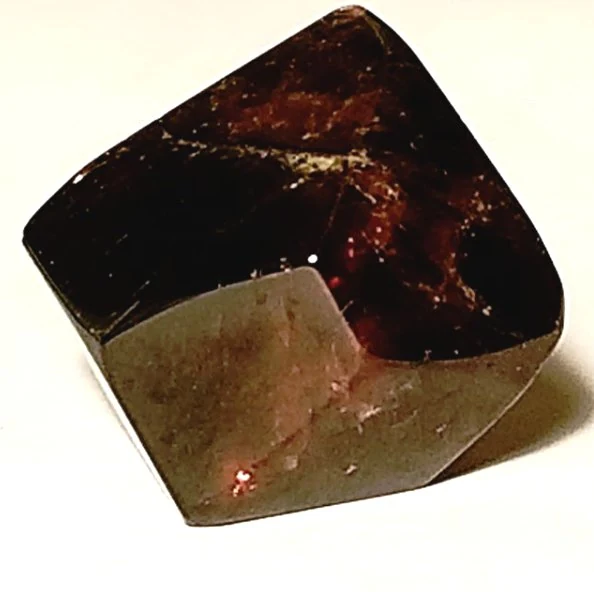
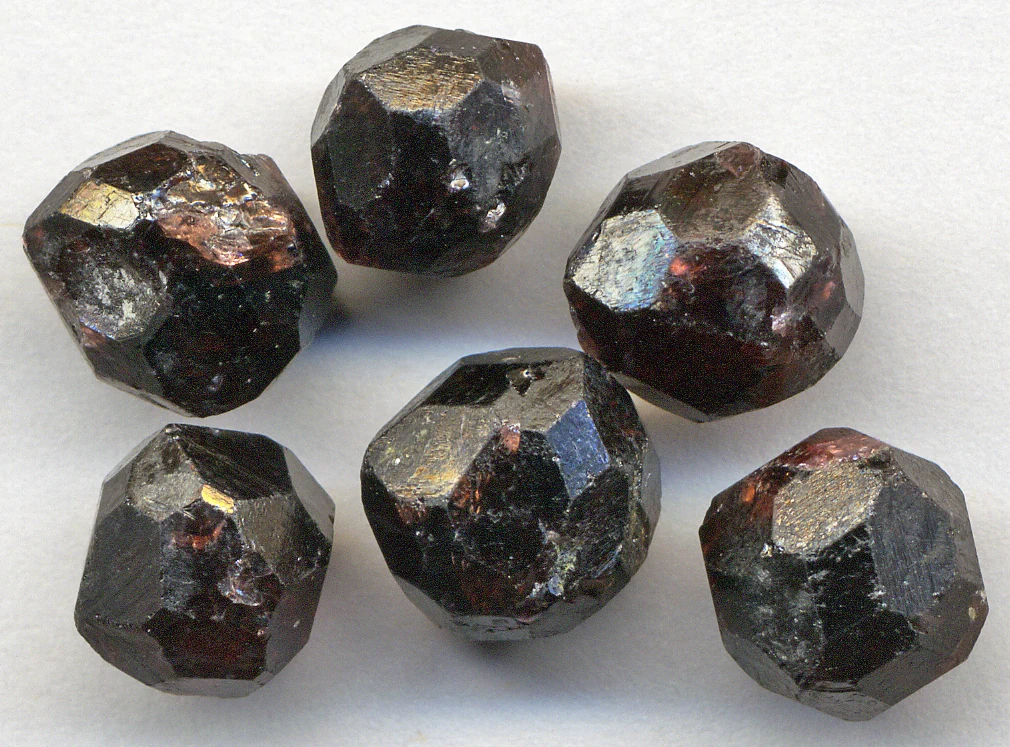
Almandine garnet crystals from Garnet Ledge, Alaska, USA, each about 8 mm across, with many-faced, nearly rounded shapes. Polished garnet with a dark red interior and shiny surfaces. Species within the group is unconfirmed. [112][113]
Common lookalikes and imitations
Other red gemstones
Why it looks similar
Red garnet varieties may resemble other red gems cut to similar shapes.
What can help distinguish it
Garnets are a group with varying compositions and properties. Refractive index, density and spectra help identify the material and variety; colour alone cannot.
What a photograph cannot establish
A photograph of a red stone cannot establish garnet species or composition.
Different garnet species have different origins. The name garnet alone cannot establish location or exact formation conditions. GIA documents historical use of garnets as ornaments. [22]
According to GIA, warm soapy water is always safe; an ultrasonic cleaner is usually safe except for fractured stones, and steam is not recommended. Garnets are stable to light and chemicals (they are attacked by hydrofluoric acid) and should not be subjected to hard blows. Clean fracture-filled stones only with warm soapy water. [154]
Storage and specimen form
Separate from other specimens and protect from drops and abrupt temperature changes.
Store the intact specimen securely; wash hands after handling rough material. Do not generalise care advice to unidentified materials or coatings.
Do not grind or drill at home. Dust is a different exposure route from handling an intact specimen. [37]
FAQ
Is the name enough to identify a specimen?
No. This card describes a material and does not authenticate your specimen. For a valuable purchase, request provenance, treatment disclosure and, when appropriate, gemological testing.
What research says — in brief
We found no studies of garnet in lithotherapy; publications on garnet concern mineralogy and gemmology. [129]
Mineralogical, gemological, institutional or scientific source. Its scope is recorded in the source index.
Garnet — contemporary practitioner accountThe Crystal Council · accessed 2026-09-30
Commercial practitioner source: documents beliefs, not medical evidence. The site sells crystals, so we give a bibliographic description without an active link; the full address is kept in Avonoria’s source documentation.
Mineralogical, gemological, institutional or scientific source. Its scope is recorded in the source index.
Garnet meaning and uses — practitioner accountCrystal Vaults · accessed 2026-10-04
Commercial practitioner source: documents beliefs, not medical evidence. The site sells crystals, so we give a bibliographic description without an active link; the full address is kept in Avonoria’s source documentation.