An iron oxide ranging from steel-grey crystals to red earthy aggregates. Its characteristic reddish-brown streak is more useful for identification than metallic appearance alone. Avoid destructive tests on jewellery.
Hematite, a heavy iron oxide whose powder is as red as blood, is in lithotherapy one of the strongest stones of grounding and focus. Since antiquity it has been linked with strength, battle and — surprisingly — with a favourable outcome in disputes.
Meaning in lithotherapy
The Crystal Council calls hematite one of the most powerful grounding stones in the mineral kingdom, intended to root body and mind back in the Earth. It is meant to help refocus thoughts and actions on what matters most and to guide one along the right path. The description calls it a stone of attraction, much like a magnet. [58]
In this view hematite serves focus, clarity, strength and balance, supports meditation, action and orderly thinking, transmutes negative energy and aligns the chakras. It is also meant to “ground” the high vibrations of other stones — which is why The Crystal Council pairs it with very high-energy stones such as phenakite or moldavite. [58]
The Crystal Council adds that hematite constantly “pulls down” excess energy from the environment so that it can be used in one’s best interest, and that once attention is anchored to the Earth, the stone shows that what one desires is achievable. The description applies with particular force to modern life: in a technological world it is hard to stay present in one’s own thoughts — constantly reaching for the phone shows that the mind is looking to escape — and hematite, by strengthening the root chakra, is meant to help keep attention on the task at hand. [58]
Ways of working with the stone
The practice proposed by The Crystal Council is simple and daily: to take a moment each day to work with hematite, centring one’s energy and setting the mind on what matters. Combined with “high-vibration” stones, hematite is meant to bring strong grounding balance. [58]
The practice proposed by The Crystal Council consists of a short daily moment with the stone in the hand, before starting work or when attention scatters, and of pairing hematite with stones whose energy feels “too powerful” — it names phenakite, moldavite and grandidierite — so that it adds grounding balance to them. [58]
Chakra, element and astrology
The modern association with Mars has a long history: according to Kunz, hematite as an iron ore was already linked with Mars, the god of war, and regarded as an invaluable help to the warrior on the battlefield. [58][120]
Mars (The Crystal Council; also an old tradition in Kunz) [58][120]
Hour
the gem of the second hour of the night in Kunz’s modern list [120]
Older beliefs
History and beliefs
Kunz cites a treatise on stones written by Azchalias of Babylon for Mithridates the Great, King of Pontus, a passionate lover of gems. According to this treatise, known from Pliny’s account, hematite worn as a talisman secured a favourable hearing for petitions to kings and a fortunate outcome of lawsuits and judgments. The name comes from the Greek haima, “blood”, because the abraded stone leaves a red streak. [120]
In ancient Egypt hematite was used for amulets with particular meanings — above all the head-rest (pillow), on which chapter 166 of the Book of the Dead was engraved, and also the carpenter’s square and some heart amulets. In Mesopotamia cylinder seals were carved from red hematite, and at Pueblo Bonito in North America a hematite cylinder inlaid with turquoise in the shape of a bird was found. [120]
In Pliny’s own text (Natural History, book 37, chapter 60; in the Bostock and Riley translation the treatise’s author is named Zachalias), “haematitis” is a blood-red stone, the finest from Ethiopia. Pliny reports the magicians’ assurance that possessing it reveals treacherous designs, and, after Zachalias, that it cured diseases of the eyes and liver, helped petitions to kings and lawsuits, and that it was beneficial to be rubbed with it on the battlefield. These are historical reports, not health advice. [145]
Kunz also relates nineteenth-century trials with the “Seeress of Prevorst”, Frederike Hauffe (born 1801), in whose hand various minerals were placed; according to this account the strongest — and unpleasant — effect came precisely from hematite, producing a sensation of inner chill and numbness. This is a period account of beliefs about stones, not a medical observation. [120]
Between old and modern accounts
The Crystal Council stresses grounding and focus, while older sources stress strength, battle and success before rulers and courts. The common thread is the link with Mars and with blood: The Crystal Council’s modern description also derives the name from the Greek word for “blood”. [58][120]
The Crystal Council writes that hematite was used as long as 164,000 years ago and that “writing on a cave wall” in red powder was found near Mossel Bay. The study this refers to (Marean et al., Nature 2007, Pinnacle Point site in South Africa) describes early use and modification of pigment — ochre — around 164,000 years ago, probably in symbolic behaviour; it says nothing of writing on a wall, and its abstract does not name hematite. [58][152]
An Avonoria editorial suggestion
Editorial suggestion — not a documented rite
Place the specimen beside a task list and choose one action to do first. When it is done, move the stone to the next item, so that it marks where your attention is.
Scope of the sources: For hematite we have one contemporary practitioner source (The Crystal Council). Crystal Vaults has no encyclopedia page on hematite (only shop pages), and we deliberately did not add other stone-selling sites; we have not read lithotherapy books, so we do not cite them. None of the sources we read describes a ritual cleansing of hematite, so none is added. We omit the old belief that hematite stops bleeding. Some “hematites” on sale are magnetic imitations — see “How to identify”.
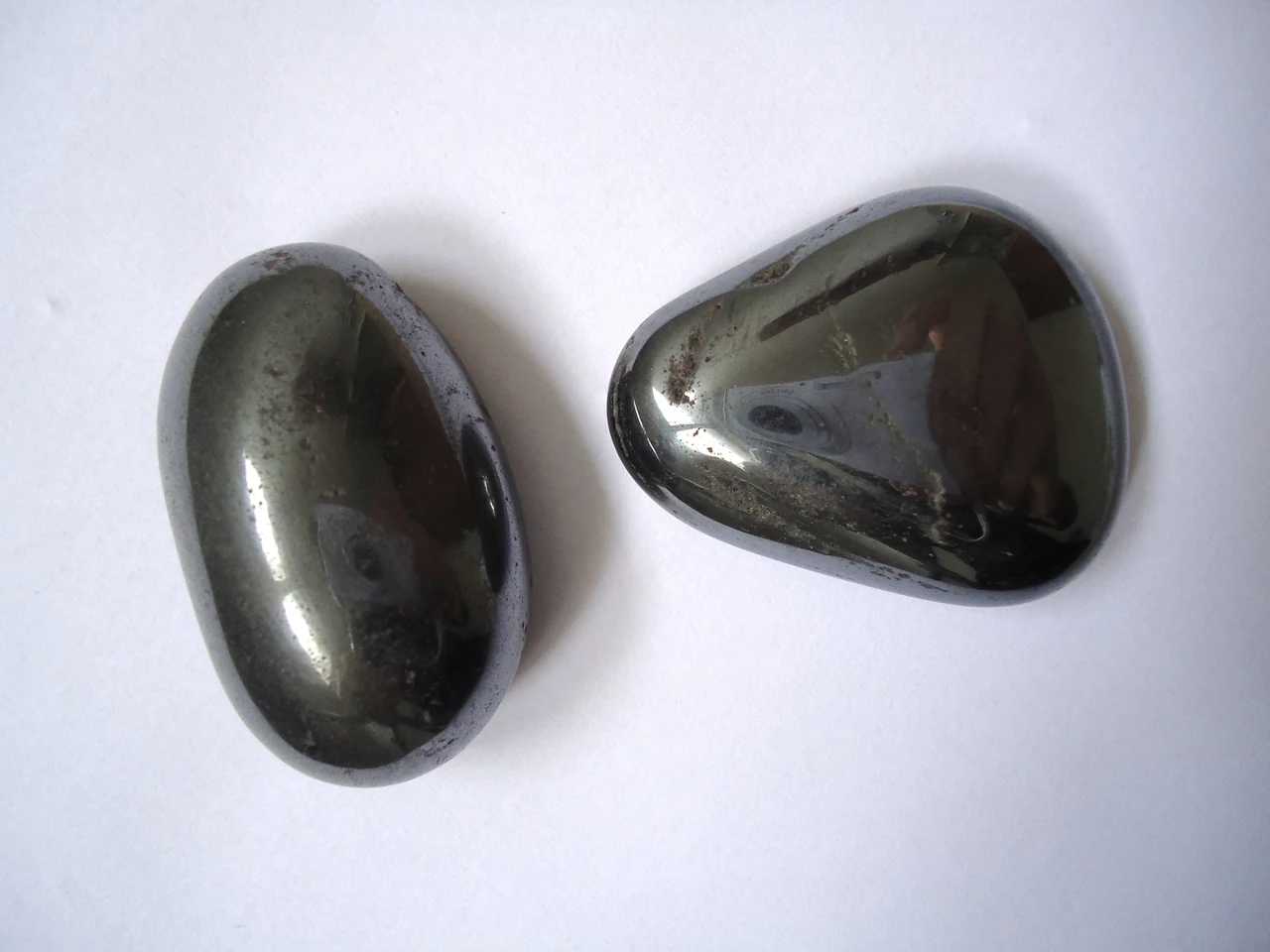
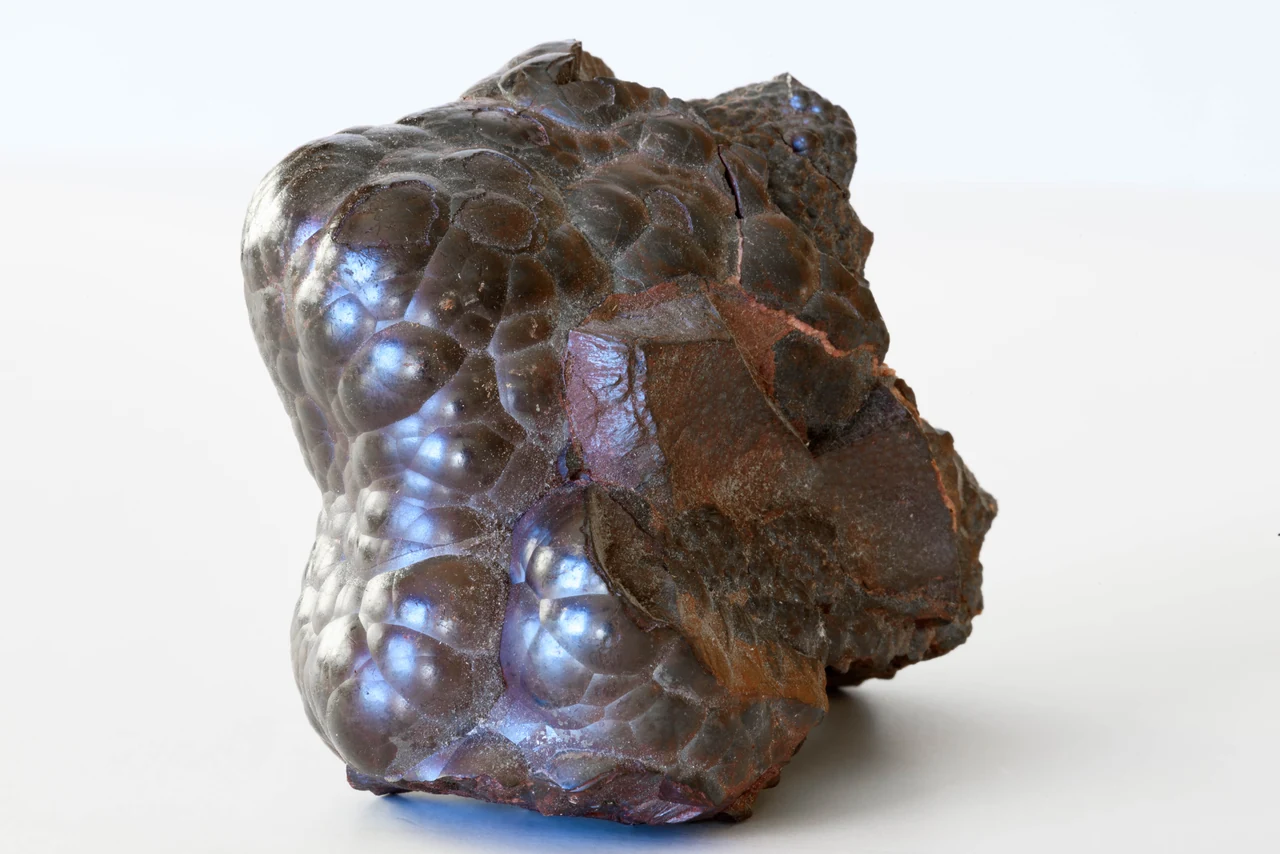
It may be steel-grey to black with metallic lustre, or reddish brown and dull. Forms include botryoidal, platy and massive aggregates. Polished stones often look dark and metallic; a key diagnostic feature is the red to reddish brown streak, which a photograph cannot establish. [12]
Reference properties
View under neutral lighting and compare existing surfaces only. Hardness and streak below are reference data: do not scratch, break, heat or grind the specimen. Ask a specialist to examine valuable or unidentified materials.
Reported parting is not the same as cleavage. [12]
Forms shown in the gallery
Kidney-ore hematite from the Beckermet Mine, Cumbria, England, with a rounded, reniform metallic surface. Two dark hematite pebbles with a pronounced metallic lustre. [108][109]
Common lookalikes and imitations
Magnetic hematite imitation
Why it looks similar
Dark, metallic-looking beads may be natural hematite or manufactured material.
What can help distinguish it
GIA identified a strongly magnetic imitation as barium ferrite, but also described genuine hematite weakly attracted by a magnet. Magnetism is a clue, not a verdict.
What a photograph cannot establish
Lustre in a photograph cannot establish composition or magnetism; do not grind beads to obtain a streak.
An important component of iron deposits, found in diverse geological environments. Its name refers to a Greek word associated with blood, reflecting the red colour of powdered material. [12]
Start with a soft, dry cloth. Unknown coatings, adhesives and settings need separate assessment.
Storage and specimen form
Separate from other specimens and protect from drops and abrupt temperature changes.
Store the intact specimen securely; wash hands after handling rough material. Do not generalise care advice to unidentified materials or coatings.
Do not grind or drill at home. Dust is a different exposure route from handling an intact specimen. [37]
FAQ
Is the name enough to identify a specimen?
No. This card describes a material and does not authenticate your specimen. For a valuable purchase, request provenance, treatment disclosure and, when appropriate, gemological testing.
What research says — in brief
We found no studies of hematite in lithotherapy; publications on hematite mostly concern nanoparticles, soils and photocatalysis. [129]
Mineralogical, gemological, institutional or scientific source. Its scope is recorded in the source index.
Hematite — contemporary practitioner accountThe Crystal Council · accessed 2026-09-30
Commercial practitioner source: documents beliefs, not medical evidence. The site sells crystals, so we give a bibliographic description without an active link; the full address is kept in Avonoria’s source documentation.