A pyroxene mineral. Jade can mean jadeite or nephrite, which are not the same species. The fine-grained structure of gem jadeite can provide high resistance to breaking.
Jade — a name covering two minerals, jadeite and nephrite — is in lithotherapy a stone of the heart, harmony and dreams. No other stone in this atlas has such a rich cultural tradition: in China it was for centuries the “concentrated essence of love”, and its sign entered the script itself.
Meaning in lithotherapy
The Crystal Council describes jade as a powerful stone for the heart that is meant to soothe, replenish and support. It transmutes negative energy around a person into positive vibrations of love and joy, brings mind and body into harmony and helps stabilise the personality. Its themes are love, balance, joy, protection, abundance, prosperity, inner peace and connection with nature. [57]
Crystal Vaults calls jade the “ultimate Dream Stone” that opens access to the spiritual world and to ritual knowledge, and a protective talisman assuring long life and a peaceful death — a symbol of wisdom gathered in tranquillity. It is meant to release negative thoughts and irritability, soothe the mind, help with guilt and self-defeat, and give confidence, self-reliance and creative courage. [141]
Ways of working with the stone
The simplest practice is carrying jade: Crystal Vaults advises keeping a piece in a pocket or pendant and stroking it from time to time to restore energy. For meditation it recommends prayer beads or a beaded jade necklace — the beads are moved through the fingers one by one while a short phrase of four or five words is repeated slowly and rhythmically. [141]
Jade is also a stone of dreams. The Crystal Council suggests putting a piece inside the pillowcase to encourage lucid dreaming, and wearing it or keeping it near to calm; Crystal Vaults recommends placing it on the forehead for insightful dreams. In feng shui green jade, linked with wood, is placed where people eat, in a small child’s room and where a new project is beginning. [57][141]
earth (The Crystal Council); wood in feng shui — the east and south-east of the home (Crystal Vaults) [57][141]
Zodiac signs
Aries, Taurus, Gemini, Libra (The Crystal Council); Taurus and Libra (Crystal Vaults) [57][141]
Planet
Earth (The Crystal Council); Venus (Crystal Vaults) [57][141]
Older beliefs
History and beliefs
Kunz writes that the original Chinese character for “precious” showed a house containing jade beads, a shell and a jar, and that the oldest character for “king” represented a string of jade beads. Chinese people who could afford it carried small pieces of jade, believing that when handled something of its secret virtue passed into the body; struck, jade gives a sound that poets likened to the voice of the beloved, and it was called the concentrated essence of love. Plates of jade were made into musical chimes used in court and religious ceremonies. [120]
Chinese jade amulets had their meanings: the butterfly — a sign of successful love, given by bridegrooms; the phoenix — for girls coming of age; a padlock-shaped amulet — to “bind” a child to life. “Mouth jades” placed in graves protected the dead. The Māori wore hei-tiki, carved images of ancestors in the green stone pounamu, whose search was guided by a tohunga who in a trance indicated where to look. Kunz also quotes Walter Raleigh, who in Guiana saw green stones the Spaniards called “piedras hijadas”, prized by chiefs’ wives as great jewels. [120]
Where the sources differ
All three sources speak of “jade” in general. Kunz notes that the name covers two different minerals — nephrite and jadeite — and The Crystal Council explains how they differ. Older sources do not always make it possible to tell which mineral a given tradition concerned; Kunz explicitly links jadeite above all with the emerald-green “imperial jade” that the Chinese called kingfisher plumes. Crystal Vaults gives many of the same threads as Kunz (the butterfly, the padlock, hei-tiki, the “stone of the loin”) but also adds some we have not checked, such as stories about Confucius. [120][57][141]
An Avonoria editorial suggestion
Editorial suggestion — not a documented rite
For a week, carry a small, smooth stone in your pocket. Each time you touch it, pause for three breaths and recall one act of kindness you can do today.
Scope of the sources: The traditions in the sources concern “jade” in general, not only the jadeite this card is about. Claims about healing injuries, kidneys or childbirth are not reproduced; the custom of placing jade in the mouths of the dead is not presented as a practice for the living. None of the sources we read gives a way to cleanse jade.
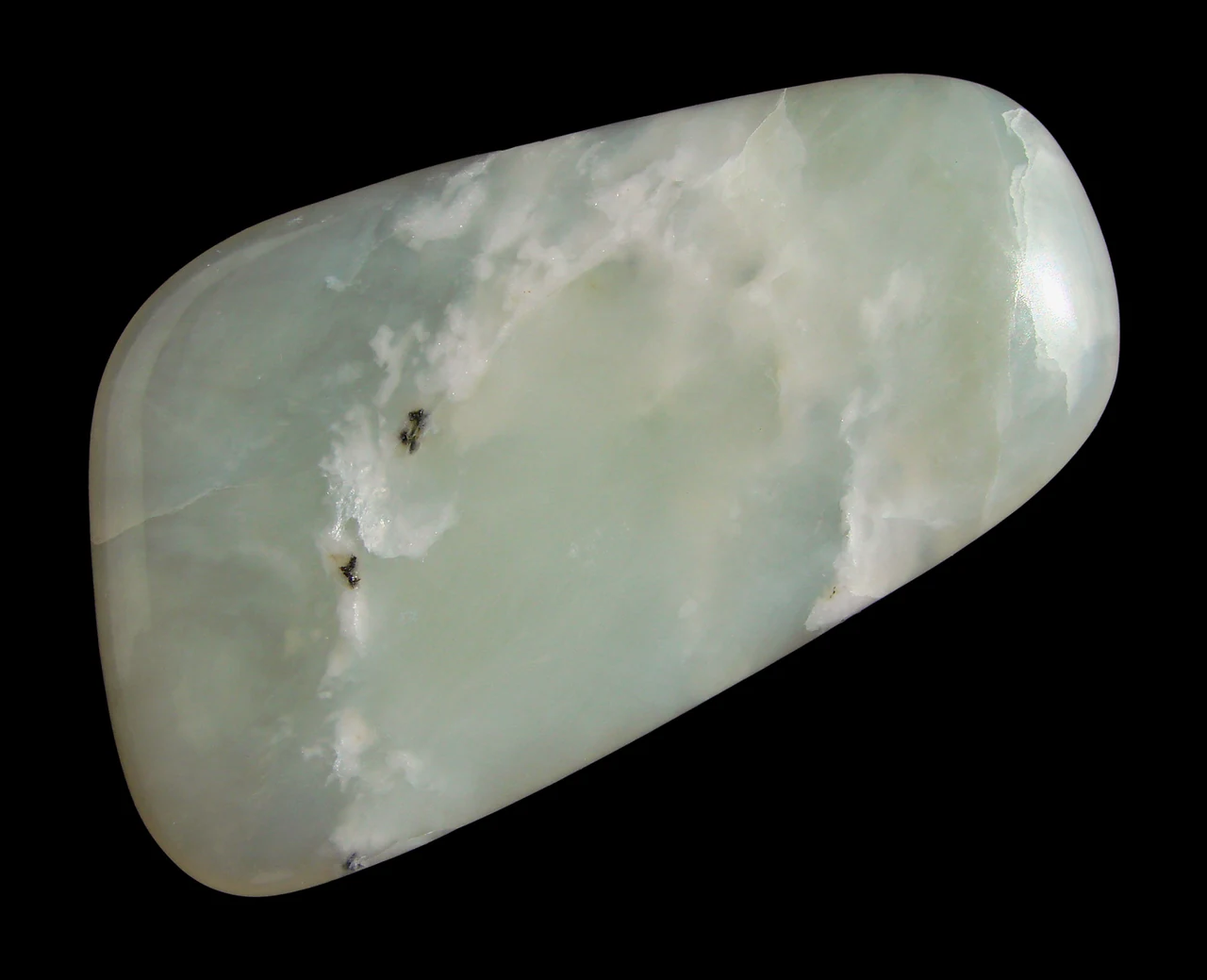
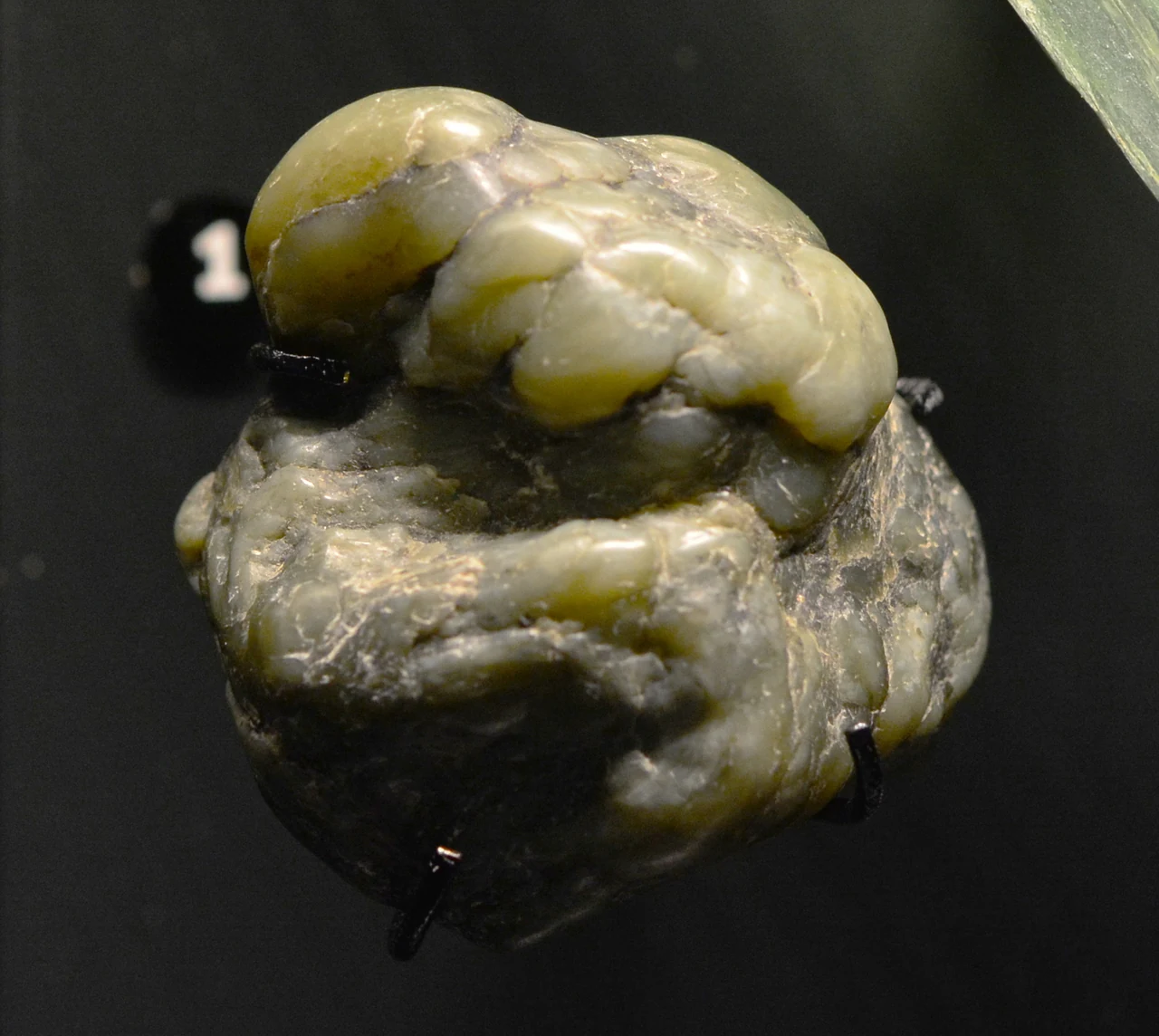
Gem jadeite is usually a compact, fine-grained aggregate rather than a single crystal. It can be green, white, lavender, yellow and other colours; transparency and colour distribution vary. Green colour is insufficient to separate it from other materials called jade. [72][7]
Reference properties
View under neutral lighting and compare existing surfaces only. Hardness and streak below are reference data: do not scratch, break, heat or grind the specimen. Ask a specialist to examine valuable or unidentified materials.
Good cleavage; aggregates behave differently from single crystals. [7]
Forms shown in the gallery
Rough jadeite from the Burke Museum collection with a greenish botryoidal surface. Polished pale jadeite with greenish and white areas. [106][107]
Common lookalikes and imitations
Nephrite and omphacite
Why it looks similar
Similar green aggregates may also be called jade.
What can help distinguish it
Nephrite differs in structure and composition; omphacite can even have gemological properties similar to jadeite. GIA identifies Raman testing as a way to separate omphacite.
What a photograph cannot establish
Saturated green colour or toughness cannot establish the species.
GIA documents plastic jade imitations; natural material may also have an altered appearance.
What can help distinguish it
Request a report identifying material and treatment. Separating jadeite, an imitation and treatment requires testing, not judging an attractive colour.
What a photograph cannot establish
A photograph cannot reliably establish dyeing or impregnation.
Jadeite is associated with high-pressure metamorphism. The formula is ideal; chemical substitutions can alter properties. Do not identify jade from colour alone. [7]
GIA permits brief cleaning with warm, mild soapy water. This is not advice to soak, make drinks or apply it to specimens with unknown treatment. Dry carefully; check the setting and coatings. [30]
Storage and specimen form
Separate from other specimens and protect from drops and abrupt temperature changes.
Store the intact specimen securely; wash hands after handling rough material. Do not generalise care advice to unidentified materials or coatings.
Do not grind or drill at home. Dust is a different exposure route from handling an intact specimen. [37]
FAQ
Is the name enough to identify a specimen?
No. This card describes a material and does not authenticate your specimen. For a valuable purchase, request provenance, treatment disclosure and, when appropriate, gemological testing.
What research says — in brief
We found no studies of jadeite in lithotherapy. Studies of facial rollers and gua sha massage compare massage techniques, not materials; the 2025 study did not state that the roller was made of jade. [128][129]
Mineralogical, gemological, institutional or scientific source. Its scope is recorded in the source index.
Jadeite — contemporary practitioner accountThe Crystal Council · accessed 2026-09-30
Commercial practitioner source: documents beliefs, not medical evidence. The site sells crystals, so we give a bibliographic description without an active link; the full address is kept in Avonoria’s source documentation.
Photograph identity and usage-rights source; not a test of specimen composition.
Jade meaning and uses — practitioner accountCrystal Vaults · accessed 2026-10-04
Commercial practitioner source: documents beliefs, not medical evidence. The site sells crystals, so we give a bibliographic description without an active link; the full address is kept in Avonoria’s source documentation.