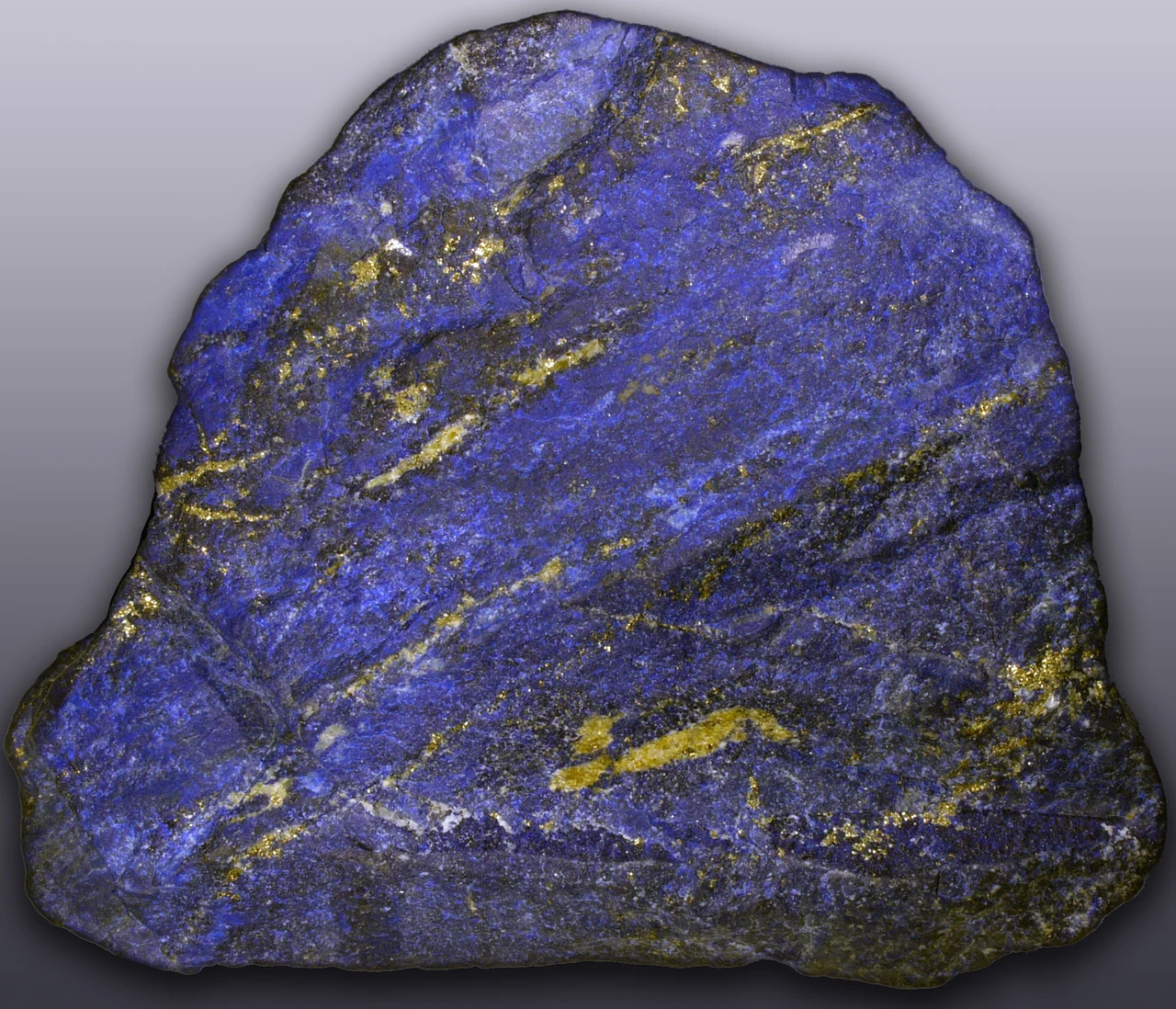
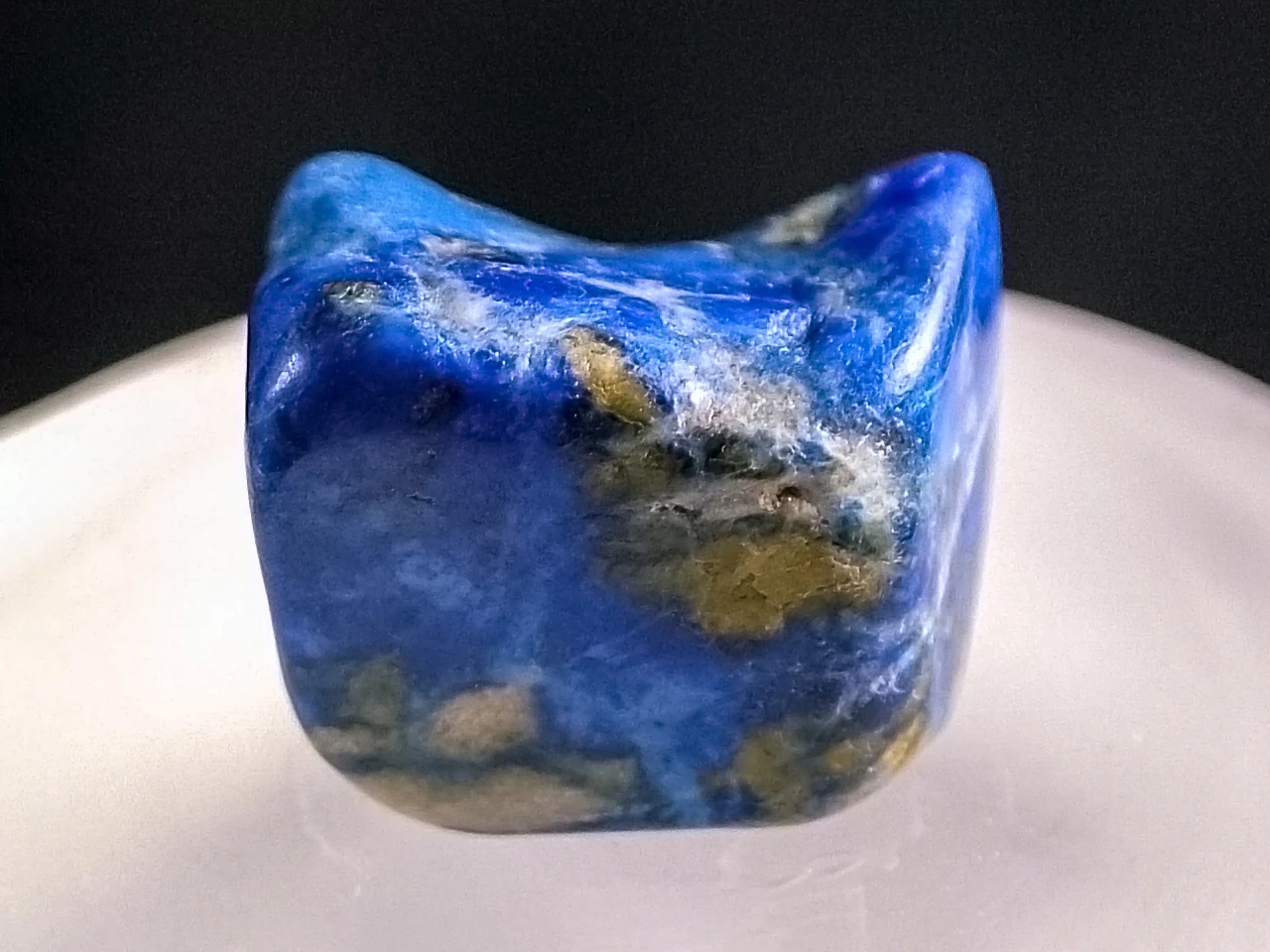
A blue rock composed of several minerals, rather than a single mineral species. It can contain pale areas and golden pyrite grains. Its composition affects its properties and care.
Lapis lazuli, a deep-blue rock flecked with pyrite, is in lithotherapy a stone of truth, wisdom and the spoken word. It has one of the oldest histories among ornamental stones: Babylonians and Egyptians prized it, and its symbolism of truth reaches back to ancient Egypt.
Meaning in lithotherapy
The Crystal Council describes lapis lazuli as a stone that strengthens communication between the mind, the throat and the heart. It is meant to encourage a keen intellect, inner visions and an expanded mind, and by opening the third eye, ascension, higher knowledge and truth-seeking. Its themes include dreams, intuition, wisdom, the higher self, angelic communication, inner peace and trust. [53]
For Crystal Vaults (Linda Mason) its celestial blue is a symbol of royalty and honour, gods and power, spirit and vision — a universal sign of wisdom and of truth in all its forms. Lapis is meant to help release what has been suppressed, especially repressed anger, and to express oneself without holding back; it encourages honesty, compassion and uprightness, and awareness of one’s own motivations and beliefs. [137]
Ways of working with the stone
Crystal Vaults recommends wearing lapis lazuli as jewellery, especially as a necklace or pendant — close to the throat with which it is linked. The stone is kept on the bedside table and in meditation laid on the forehead over the third eye. Arranged in a grid in the home, it is meant to bring calm and loving communication between the people who live there. [137]
Crystal Vaults also lists “public” uses: wearing lapis to auditions and performances when seeking recognition in a creative field, and at work — for promotion and lasting recognition. Lapis laid on the third eye is meant to expand awareness and support dream work, and meditation with it to help recall memories that this current calls past-life memories. The divinatory meaning of lapis: “It is the right time to get yourself noticed in a positive way; a high-profile presentation of your talents is the key.” The Crystal Council draws attention to the rock’s components: pyrite is meant to help process thoughts and make them real, calcite to awaken dormant mystical energies, and sodalite to embolden the mind. [137][53]
Chakras, elements and astrology
On the chakras both sources agree: lapis lazuli belongs to the third eye and the throat. They part on the element — air for The Crystal Council, water for Crystal Vaults — while both authors name Sagittarius and Neptune. [53][137]
“Enhancer–Filter” in the Crystal Vaults system [137]
Cleansing and “charging” in the tradition
Crystal Vaults recommends “charging” lapis lazuli in sunlight and cleansing it without water — with sage, in rice or by burying it — because it holds that water may dissolve the calcite it contains and leach sulphur from its pyrite flecks. [137]
Older beliefs
History and beliefs
Kunz stresses how highly the Babylonians and Egyptians valued lapis lazuli: in a hymn to the moon-god Sin, the god is “bright as lapis-lazuli”. In Egypt lapis was used for scarabs, heart amulets, frogs, cats and crocodiles, and above all for the image of Truth (Maat), which the Egyptian chief justice wore around his neck. Kunz also notes that the “sapphire” of the ancients — a blue stone with golden spots — was in fact lapis; hence the suggestion that the tablets of the Law in biblical tradition were described as made of this stone. [120]
In later European tradition, according to Kunz, blue stones — sapphire, lapis lazuli and others with the colour of the sky — were believed to have a tonic influence and to counter the wiles of the spirits of darkness, winning the favour of the spirits of light and wisdom. [120]
Pliny the Elder (Natural History, book 37, chapters 38–39) described the azure “sapphiros”, which his translators consider most probably lapis lazuli rather than modern sapphire: a stone never transparent, “refulgent with spots like gold” (the translators suggest pyrite), the best coming from Media. He also mentioned the related blue “cyanos”, an artificial, dyed version of which was counted among the glories of the kings of Egypt. [145]
Where the sources differ
The historical thread is shared by all the sources: The Crystal Council mentions Mesopotamia, Egypt, Tutankhamun’s sarcophagus and the pigment of Renaissance painters, and Crystal Vaults adds the Sumerian goddess Inanna and the medieval belief in protection from the spirits of darkness — the latter is confirmed by Kunz. We did not find the details about Cleopatra or Inanna in the historical source we read. The Crystal Council also warns that lapis is often faked, most often with dyed agate. [53][137][120]
Crystal Vaults also quotes a legend of a lapis ring that an angel is said to have given King Solomon, and a lapis room in the palace of Catherine the Great, placing it wrongly “in the Renaissance” (Catherine reigned in the eighteenth century). We have not checked these threads in a historical source. [137]
An Avonoria editorial suggestion
Editorial suggestion — not a documented rite
Write down a thought you have long put off saying, and say it aloud in your own words while holding the stone. Then note to whom and when you want to share it.
Scope of the sources: Health claims from Crystal Vaults are not reproduced. We omit the old belief, recorded by Kunz, that lapis cured melancholy, so as not to suggest a healing effect.
Usually an opaque blue to violetish blue rock. White calcite patches and metallic, gold-coloured pyrite flecks may occur, but their absence does not rule out lapis. Lustre ranges from waxy to glassy; texture reflects an aggregate of minerals. [20]
Reference properties
View under neutral lighting and compare existing surfaces only. Hardness and streak below are reference data: do not scratch, break, heat or grind the specimen. Ask a specialist to examine valuable or unidentified materials.
Waxy to glassy lustre. The rock has no single universal streak or cleavage covering all its components. [20]
Forms shown in the gallery
Blue lapis lazuli specimen from Afghanistan with visible gold-coloured pyrite areas. Polished lapis lazuli pebble with blue, pale and gold-coloured areas. [98][99]
Common lookalikes and imitations
Sodalite
Why it looks similar
Blue sodalite with white calcite can resemble lapis.
What can help distinguish it
Lapis is a rock containing lazurite among other minerals; sodalite is a distinct species. Gold-coloured pyrite flecks may support comparison, but their absence does not rule out lapis.
What a photograph cannot establish
A photograph does not establish composition, hardness or treatment.
GIA documents manufactured materials imitating blue lapis.
What can help distinguish it
Component distribution can be assessed microscopically; imitations need composition and property checks. Natural lapis can also be dyed or impregnated.
What a photograph cannot establish
Neither golden flecks nor even blue colour establish natural origin or absence of treatment.
GIA permits mild soapy water but advises testing an inconspicuous area: dyes, wax and impregnation can change behaviour. Do not soak an unidentified specimen. [28]
Storage and specimen form
Separate from other specimens and protect from drops and abrupt temperature changes.
Store the intact specimen securely; wash hands after handling rough material. Do not generalise care advice to unidentified materials or coatings.
Do not grind or drill at home. Dust is a different exposure route from handling an intact specimen. [37]
FAQ
Is the name enough to identify a specimen?
No. This card describes a material and does not authenticate your specimen. For a valuable purchase, request provenance, treatment disclosure and, when appropriate, gemological testing.
What research says — in brief
In the PubMed searches we found no studies of lapis lazuli in lithotherapy or medicine. [129]
Commercial practitioner source: documents beliefs, not medical evidence. The site sells crystals, so we give a bibliographic description without an active link; the full address is kept in Avonoria’s source documentation.
Commercial practitioner source: documents beliefs, not medical evidence. The site sells crystals, so we give a bibliographic description without an active link; the full address is kept in Avonoria’s source documentation.