Natural volcanic glass rather than a mineral with a regular crystal lattice. It forms from rapidly cooling silica-rich lava. Sharp edges require care when handling rough material.
Black obsidian, a natural volcanic glass, is in lithotherapy a stone of protection and truth — a mirror in which hidden things are meant to be seen. This role has deep roots: obsidian mirrors were used for divination in ancient Mexico, and one of them is said to have served John Dee.
Meaning in lithotherapy
The Crystal Council gives black obsidian protection, grounding and spiritual communication. It calls it a “psychic vacuum cleaner” that draws negativity out of the aura and the surroundings, and at the same time a stone that awakens creative energy. [50]
In the Crystal Vaults account obsidian is above all a teacher — a “Warrior of Truth”. It exposes darkened areas of the subconscious so that a person can face their true self. It helps examine unresolved issues and harmful attitudes, bringing difficult emotions and truths to the surface to be experienced and released. It is one of the stones most often linked with what contemporary language calls shadow work. [133]
Crystal Vaults gives the varieties of obsidian distinct roles. Black obsidian, “ruled by Pluto”, is the most powerful teacher. Gold-sheen obsidian is meant to reveal the heart of a present problem; mahogany obsidian, gentler, is the “Stone of Closure”, helping one recognise old feelings of shame and humiliation; rainbow obsidian is a gentler tool for searching out the roots of emotions; silver-sheen is meant to sharpen the senses and keep personal dislikes out of decisions; peacock obsidian serves spiritual journeys; snowflake obsidian is a “stone of purity”, helping one accept change. “Apache tears” are meant to protect from sorrow and help one forgive. Each variety also has its own divinatory meaning; for black obsidian: “You have a great deal of power to improve a situation or relationship if you are not afraid to change the status quo.” [133]
Ways of working with the stone
Slabs, mirrors and spheres of black obsidian are, according to Crystal Vaults, excellent tools for gazing and scrying in meditation. A stone placed at the feet is meant to “anchor” a person in times of turmoil. The most intense way of working is with obsidian spheres — and here the tradition itself urges caution. [133]
Crystal Vaults regards obsidian as a very personal stone — bought, kept and worn by one person — and a talisman for sensitive people on whom others offload their problems. After Cassandra Eason it describes an obsidian arrow worn on a necklace against bullying until it stops, and seven small obsidian arrowheads set at work facing outwards, against gossip. A dish of “Apache tears” at home or at work is meant to “absorb bad vibes” — the stones are washed once a week. In Native American teachings, according to Margaret Lembo, black obsidian belongs to the western quadrant of the medicine wheel. The Crystal Council pairs obsidian with jet and smoky quartz: obsidian is meant to cleanse the aura and smoky quartz to transmute the released energy. [133][50]
Chakras, elements and astrology
Chakra
root (both sources); in Crystal Vaults joined by a “grounding cord” to the Earthstar chakra below the feet [50][133]
Element
water in feng shui — the north of the home, the career and life-path area (Crystal Vaults) [133]
Zodiac signs
Scorpio, Sagittarius (The Crystal Council); Capricorn (Crystal Vaults) [50][133]
Planets
Saturn (The Crystal Council); Pluto (Crystal Vaults) [50][133]
Since obsidian is meant to draw heavy energy out of its surroundings, Crystal Vaults recommends cleansing it regularly under running water and covering spheres after use. [133]
Older beliefs
History and beliefs
Kunz writes that the Mexicans made images of the god Tezcatlipoca of obsidian, his name being interpreted as “shining mirror”, and that mirrors of the stone were said to be used for divination in ancient Mexico and neighbouring lands. One reached Europe: a polished slab of black Mexican obsidian in Horace Walpole’s collection was catalogued as “the black stone into which Dr. Dee used to call his spirits”. Kunz also records an obsidian mask from the Fayum in Egypt. [120]
Pliny the Elder (Natural History, book 36, chapter 67) described “Obsian stone”, which his translators identify with obsidian: very dark, sometimes transparent, and, fixed to a wall as a mirror, reflecting the shadow of an object rather than its image. Pliny had seen solid statues of the Emperor Augustus made of it, and Augustus dedicated four figures of elephants in this stone in the Temple of Concord as something marvellous. [145]
Where the sources differ
The Crystal Council stresses protection and cleansing of the surroundings, Crystal Vaults demanding work with the truth about oneself. Even details differ: Crystal Vaults translates Tezcatlipoca’s name as “Smoking Mirror”, Kunz as “shining mirror”. Both sources and Kunz agree, however, in linking obsidian with mirrors and divination. [50][133][120]
Crystal Vaults cites Pliny for the claim that obsidian was an amulet of those travelling by sea and river and — burned with pine resin and incense — gave the gift of prophecy. The chapter of Pliny on Obsian stone that we read (book 36, chapter 67) contains nothing of this; it may come from another old lapidary, but we have not checked. The legend of the “Apache tears” rests on events of the 1870s and is related by Crystal Vaults. [133][145]
An Avonoria editorial suggestion
Editorial suggestion — not a documented rite
Choose a securely placed specimen without sharp edges. Write down a boundary you want to communicate clearly; the stone can be a reminder of that decision.
Scope of the sources: The Crystal Vaults obsidian page has no single author. Health claims, including those about addictions, are not reproduced. Protective practices against bullying do not replace action by adults, a school or an employer.
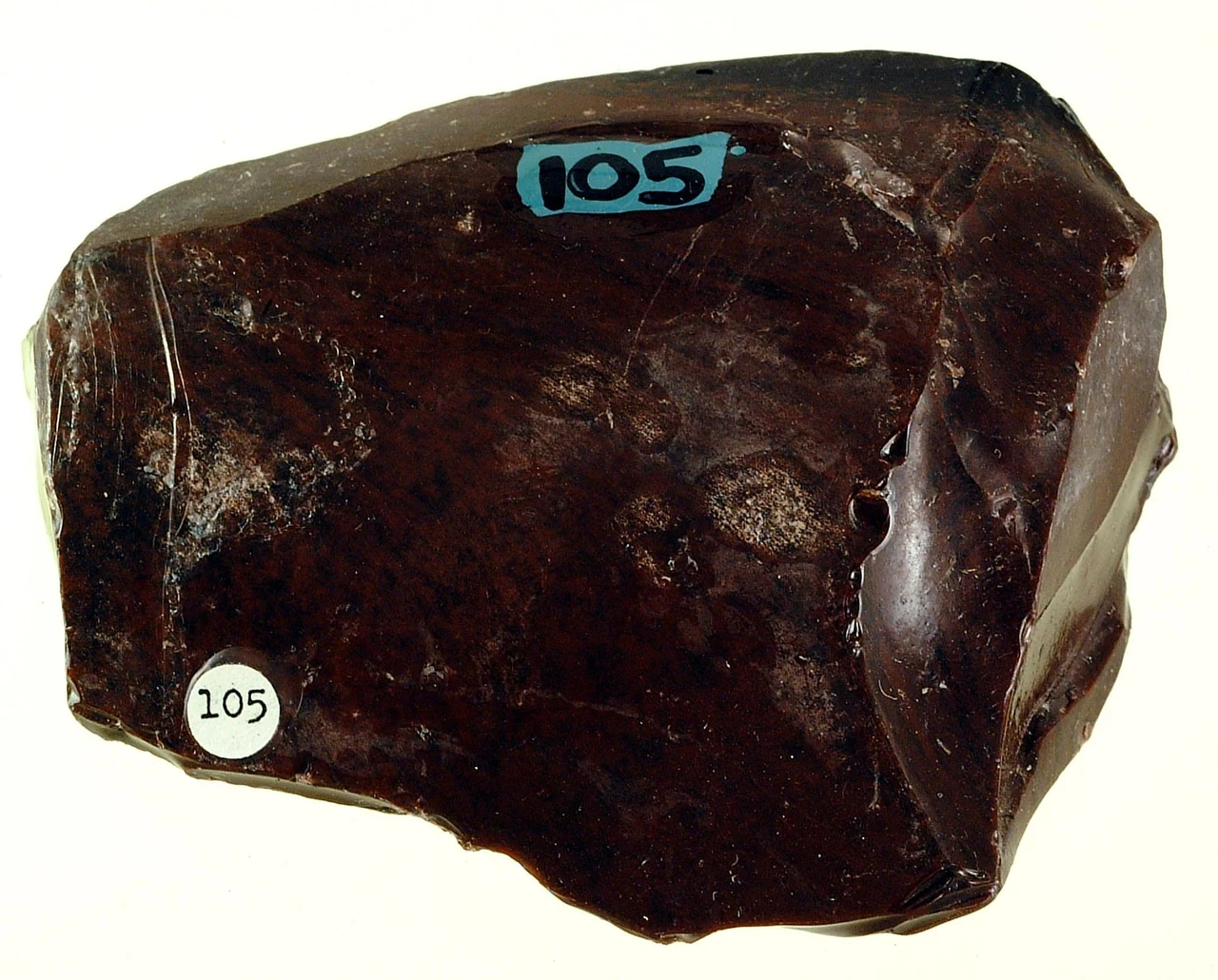
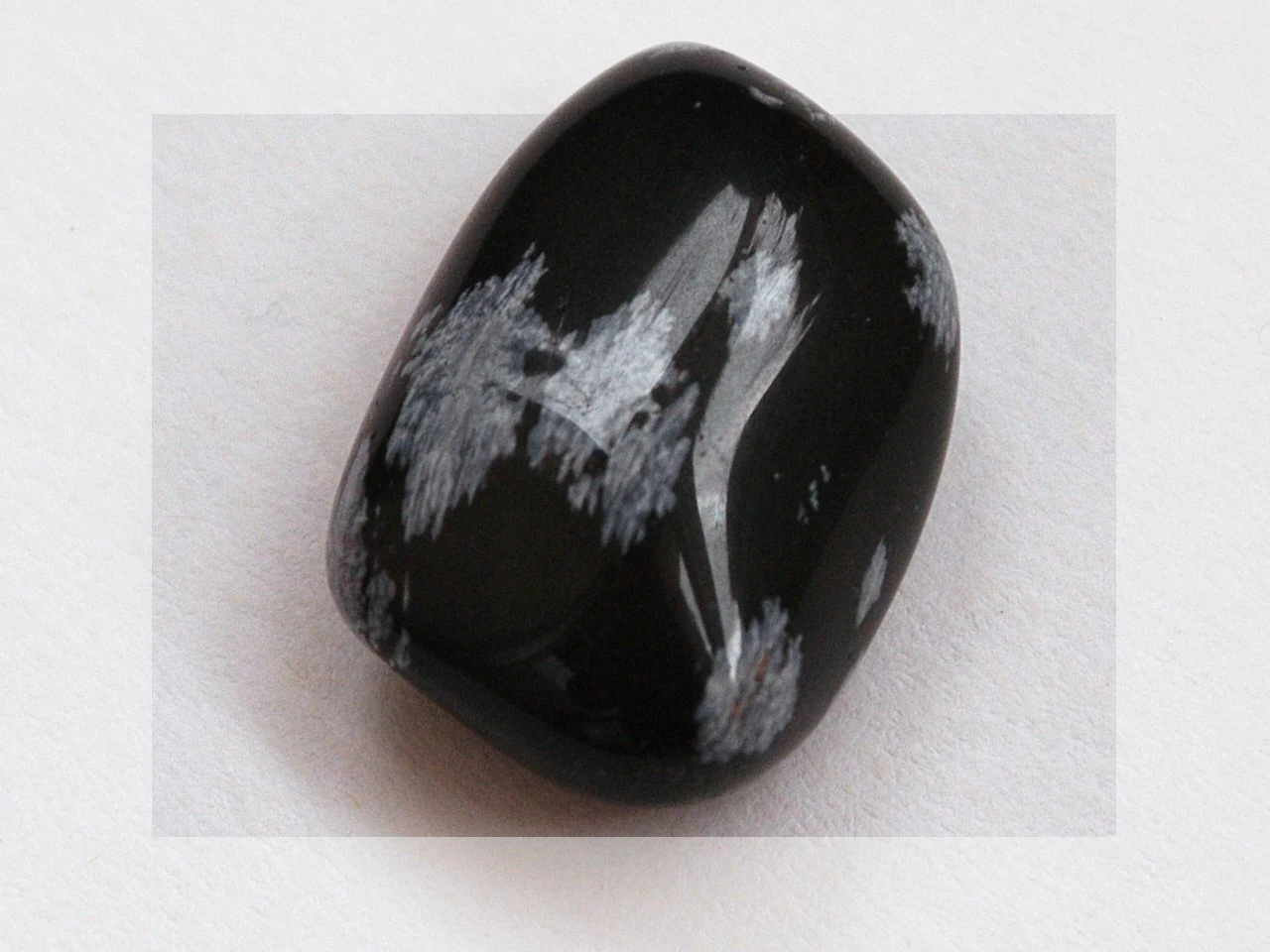
Usually black, grey or brown volcanic material with a glassy surface; it is glass rather than a distinct crystalline mineral species. Some varieties have bands or pale spherulites, including snowflake obsidian. Existing broken surfaces may show smooth, curved outlines. [79][34]
Reference properties
View under neutral lighting and compare existing surfaces only. Hardness and streak below are reference data: do not scratch, break, heat or grind the specimen. Ask a specialist to examine valuable or unidentified materials.
Conchoidal fracture; existing edges may be very sharp. [79]
Forms shown in the gallery
Brown obsidian specimen from a geological collection, with a shiny glass surface. Polished black snowflake obsidian with pale radiating patterns. [90][91]
Common lookalikes and imitations
Manufactured glass
Why it looks similar
Both are glasses and can share lustre, colour and curved fracture.
What can help distinguish it
Geological provenance, composition and material analysis matter more than lustre. Even snowflake-like structures can form in manufactured glass.
What a photograph cannot establish
A photograph of snowflakes or uniform black colour does not prove volcanic origin.
Rapid cooling of lava can preserve a glassy structure. Obsidian Cliff in Yellowstone documents the geological and cultural context of this material. [34]
Start with a soft, dry cloth. Unknown coatings, adhesives and settings need separate assessment.
Storage and specimen form
Separate from other specimens and protect from drops and abrupt temperature changes.
Rough glass can have very sharp edges. Use a stable support and keep sharp fragments away from children.
Do not grind or drill at home. Dust is a different exposure route from handling an intact specimen. [37]
FAQ
Is the name enough to identify a specimen?
No. This card describes a material and does not authenticate your specimen. For a valuable purchase, request provenance, treatment disclosure and, when appropriate, gemological testing.
What research says — in brief
We found no studies of obsidian in lithotherapy; results for the name concerned medical products and software of the same name. [129]
Mineralogical, gemological, institutional or scientific source. Its scope is recorded in the source index.
Obsidian — contemporary practitioner accountThe Crystal Council · accessed 2026-09-30
Commercial practitioner source: documents beliefs, not medical evidence. The site sells crystals, so we give a bibliographic description without an active link; the full address is kept in Avonoria’s source documentation.
Commercial practitioner source: documents beliefs, not medical evidence. The site sells crystals, so we give a bibliographic description without an active link; the full address is kept in Avonoria’s source documentation.