An iron sulfide with metallic lustre and a brass-yellow colour, sometimes mistaken for gold. Some specimens decay in humid conditions; care also concerns materials stored nearby.
Pyrite, known as fool’s gold, has a fiery character in lithotherapy: it is a stone of will, action and persistence. This is how contemporary practitioners describe it, while older records show it as a material for amulets and mirrors.
Meaning in lithotherapy
The Crystal Council regards pyrite as one of the strongest stones of determination. Its energy is said to resonate with the solar-plexus chakra, which activates personal will, and to support “manifestation” — turning intentions into reality. In this description pyrite encourages confidence, focus, motivation and courage in the face of fear, as well as luck and good fortune. [46]
Crystal Vaults calls it the “stone of hidden fire”: masculine, linked with action, vitality and will, and helping a person discover their own potential. It is meant to give the confidence and persistence needed to see things through, and to help in moments of low mood and dwelling on misfortune. [124]
Crystal Vaults’ name “stone of hidden fire” refers to the sparks pyrite gives when struck against metal or stone; its earth “resonates with fire” and symbolises the warmth of the sun and the ability to generate wealth by one’s own effort. As a talisman it is meant to form a shield against negative energy and physical harm, especially away from home and in hazardous work, and to support bold action in defence of others and of community causes. At work — leadership and efforts towards promotion (after Cassandra Eason); according to Florence Megemont it is a talisman of the fire trades — bakers, blacksmiths, firefighters — and of builders. The divinatory meaning of pyrite: “A seeming bargain arrives at the time most needed. It could be the answer, but check carefully.” [124]
Ways of working with the stone
The Crystal Council suggests meditating with pyrite or carrying it daily, combined with saying aloud what you want. Pyrite is also meant to accompany physical effort: it is carried or worn when exercising, and for home workouts a larger piece is placed in the room. In crystal grids it is combined with quartz, selenite and chrysocolla. [46]
Crystal Vaults describes meditating with a pyrite in each hand as a way to restore balance quickly, and a pyrite amulet as protection from harm. A stone in the home or workplace is meant to energise the space; in body layouts it is placed on the solar plexus, in the hands and at the root chakra. In feng shui it is linked with earth and fire energy. [124]
Crystal Vaults adds that a pyrite in each hand is also good for ending a meditation — to “bring” the energy fully into the body. It links the golden colour with success, enthusiasm and the old symbol of kings and the sun. In feng shui pyrite (earth energy) is recommended for resting places and wherever one needs to feel safe and in control — in the north-east and south-west of the home. [124]
Chakras, elements and astrology
Chakras
solar plexus (both sources); Crystal Vaults adds the sacral chakra [46][124]
Element
earth (both sources); according to Crystal Vaults it also resonates with fire [46][124]
Zodiac sign
Leo according to The Crystal Council; Crystal Vaults links it to no sign [46][124]
Planets
Mars and the Sun (The Crystal Council); gold-coloured pyrites — the Sun in an old planetary table (Kunz) [46][120]
Birth period
“natural birthstone” for those born 22 July – 21 August (Crystal Vaults) [124]
Crystal type
“Enhancer–Mirror” in the Crystal Vaults system [124]
Cleansing: no ritual in the sources — a practical caution
Safety and care
The practitioner sources we read describe no cleansing rituals for pyrite. If you borrow methods used for other stones, pyrite is an exception: do not immerse it in water or leave it in damp conditions, because moisture and oxygen speed up its decay, as natural-history museums describe. Crystal Vaults also explicitly warns not to ingest it. [40][41][124]
Older beliefs
History and beliefs
Kunz noted in 1913 that pyrite crystals served as amulets for Indigenous peoples of North America and were among the objects used by healers in ceremonies. The ancient inhabitants of Mexico made mirrors of pyrite — flat on one side, convex and richly carved on the other. The name “fool’s gold” comes from mistaking its lustre for gold, and in an old planetary table gold-coloured pyrite was assigned to the Sun. [120]
Where the sources differ
The Crystal Council emphasises manifestation, luck and energy for effort, linking pyrite with Leo and with Mars and the Sun. Crystal Vaults stresses will, protection and persistence and assigns it no zodiac sign. Both descriptions refer to older use — Crystal Vaults mentions Inca and Aztec mirrors, The Crystal Council Greek and Roman jewellery — but only the mirrors and amulets are found in the historical source. [46][124][120]
Crystal Vaults also attributes a later decorative history to pyrite — rosettes, shoe buckles and snuff boxes before the nineteenth century and popularity in Victorian jewellery — and The Crystal Council states that Dioscorides first described it. We have not checked these details in a historical source. [124][46]
An Avonoria editorial suggestion
Editorial suggestion — not a documented rite
Put the pyrite next to your task list for the coming week. Each time you finish a step, turn the stone over or move it one place along, so that it shows in a tangible way how will becomes action.
Scope of the sources: The sources describe no cleansing or “charging” rituals for pyrite. References to elixirs and financial promises are not reproduced; nor are the health claims from Crystal Vaults.
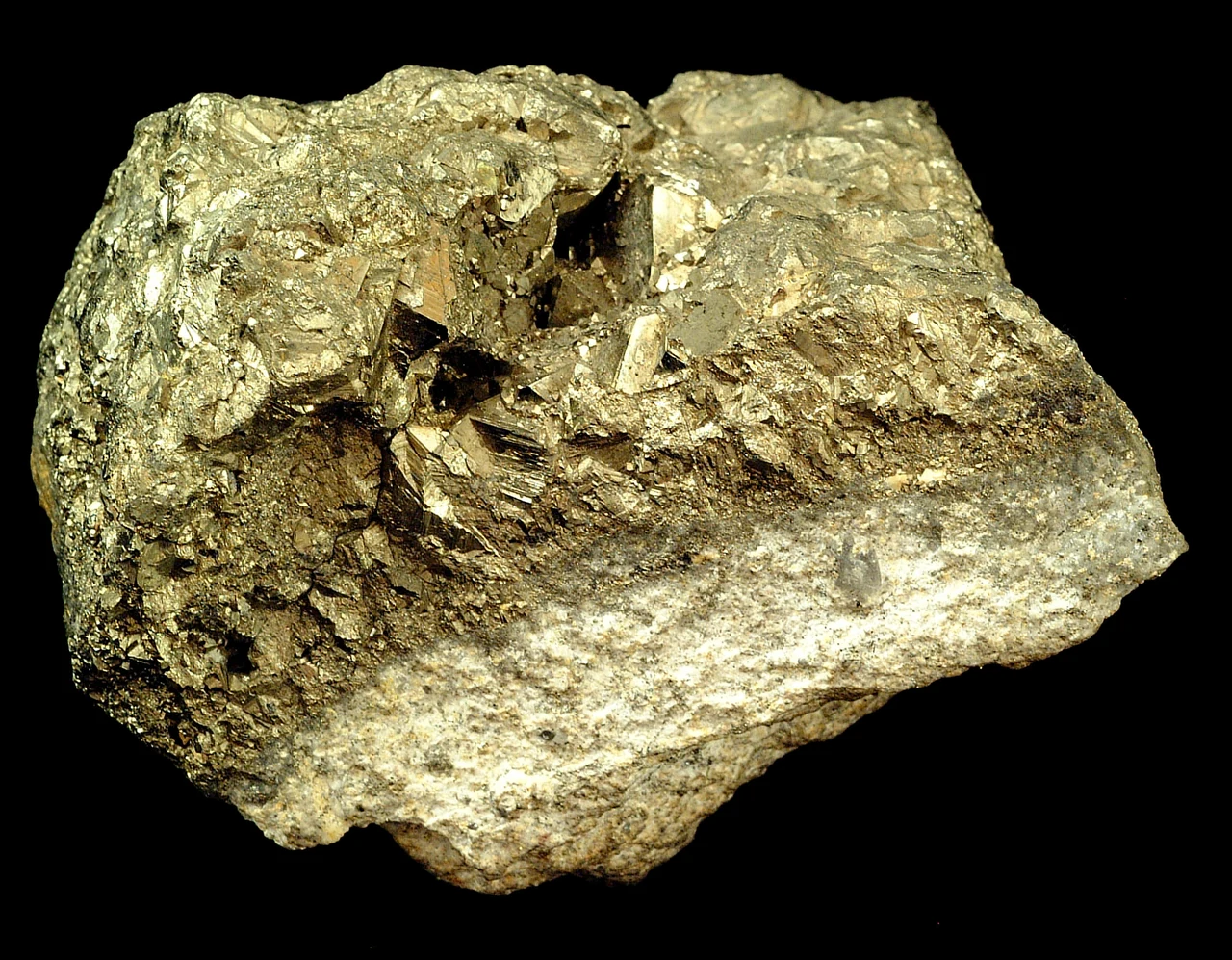
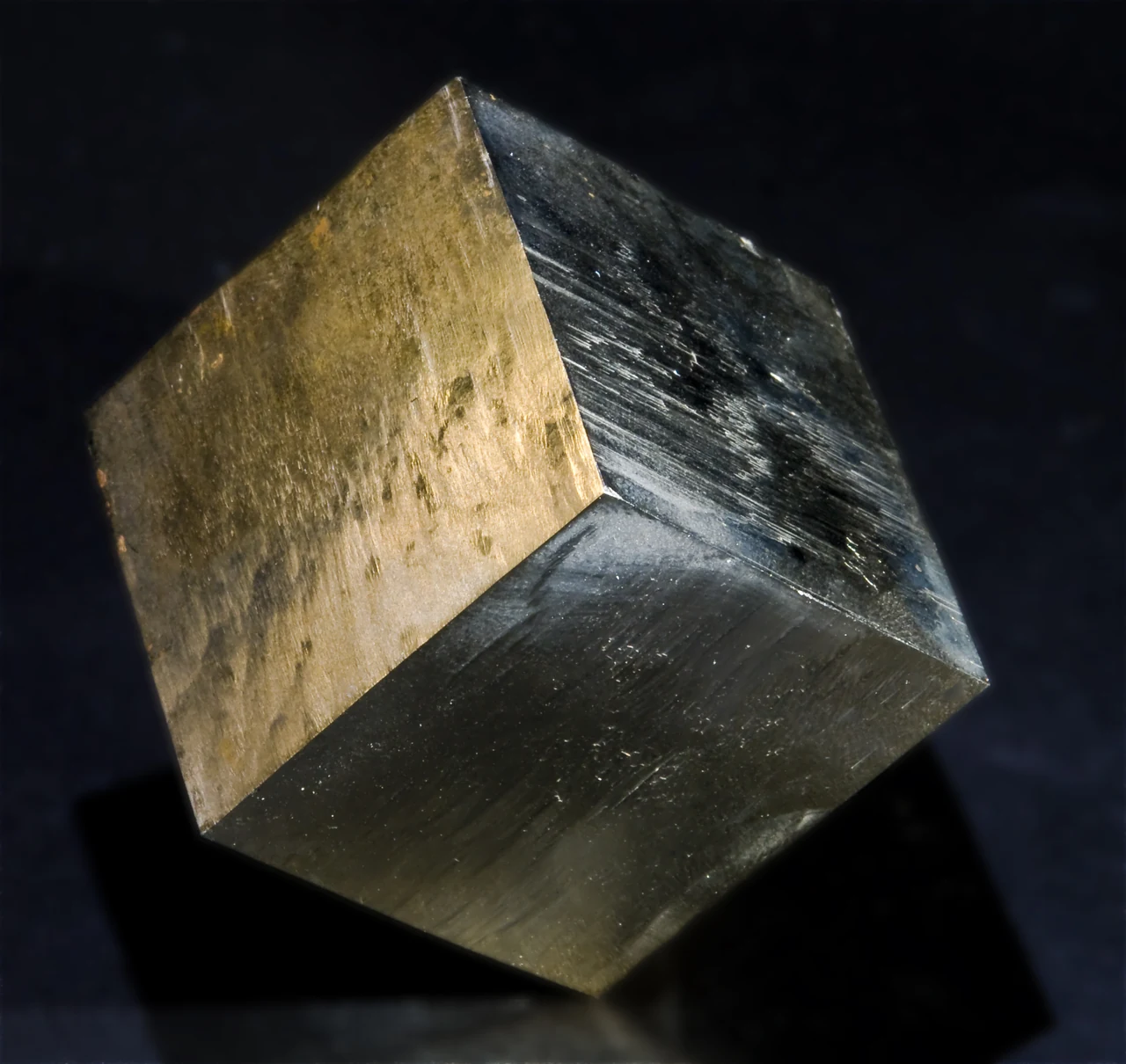
An opaque, pale brass-yellow mineral with metallic lustre. It may form natural cubes, pyritohedra or massive aggregates. Some cube faces are striated; tarnish can darken the surface. A geometrically perfect cube need not be carved. [9]
Reference properties
View under neutral lighting and compare existing surfaces only. Hardness and streak below are reference data: do not scratch, break, heat or grind the specimen. Ask a specialist to examine valuable or unidentified materials.
Massive pyrite specimen with a gold-coloured metallic uneven surface. Natural pyrite cube from Navajún, La Rioja, Spain (about 4 cm on edge) with flat faces and metallic lustre. [114][115]
Common lookalikes and imitations
Gold
Why it looks similar
A gold-coloured metallic surface can resemble gold.
What can help distinguish it
Pyrite has Mohs 6–6.5 and density about 5.02 g/cm³; gold has Mohs 2.5–3 and density about 19.3 g/cm³. These are comparisons, not instructions to crush or scratch a specimen.
What a photograph cannot establish
A photograph of a golden surface is not a metal analysis.
Occurs in hydrothermal, sedimentary and metamorphic settings. The name is linked to the Greek word for fire. Oxidation reactions depend on the specimen and storage conditions. [9]
This catalogue adopts dry cleaning as a precaution. It is not a universal claim that brief water contact poisons or immediately destroys every specimen.
Storage and specimen form
Store dry, away from vulnerable materials. If powder, cracking or decay products appear, isolate the specimen and seek conservation advice.
Store the intact specimen securely; wash hands after handling rough material. Do not generalise care advice to unidentified materials or coatings.
Do not grind or drill at home. Dust is a different exposure route from handling an intact specimen. [37]
Safety and care
Store dry, away from vulnerable materials. If powder, cracking or decay products appear, isolate the specimen and seek conservation advice. [40][41]
FAQ
Is the name enough to identify a specimen?
No. This card describes a material and does not authenticate your specimen. For a valuable purchase, request provenance, treatment disclosure and, when appropriate, gemological testing.
What research says — in brief
In the medical literature pyrite appears as an ingredient of multi-component Chinese medicines used for fractures; a 2023 review reports favourable results but across highly heterogeneous trials. This is an entirely different practice from lithotherapy and is no reason to take pyrite oneself. We found no studies of wearing pyrite or meditating with it. [127][129]
Mineralogical, gemological, institutional or scientific source. Its scope is recorded in the source index.
Pyrite — practitioner accountThe Crystal Council · accessed 2026-09-30
Commercial practitioner source: documents beliefs, not medical evidence. The site sells crystals, so we give a bibliographic description without an active link; the full address is kept in Avonoria’s source documentation.
Photograph identity and usage-rights source; not a test of specimen composition.
Pyrite Uses and Meaning — practitioner accountCrystal Vaults · accessed 2026-10-04
Commercial practitioner source: documents beliefs, not medical evidence. The site sells crystals, so we give a bibliographic description without an active link; the full address is kept in Avonoria’s source documentation.