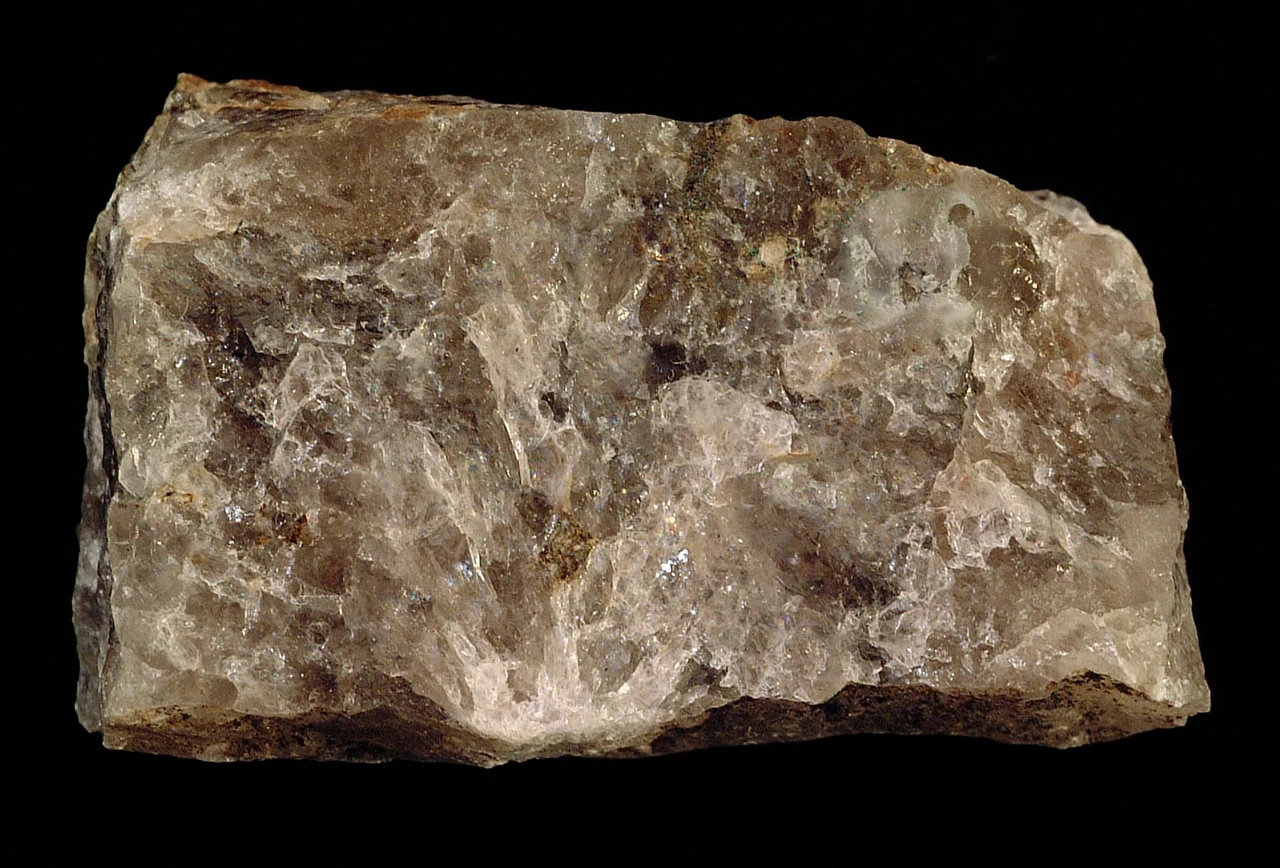
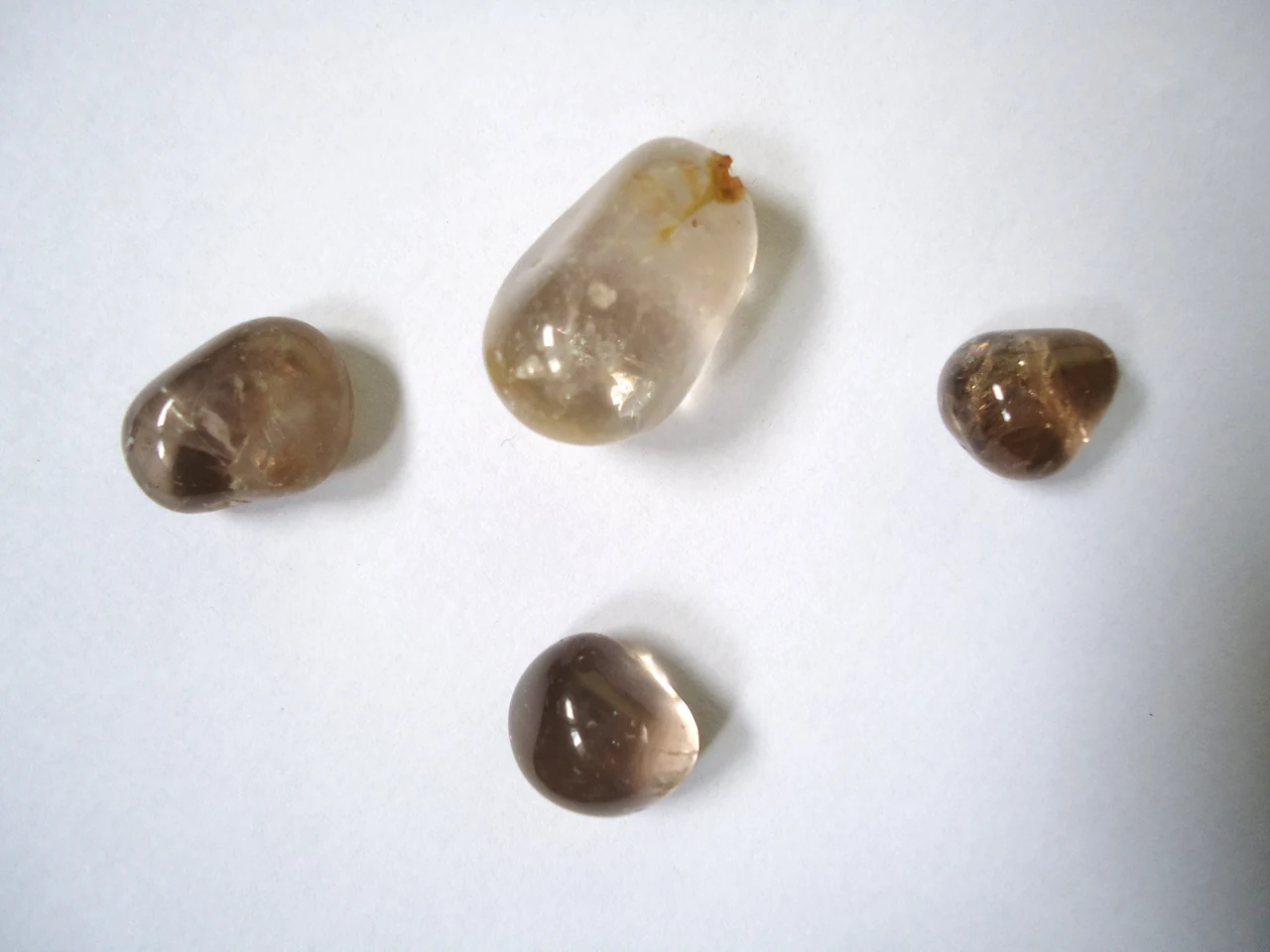
A brown to nearly black quartz variety. Identification separates the colour name from the mineral species. Dark colour alone cannot establish whether a specimen is quartz, glass or another material.
In lithotherapy smoky quartz is a stone of grounding and protection — an “anchor” in the natural world. Contemporary practitioners link it with transmuting heavy energy, and its Scottish form, cairngorm, has a history of its own that reaches as far as John Dee’s crystal ball.
Meaning in lithotherapy
According to The Crystal Council, smoky quartz helps one “ground” oneself and opens the root and solar-plexus chakras, which makes it a stone for people whose thoughts constantly wander. In this current it is one of the most effective tools for dissolving and transmuting negative energy: it is meant to protect the aura and turn heavy vibrations into positive ones. It restores a level head, lost drive and determination, and helps break bad habits. [49]
Crystal Vaults calls it a talisman of the root chakra, an anchor in the natural world and a “Stone of Power”. It is meant to protect and ground both physically and spiritually, to absorb and transmute a great deal of heavy energy, and to ease fear, stress, anger and unspoken resentment, giving strength and stability in their place. [132]
Crystal Vaults distinguishes varieties: morion — very dark smoky quartz meant to ease the effects of stress and lack of trust and give zeal for important tasks; cairngorm — yellow-brown quartz from the Cairngorm Mountains, meant to “bring light into the heart of darkness” and protect when travelling through dark places and shadow worlds. The colours carry their own symbolism: black gives protection and refuge, brown a connection with home, hearth and nature, helping one regain composure. The divinatory meaning of smoky quartz according to Cassandra Eason, quoted by this source: “There is light at the end of the tunnel; a long-standing worry will slowly improve.” [132]
Ways of working with the stone
The Crystal Council suggests carrying smoky quartz or “speaking” to it daily, and meditating with it together with other grounding stones. Crystal Vaults considers it the ideal crystal for grounding the spirit in meditation; worn, it is meant to strengthen survival instincts, and placed at home or at work, to “filter out” bad moods. In body layouts crystals or clusters are placed at the instep of each foot and at the knees. [49][132]
Crystal Vaults describes several practices in detail. To “give away” sorrow, misfortune or a seemingly impossible obstacle, one holds a natural or faceted smoky-quartz point in each hand pointing towards the ground and consciously releases these burdens to Mother Earth. As a protective amulet the stone is kept in a bag, in the car’s glove box or near valuables; as a “driving crystal” it is meant to reduce stress and improve concentration on long journeys. Against hostility or gossip at work, dark points are set in a semicircle on the desk, facing outwards. In body layouts a termination pointing towards the body is meant to draw in light, and one pointing away to lead heavy energy out. [132]
According to Cassandra Eason, quoted by Crystal Vaults, a smoky-quartz sphere with candlelight shining into its centre is meant to open a “pathway” for a meditative journey if the mind is allowed to follow the light; in Switzerland, Germany and Austria smoky-quartz crucifixes were hung on bedroom walls at night as a guard against misfortune. [132]
Chakras, elements and astrology
Chakras
root, sacral, solar plexus (The Crystal Council); root and the Earth chakra below the feet (Crystal Vaults) [49][132]
Element
earth (The Crystal Council); wood in feng shui — the east and south-east of the home (Crystal Vaults) [49][132]
Zodiac signs
Scorpio, Sagittarius, Capricorn (The Crystal Council); “an affinity with all the signs”, especially helping Capricorns soften self-criticism (Crystal Vaults) [49][132]
Hecate and Gaia; all quartz — Gendenwitha (Iroquois) (Crystal Vaults) [132]
Cleansing in the tradition
Although smoky quartz is itself said to transmute heavy energy, Crystal Vaults recommends cleansing it energetically on a regular basis; it does not specify the method. The same source warns that many stones on the market are clear quartz artificially darkened by irradiation — such a stone looks unnatural and loses its transparency. [132]
Older beliefs
History and beliefs
Kunz noted that John Dee’s crystal ball kept in the British Museum is of cairngorm, that is smoky quartz, and that it arrived there in 1700 with the Cotton library. He supposed that Dee chose this variety precisely because of Scottish superstitions about its powers — seers liked to build on beliefs that already existed. [120]
Where the sources differ
Crystal Vaults develops the Scottish theme: it calls smoky quartz Scotland’s national gem and mentions Celtic mining in the Cairngorm Mountains, the sgian-dubh dagger and a sceptre among the Scottish regalia; the historical source we read confirms only the existence of Scottish beliefs about cairngorm. The Crystal Council does not refer to history at all, focusing on grounding and changing habits. [132][120][49]
Crystal Vaults attributes far more old threads to smoky quartz than we can confirm: sacredness among the Druids and a link with Samhain and Crom Dubh, smoky-quartz panes as early “sunglasses” for Chinese judges who hid their expressions during interrogations, crystals at the tips of ritual wands especially prized by the Cherokee, and the sphere on the sceptre among the Scottish regalia. These threads come from practitioners’ books and websites cited by Crystal Vaults; we have not checked them in historical sources. [132]
An Avonoria editorial suggestion
Editorial suggestion — not a documented rite
Notice the specimen’s shades and name three things around you. You can use it as a reminder to return your attention to what you are doing.
Scope of the sources: The Crystal Vaults smoky-quartz page has no single author. Its health claims are not reproduced. None of the sources we read gives a specific cleansing method for this stone.
Quartz with smoky grey, brown to nearly black colour; transparency decreases in very dark material. Glassy lustre and natural terminated prisms are consistent with quartz, but a dark tumbled stone may retain none of those outlines. [1][31]
Reference properties
View under neutral lighting and compare existing surfaces only. Hardness and streak below are reference data: do not scratch, break, heat or grind the specimen. Ask a specialist to examine valuable or unidentified materials.
Quartz forms in many settings, including hydrothermal veins, pegmatites and igneous rocks. It also occurs in sediments and metamorphic rocks. A variety name cannot establish the origin of an individual specimen. [1][31]
Start with a soft, dry cloth. Unknown coatings, adhesives and settings need separate assessment.
Storage and specimen form
Separate from other specimens and protect from drops and abrupt temperature changes.
Store the intact specimen securely; wash hands after handling rough material. Do not generalise care advice to unidentified materials or coatings.
Do not grind or drill at home. Dust is a different exposure route from handling an intact specimen. [37]
FAQ
Is the name enough to identify a specimen?
No. This card describes a material and does not authenticate your specimen. For a valuable purchase, request provenance, treatment disclosure and, when appropriate, gemological testing.
What research says — in brief
We found no studies of smoky quartz in lithotherapy. [129]
Commercial practitioner source: documents beliefs, not medical evidence. The site sells crystals, so we give a bibliographic description without an active link; the full address is kept in Avonoria’s source documentation.
Photograph identity and usage-rights source; not a test of specimen composition.
Smoky Quartz Meaning and Uses — practitioner accountCrystal Vaults · accessed 2026-10-04
Commercial practitioner source: documents beliefs, not medical evidence. The site sells crystals, so we give a bibliographic description without an active link; the full address is kept in Avonoria’s source documentation.