A sodium aluminosilicate containing chlorine, often blue although the species can occur in other colours. It is not the same material as lapis lazuli. Colour alone is insufficient for identification.
In lithotherapy sodalite is a stone of insight and logical thinking — a calmer, more “rational” relative of lapis lazuli. Its lithotherapy tradition is modern — the mineral was only described in Europe in the nineteenth century — although it was used as an ornamental material in the Andes much earlier.
Meaning in lithotherapy
The Crystal Council calls sodalite a stone of insight and mental enhancement. It is meant gradually to weaken the mind’s inner contradictions, reach deep into the subconscious and prompt an honest evaluation of oneself — recognising strengths and weaknesses, understanding truth and deepening intuition — until a calm, reflective state is reached. [54]
Crystal Vaults calls it the “Logic Stone”: it clears the mind, prompts deep thought and teaches one to understand oneself in relation to the universe. It is meant to connect the conscious and subconscious mind with one’s own thoughts and feelings, discharge anger and negative thoughts, and help release deep-rooted fears and guilt. [138]
Crystal Vaults illustrates this with the image of gazing into a starry sky. According to this source sodalite does not “give” wisdom but clears one’s vision and intellect so that wisdom can be formed; it is meant to strengthen analysis, observation, intuition and creativity, as well as self-discipline and organisation. In the same current sodalite is a “stone of truth”: it lets the traits one dislikes in oneself come to the surface and be accepted without judgement, leading to self-acceptance and self-trust. [138]
Crystal Vaults also calls sodalite a writer’s talisman — the “Poet’s Stone” and the “Stone of Creatives” — and a study aid for sorting out new material. Citing Margaret Lembo, it recommends it to astrologers, numerologists, tarot readers and those who consult the I Ching as a stone of pattern recognition. The divinatory meaning of sodalite according to Cassandra Eason, quoted by this source: “There is something that needs to be said, but you will have to use the right words.” [138]
Ways of working with the stone
In meditation, according to Crystal Vaults, sodalite clears the mind and quiets inner chatter; laid on the forehead over the third eye, it supports intellectual understanding. Worn or carried, it gives a calm, stable energy, and in group work it fosters unity. Crystal Vaults also recommends placing it by computers. [138]
The Crystal Council emphasises the voice: working with sodalite is meant to expand the communication centre so that inner thoughts can be spoken. It recommends combining it with lapis lazuli, moldavite and rose quartz. [54]
Crystal Vaults gives several simple ways of working. For people who are oversensitive, impulsive or prone to anxiety it suggests holding sodalite as a worry or palm stone to move from an emotional reaction to calm consideration; work with a sodalite sphere is linked with tempering aggression towards others and oneself. For sleep it recommends placing the stone under the pillow or on a bedside table, and when travelling, holding it during a plane’s take-off and landing. Meditation with sodalite is also meant to help one remember dreams and practise lucid dreaming. [138]
19 February – 19 March (blue) and 20 January – 18 February (indigo) according to Crystal Vaults [138]
Deities and angels
Hera, Nut (Nuit), Danu and Venus; Archangels Michael and Raziel according to Lembo (all as given by Crystal Vaults) [138]
Feng shui
Water energy — the north of the home, the Career and Life Path area; places of rest and prayer (Crystal Vaults) [138]
History
History and beliefs
The Andean thread mentioned by practitioners is confirmed by museum collections. The Metropolitan Museum of Art in New York holds a pair of gold ear ornaments of the Moche culture from the north coast of Peru (400–700 CE) showing a winged runner; according to the museum’s record they are made of gold, turquoise, sodalite and shell. This documents the use of sodalite as an ornamental material — the object record says nothing about beliefs attached to the stone. [146]
Where the sources differ
Both sources agree on the chakras and on Sagittarius and differ on the element. On history, both state that sodalite was described in Europe in 1811, in Greenland, and mention its much earlier use by Andean communities in Peru and Bolivia; Crystal Vaults adds the story of Canadian deposits and a mine named after a princess. The Andean thread is supported by a museum record (see “History”); we have not checked the details about Caral and Lukurmata. [54][138]
Crystal Vaults adds threads we have not verified: that in ancient tombs sodalite sometimes appears where lapis lazuli would be expected (in old texts almost any dark blue stone was called sapphire or lapis), that Egyptian priests used it to dispel fear and guilt (after Dorothee Mella), and the story of the Princess Sodalite Mine in Ontario, named in 1901 after the Princess of Wales, who ordered sodalite to decorate Marlborough House. [138]
An Avonoria editorial suggestion
Editorial suggestion — not a documented rite
While looking at the specimen, name one observation and distinguish it from your interpretation. Then write a sentence you could use to communicate that observation.
Scope of the sources: The history rests on a museum object record (material, culture, date), not on accounts of beliefs; sodalite does not appear in the historical sources we read (Kunz, Pliny). None of the sources we read gives a ritual cleansing for sodalite, so none is added. Health claims from Crystal Vaults are not reproduced.
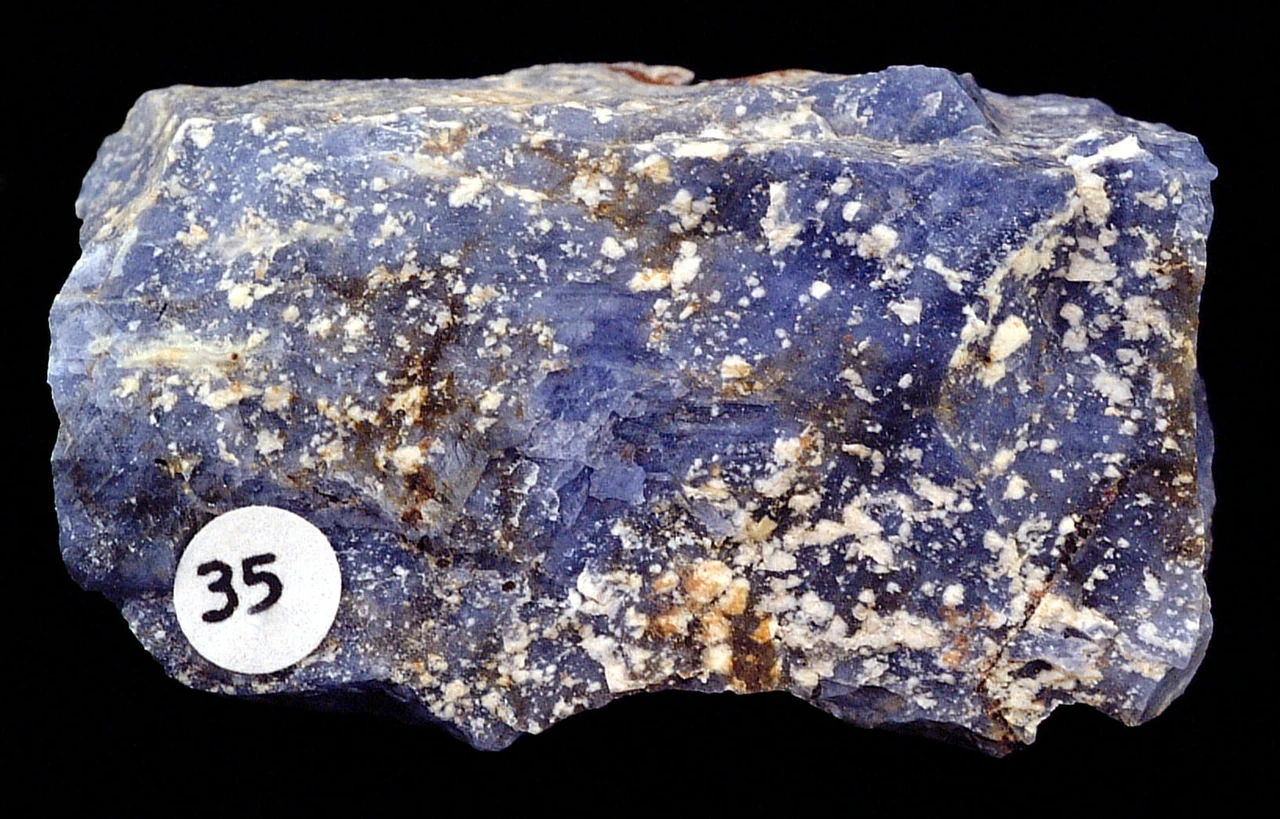
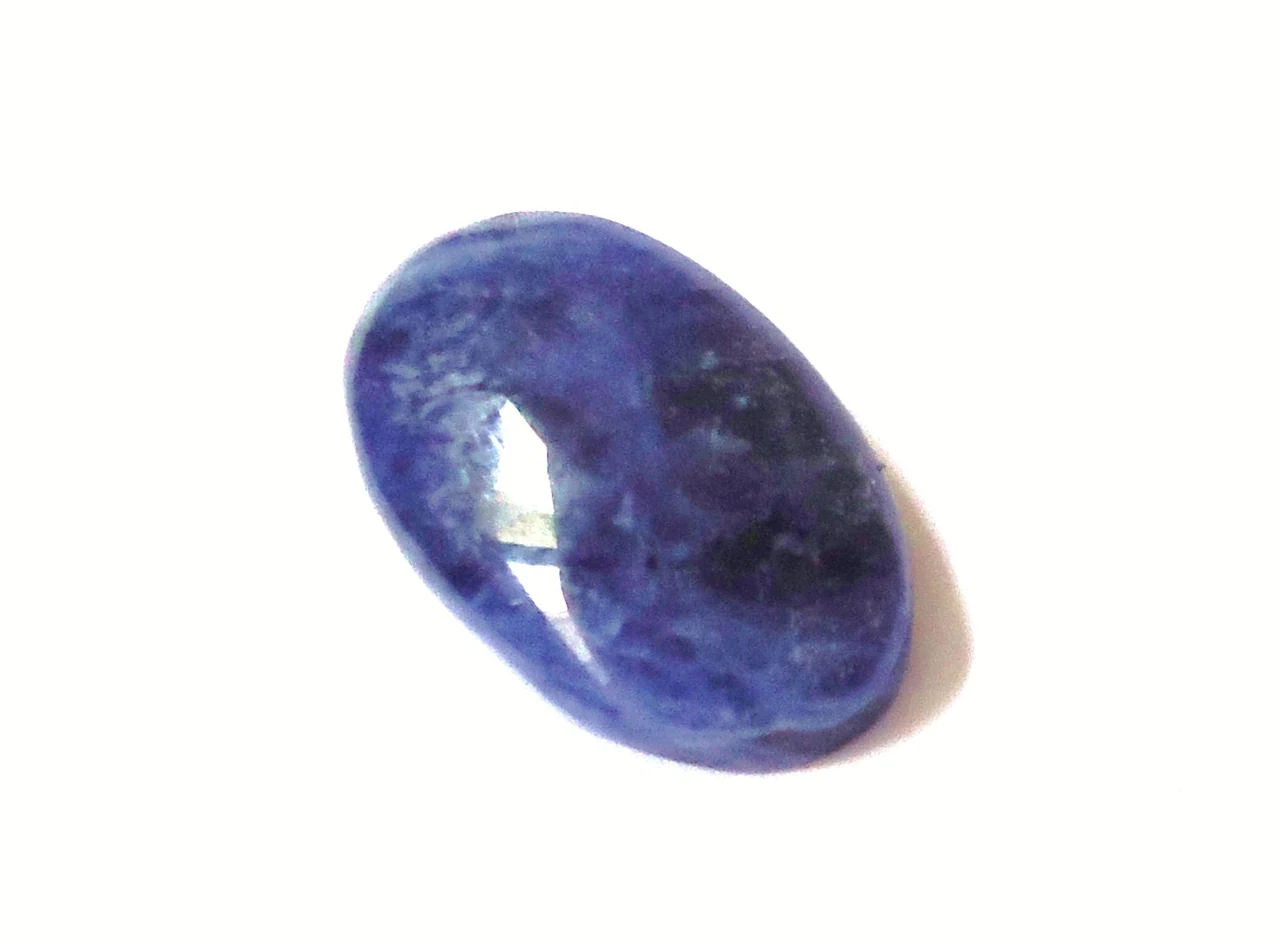
The best-known material is blue to violetish blue, often with white calcite veins. It can be translucent or opaque. Rare transparent crystals and other colours also occur; saturated blue is not a requirement for every specimen. [77][4]
Reference properties
View under neutral lighting and compare existing surfaces only. Hardness and streak below are reference data: do not scratch, break, heat or grind the specimen. Ask a specialist to examine valuable or unidentified materials.
Massive, deep blue sodalite with white flecks; the specimen carries a small collection-number sticker. Blue sodalite cabochon with pale irregular streaks. [100][101]
Common lookalikes and imitations
Lapis lazuli
Why it looks similar
Both can be blue with white veins.
What can help distinguish it
Lapis is a multi-mineral rock; sodalite has a distinct composition. A sodalite crystal differs from typical lapis, but tumbled stones need further assessment.
What a photograph cannot establish
A photograph cannot confirm which minerals are present.
It occurs in nepheline syenites and phonolites. The name refers to sodium in its composition. Distinguish the mineral from blue rocks that contain it. [4]
Start with a soft, dry cloth. Unknown coatings, adhesives and settings need separate assessment.
Storage and specimen form
Separate from other specimens and protect from drops and abrupt temperature changes.
Store the intact specimen securely; wash hands after handling rough material. Do not generalise care advice to unidentified materials or coatings.
Do not grind or drill at home. Dust is a different exposure route from handling an intact specimen. [37]
FAQ
Is the name enough to identify a specimen?
No. This card describes a material and does not authenticate your specimen. For a valuable purchase, request provenance, treatment disclosure and, when appropriate, gemological testing.
What research says — in brief
We found no studies of sodalite in lithotherapy, nor any testing whether a stone placed beside a computer “blocks” anything. [129]
Mineralogical, gemological, institutional or scientific source. Its scope is recorded in the source index.
Sodalite — contemporary practitioner accountThe Crystal Council · accessed 2026-09-30
Commercial practitioner source: documents beliefs, not medical evidence. The site sells crystals, so we give a bibliographic description without an active link; the full address is kept in Avonoria’s source documentation.
Photograph identity and usage-rights source; not a test of specimen composition.
Sodalite meaning and uses — practitioner accountCrystal Vaults · accessed 2026-10-04
Commercial practitioner source: documents beliefs, not medical evidence. The site sells crystals, so we give a bibliographic description without an active link; the full address is kept in Avonoria’s source documentation.